
This collage shows eight very popular singers of the epoch in the Spanish-speaking world. The Table below specifies their nationality, their years of birth and death and the location (a.b) of their songs in the Radio Sounds Library: a (1-28) pinpoints a listening block and b (1-10) a row.
| Name | Nationality | Year Born | Year Died | Songs | |
|---|---|---|---|---|---|
| Carlos Gardel | Argentinian | Disputed | 1935 | 2.1, 4.10, 18.2, 27.3 | |
| Sarita Montiel | Spanish | 1928 | 2013 | 1.6, 15.2, 26.7, 27.5 | |
| Antonio Molina | Spanish | 1928 | 1992 | 1.10, 5.1, 6.9, 24.7 | |
| Conchita Piquer | Spanish | 1906 | 1990 | 1.3, 24.8 | |
| Jorge Negrete | Mexican | 1911 | 1953 | 1.9, 2.3, 2.6, 3.1, 4.1, 9.7, 11.1, 12.10, 17.10 |
|
| Lilián de Celis | Spanish | 1935 | — | 2.5, 4.3, 4.4, 6.1, 16.10, 23.3, 28.8 |
|
| Jorge Sepúlveda | Spanish | 1917 | 1983 | 5.5, 17.5, 18.3, 18.10, 19.3, 19.4, 21.5, 23.6, 25.10 |
|
| Gloria Lasso | French | 1922 | 2005 | 3.7, 4.7, 5.6, 7.3, 16.5, 16.6, 19.2, 19.5, 20.2, 28.4 |
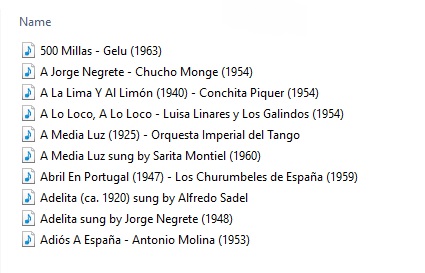
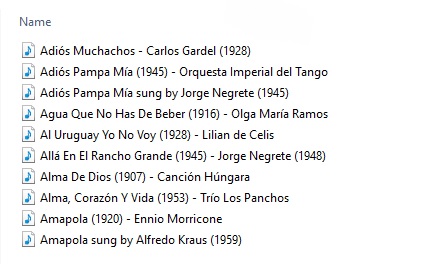
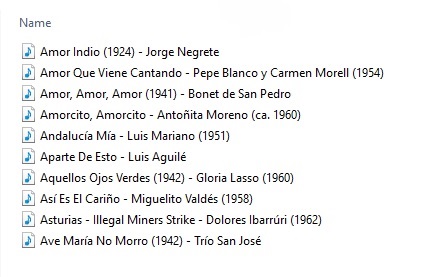
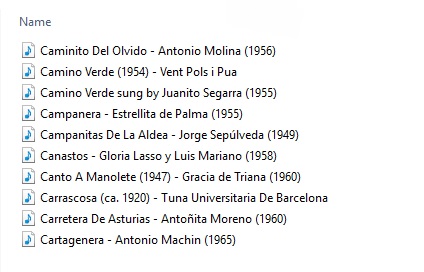
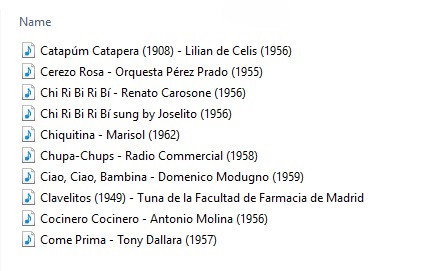
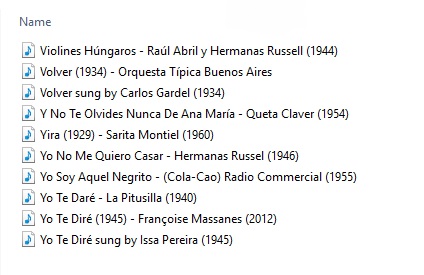
Most songs in the twenty-eight instalments offered below are the genuine article sung by the original artists. Notable instrumental versions were added which were recorded in the nineteen seventies or later. For example the rendition of "Adiós Pampa Mìa" by the Orquesta Imperial del Tango (instalment 2) or the execution on the accordion by Françoise Massanes of "Yo Te Diré" the theme song of the classic Spanish movie, "Los Últimos de Filipinas" (instalment 27). They are followed by the original song always. In addition there are twelve genuine instrumentals, "Carrascosa," "Cerezo Rosa," "Chi Ri Bi Ri Bí," "Danke Schöen," "El Pájaro Campana," "The Bridge Over The River Kwai" march, "La Boda De Luis Alonso," "La Machicha," "Mambo nº 8," "Paquito El Chocolatero," "Perfidia" and "Tequila". Nine clips are not songs. For example one recorded the voice of Communist Dolores Ibarrúri ("La Pasionaria") speaking over pirate "Pyrennees Radio" in 1962 (instalment 3). Another takes up the misadventures of "Garbancito" (The Little Chick Pea) a funny children's story broadcast in the nineteen fifties (instalment 12). Popular comedian Miguel Gila used absurd humour to make the audience laugh (instalment 18). Another clip abridges the Generalissimo's New Year's Message for 1958 (instalment 22).
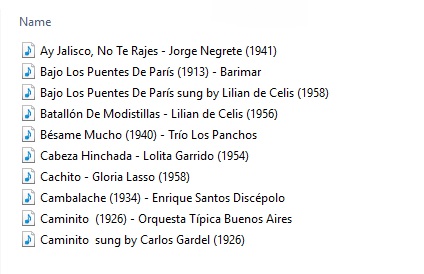
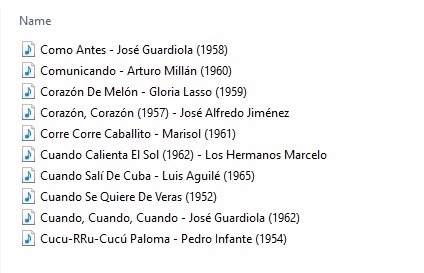
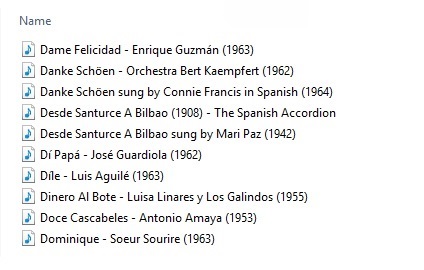
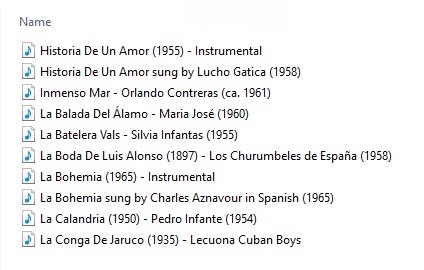
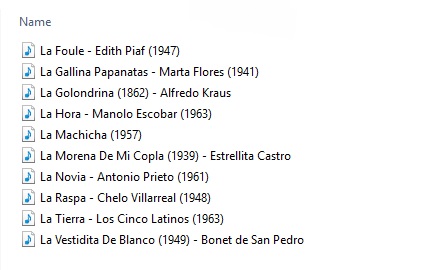
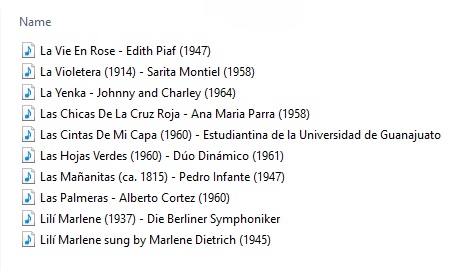
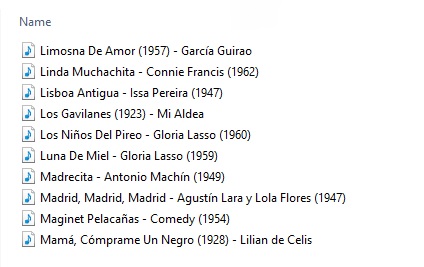
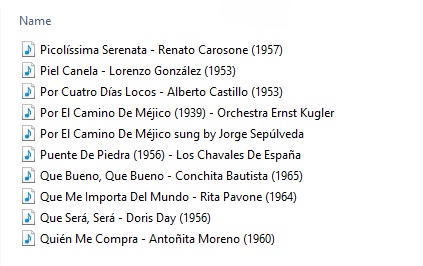
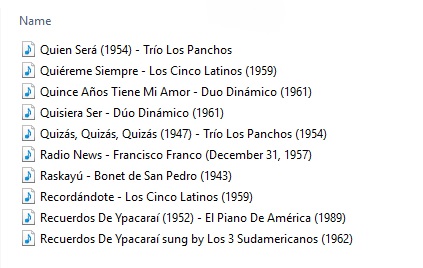
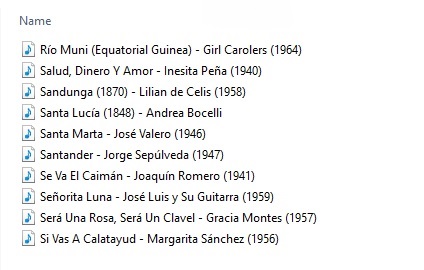
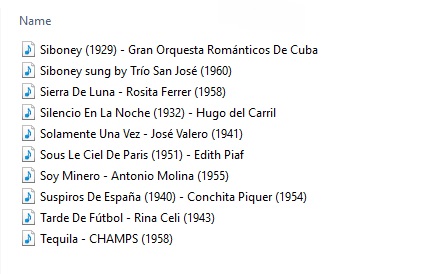
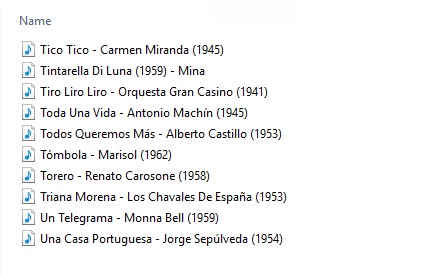
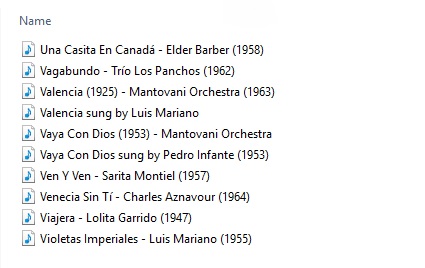
Nearly every line in the twenty-eight instalments below is made up of two fields separated by a hyphen. The first field is the name of the song followed sometimes by its year of composition in brackets. The second field is the name of the performer(s) often followed either by the year of the recording in brackets or by the year of its first showing in the list of the top 20 records sold in Spain between the years 1940 and 1965 as compiled by Clasificación Nacional Del Disco. For instance, the year of composition of the tango "A Media Luz" (instalment 1) is 1925 (source: Spanish Wikipedia) and Sarita Montiel performed it in 1960. Lilian de Celis recorded "Batallón De Modistillas" (instalment 4) which ranked tenth in the Spanish hit parade of 1956. Exceptionally a line may carry two dates. "Catapúm Catapera" (instalment 6) also known as "El Polichinela" was recorded by Lilian de Celis in 1956, it had been composed in 1908.
A few songs date back to the nineteenth century. "Fonseca" (instalment 12) is said to hail from the year 1870 and from the environs of the University of Santiago de Compostela. The popular Mexican birthday song, "Las Mañanitas" (instalment 15) is said to have originated with the Jews of Spain before their expulsion in 1492. The opening line reads, "These are the morning songs that King David used to sing to the pretty girls, today we sing them to you." These venerable songs were quite popular when I was a child.
The exercise of finding the year of a song's debut or the year of a performance turned out to be more laborious than I expected. The exercise was made more difficult when a song owned several titles in cyberspace. Two examples follow. "Aparte De Esto" (instalment 3) is also tabbed "Es Una Lata El Trabajar" or "La Vida Pasa Felizmente". "Alma Llanera" is also given the erroneous title "Hermano Del Sol" (instalment 12).
The only date I discovered in cyberspace for the debut of "Aparte De Esto" (instalment 3) is 1969 when the song purportedly became a summer hit in Spain. However I believe I heard it played much earlier. The reason for the discrepancy could be that Argentinian singer-songwriter Luis Aguilé recorded several albums in his native land before moving to Spain in the nineteen sixties. The song I believe I heard as a child must have been an Argentinian recording. Certainly the tune bespeaks the nineteen fifties more than it does the year 1969.
At least one Spanish webpage holds that "Cuando Salí De Cuba" (instalment 7) was written by Luis Aguilé to lament a broken romance with a Cuban girlfriend following his visit to the Caribbean island. The lyrics, however, refute this assertion and point to the Cuban émigré community of Miami as the source and suggest a composition date prior to the Bay of Pigs invasion (1961).
"Raskayú" (instalment 22) and "Se Va El Caimán" (instalment 23) were appropriated by opponents of the Franco regime as equivocal references to the dictator. The first song was a comical danse macabre with the refrain, "Raskayú [meaningless name] when you are dead, what will you do? You'll be no more than a corpse." The second was a farcical song from Cuba about a man turned alligator. Its refrain is "The alligator is going away to Barranquilla [placename]."
The instrumental clip of "Siboney" (instalment 24) played by the orchestra "Gran Orquesta Románticos De Cuba" actually blends two songs, "Siboney" and "Desesperadamente." A good guess for the date of this recording would be the year 1960.
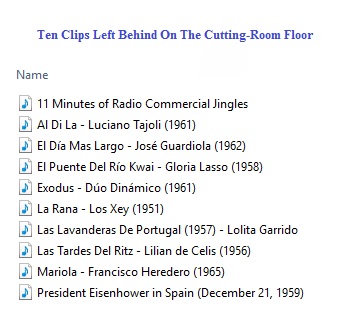
The twenty-eighth instalment is a collection of "clips left behind on the cutting-room floor." The audio in the "11 Minutes of Radio Commercial Jingles" clip sold listeners on a jewellery shop of Madrid, soap, four types of insecticide (including the infamous D.D.T.) a chain of fabric retail stores, custard pie, bleach and champagne. The brands of soap and champagne are still around. Three clips carry Spanish lyrics for the movie themes of "The Bridge Over The River Kwai", "The Longest Day" and "Exodus". The sixth clip was a popular Cuban song entitled "La Rana" (The Frog): "A frog was sitting under the water—when it started to sing—along came a housefly and made it shut up..." The housefly was followed by a spider, mouse, cat, dog, man and his mother-in-law. The punch line is, "When the mother-in-law started to sing, not even the devil made her shut up." The last clip is a news report dated December 21, 1959, on the arrival at 4:20 PM (local time) of U.S. President Eisenhower to the joint American-Spanish military air base of Torrejón de Ardoz near Madrid. Eisenhower sealed a treaty of friendship between the United States and General Franco and put an end to Spain's international isolation. The clip recorded this fragment of Franco's speech,
This base of Torrejón built with the formidable help of the United States, and housing in close comradeship the Spanish and North American air wings, is a symbol of our friendship and is erected under the motto which doubtless is very dear to you, "Peace In Our Profession."
Freeware program "MP3Gain version 1.2.4" written by Glen Sawyer was used to try and preserve an uniform volume of sound throughout. The track gain was set at 93.0 ± 0.7 db. The result was more or less satisfactory. It was deemed necessary to alter the gain of several tracks.
Windows Media Player opens and plays every instalment without problem. Clicking on the LISTEN hyperlink at the Ferrolian cybercafé I visit gives the choice of listening to or downloading an instalment file. Right-clicking on the LISTEN hyperlink on my laptop at home (O.S. Windows 10 Home Version 1511) also lets me download the instalment files. Hopefully you, the reader, have similar ways of downloading these twenty-seven audio files (MP3) should you wish to.
| 1. LISTEN |
|
| 2. LISTEN |
|
| 3. LISTEN |
|
| 4. LISTEN |
|
| 5. LISTEN |
|
| 6. LISTEN |
|
| 7. LISTEN |
|
| 8. LISTEN |
|
| 9. LISTEN |
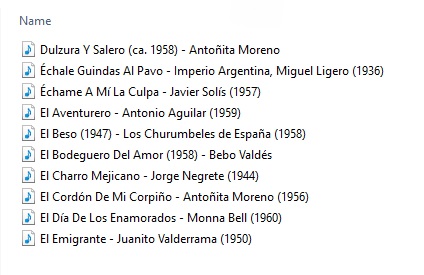
|
| 10. LISTEN |
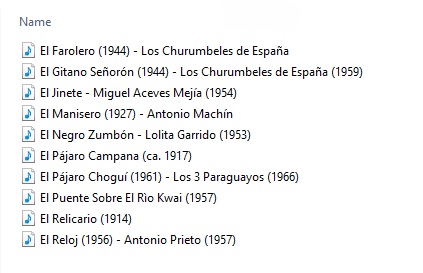
|
| 11. LISTEN |
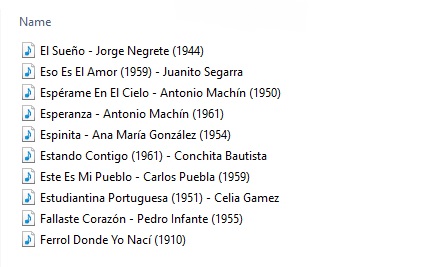
|
| 12. LISTEN |
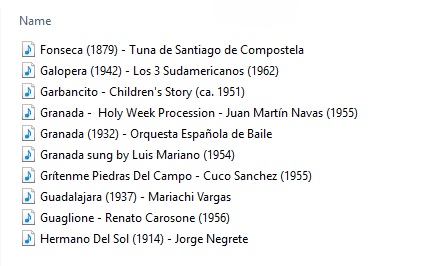
|
| 13. LISTEN |
|
| 14. LISTEN |
|
| 15. LISTEN |
|
| 16. LISTEN |
|
| 17. LISTEN |
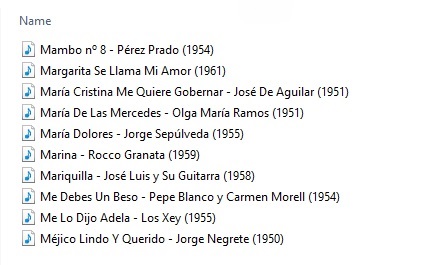
|
| 18. LISTEN |
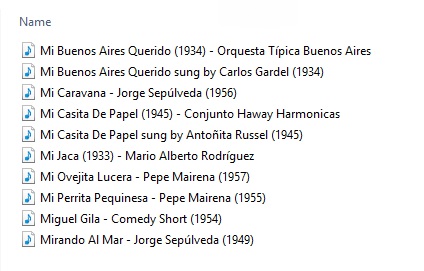
|
| 19. LISTEN |
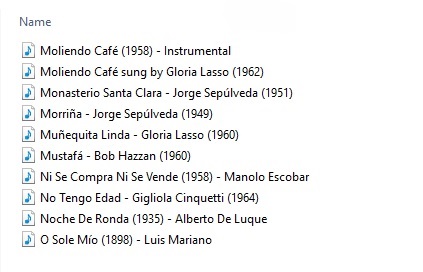
|
| 20. LISTEN |
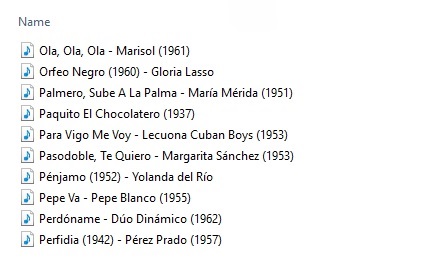
|
| 21. LISTEN |
|
| 22. LISTEN |
|
| 23. LISTEN |
|
| 24. LISTEN |
|
| 25. LISTEN |
|
| 26. LISTEN |
|
| 27. LISTEN |
|
| 28. LISTEN |
|
| Ferrol's New England Theater (1906-1914) |