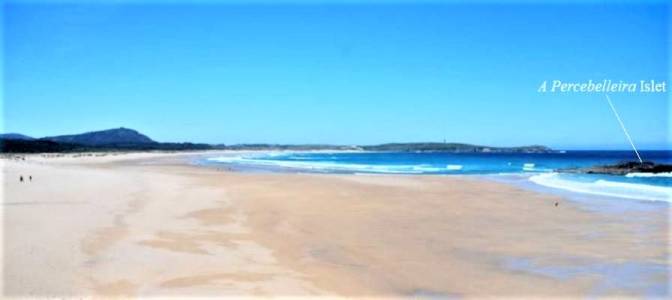
When I was a child the highlight of my summer holidays was the beach and lagoon of A Frouxeira in the municipality of Valdoviño located seventeen kilometers away from the city.
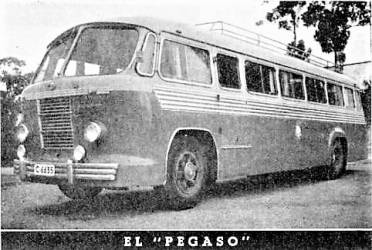
We travelled on the Bazan bus that everyone called, "El Pegaso" (photograph on the right). The service, "already a tradition" in the summer of 1955, ran from early July to the middle of August, the few warm days of a normal Ferrolian summer. Every "producer" and his family had a right to use the free service a set number of times. Without a valid pass, however, no one could board the bus. A boarding pass specified the date and time of boarding both ways. These passes were transferable, so a "producer" could make use of a friend's pass if this one ceded his pass on a specific date. Plaza de España was the last boarding opportunity in the city.
According to Bazan, 7, "El Pegaso" made around 200 two-way trips during the summer for a total mileage of 7,000 kilometers. Around ten thousand "producers" and their families boarded the bus to Valdoviño. There were two other beaches along the way, namely Meirás and Porto, in whose vicinity passengers could get off and be picked up again later that same day.
My parents opted to go on weekdays to avoid the crowds. The morning may have dawned cloudy and damp over the city but the summer sun invariably shone bright over the beach. Fun and games with other children—eating in the camping tent that we set up near the dunes, or without the tent, in the clearing of a resin-fragrant pine stand guarded by walls of gorse taller than I—playing soccer with the adults on the sand or on a rustic playing field just behind the beach—exploring the dunes strewn with sea hollies—exploring the solitary lagoon and catching glimpses of its birds and animals (ospreys, Eurasian coots, skylarks, common reed buntings, adders) or plodding in safari to the far end of the beach—I could never get enough of A Frouxeira.
One day we took the last bus home, but it would not start. I had pleasant visions of spending the night on the beach but alas! a replacement bus showed up after an hour or so and carried us away. Another time in one of my reconnaissance missions I happened upon a teenage couple lying among the reeds. The boy told me to be very careful because they had just seen an adder wind past. I left in a hurry, but was not completely fooled: why hadn't they bolted?
On our final trip to Valdoviño I was twelve years old and the sun did not break through as it customarily did. The whole day was cloudy and drizzly, as miserable as I was.
The newspaper of July 12, 1955, described the drive and the place thus,
The road to the place is very bad, but the drive is admirable as it crosses a forest of pine, alders, eucalyptus and chestnut trees that exude a pungent aroma. The panoramic views of the valley bound by the parishes of Lago and Castro are really stunning. There are many brooks along the way and diverse hues of greenery and wheat fields.The beach has a permanent sea breeze and a majestic lagoon. From the road it looks like a very broad stretch of sand dazzling in the sun; the sea is very blue. The islet known as A Percebelleira is at times overrun by towering waves, accessible others. Clung to its rocky mass are thousands of shellfish of diverse species.
As many of us as have paid a visit will cherish a grateful memory.
| Ferrol's New England Theater (1906-1914) |