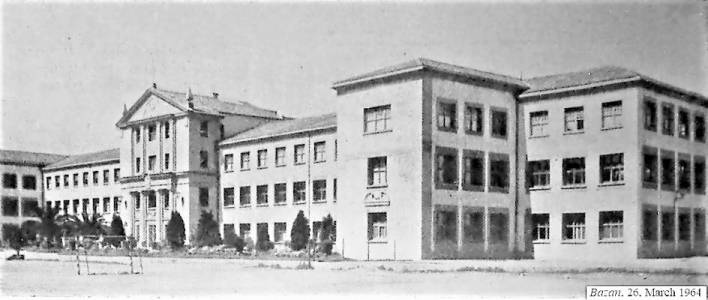
The above photograph comes from page 16 of Bazan, 26, March 1964.
When I was a child the official name of the high school was "Instituto Nacional de Enseñanza Media de El Ferrol del Caudillo." The principal taught Language and Literature, his wife taught Physics and Chemistry. Girls and boys were segregated.
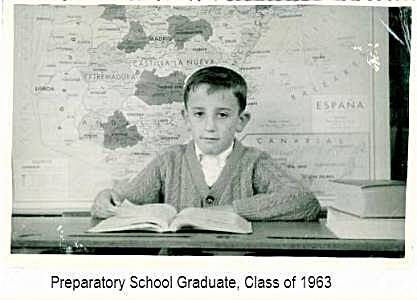
The school offered two years of preparatory school followed by six years of high school and a final year of preparation for university studies elsewhere. The classes of "preparatory" were given in two classrooms located in the east wing of the building. Initially I was assigned to the crowded, south-facing homeroom of teacher Mr. Saturnino Hermida López. Of stern demeanour, he always wore black. A former pupil remembers him,
He tutored me for a few years after [preparatory] and I went to see him several times, e.g. when I lived in Santiago [de Compostela] and he, retired already, ran the library of the Boys Institute...Eventually I found out that he took Law [in his youth], challenged the professor's demonstration of the existence of God—he told me this himself, I remember his very words—and was expelled from university, so he had to etch out a living in the middle of the [Spanish Civil] war. Short and slim, of striking eyes, father of three daughters...Beloved and venerated, I said to two Ferrolian mayors that he deserved to have at least one street named after. He taught many generations of Ferrolians and today his figure fades away without the homage that he without doubt deserves.
I was transferred very quickly to the north-facing classroom of teacher Mr. Antonio Pardo Lozano, some said he was a Falangist. Usually pleasant, he read to us short animal stories that I looked forward to hearing.
After preparatory the student enrolled in six years of high school proper which were followed by an optional year of preparation for university. The high school curriculum was hard and classroom discipline tough from the start, the students were forbidden to ask questions.
Another Falangist taught a course called "Forging of the National Spirit." I expected an enthusiastic delivery on the history and political platform of fascist Falange Española, but he seemed bored or disenchanted and even told us one morning, "Go play soccer far from the high school, but don't let the principal see you leave." We naturally obliged.

The Catholic religion was taught everywhere in Spain as an integral part of the academic curriculum, and senior Ferrolian high school students were exposed, like the shipyard workers, to a series of religious lectures dubbed "Spiritual Exercises," so called after the series of meditations by St. Ignatius of Loyola published in 1548.
The photograph on the left shows my sixteen-year-old brother (yellow circle) and all his sixth-year classmates attending the Holy Week seminar at the Diocese Headquarters of Ferrol in the year 1965. The building had been inaugurated in 1963. The photograph is courtesy of Mr. Alfredo Diaz del Rio Franco. He was the boy crouching beside my brother.
The original B/W was colorized with Lunapic.
Note: "Sixth year" was the name then given to the final year of High School. The Spanish high school program entailed four years of "bachillerato elemental" followed by two years of "bachillerato superior" for a total of six years. This was followed by a preparatory year for university ("curso preuniversitario"). The transition from "bachillerato elemental" to "bachillerato superior" required passing a tough revalidation exam (End of Note).
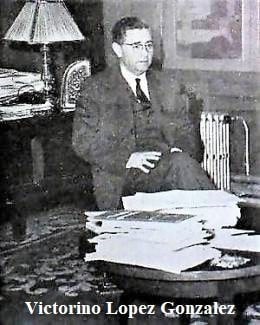
The principal's name was Victorino López González.
Bazan, 26, March 1964, pages 16-18, states that he was a professor of Literature, the founder of the Alumni Association and the organizer of seminars given by such intellectuals as Aranguren, Álvaro d'Ors, Dámaso Alonso, Lafuente Ferrari, Gerardo Diego, París Amador, Torrente Ballester and Muñoz Alonso. He was also the patron of amateur theater and cinema at the High School.
Bazan's article next praises the principal for the creation of a night school to enable "producers with the will and vocation to study" to obtain the official Basic High School Diploma upon passing all trimester and final exams.
"Mr. Victorino, what is the fundamental goal of the night school?" "To give the working class access to the Elementary High School Diploma. The legal prerequisites for registering are: age fourteen or older, a working contract or justifying the inability to attend daytime classes."
"Outstanding differences—if any—between this new model and the conventional or daytime one?" "The total exclusion of Latin and a greater stress on Drawing."
"Did these courses start long ago?" "In the year 1956 some twenty pupils signed up provisionally, but when the time for formal registration came, only two followed through. Since the requirement for legal validity was the registration of at least fifteen pupils, everything fell apart. Finally in the school year 1960-61 seventeen registered formally, several of whom are now enrolled in the fourth-year program. After 1960-61 the second, third and fourth-year programs were gradually implemented. Presently the night school offers a four-year programme and has approximately one hundred pupils."
"What is the nighttime schedule?" "The classes last three quarters of an hour each. They run from 6:45 to 7:30 PM, from 7:30 to 8:15 PM, from 8:15 to 9:00 PM and from 9:00 to 9:45 PM."
"A final question, Mr. Victorino. We have heard that some night-school pupils have received scholarships. Is this true?" "Yes. Last school year 1962-63 twelve scholarships worth 3,600 Pesetas each were awarded. And this year, eighteen of the twenty allocated to the whole province." Note: The Bazan reporter adds, "What Mr. Victorino does not tell us is that these scholarships were created thanks to his diligent personal inquiries" (End of Note).
Regular students paid a registration fee in September. Some students had the fee waived if their family could not afford it. The newspaper cites ten such waivers on September 23, 1955. Occasionally a few scholarships were offered by various institutions including the school itself, e.g. five scholarships worth 1,000 Pesetas each were made available to applicants on January 22, 1954.
Final exams were held in the second half of June. For example on Saturday June 26, 1954, these were the subjects and the times. 9:00 AM: Modern Languages. 4:00 PM: Physics and Mathematics for students majoring in Science, the students could bring a table of logarithms. 4:00 PM: Latin and Greek for students majoring in Letters, students were allowed to bring a dictionary.
Students who failed in June could take the exam(s) over in September, before the start of the school year. This was the schedule for fourth and sixth-year repeats in the year 1955. Tuesday September 7, 9:30 AM: French and English. 10:45 AM: Mathematics. 12:00 noon: Latin and Greek. 1:15 PM: Forging of the National Spirit. 3:30 PM: Drawing (sixth year) or Physics and Chemistry. 4:45 PM: Spanish. 6:00 PM: Sciences. 9:30 PM: Religion. The oral exams continued on the Wednesday.
The school boasted an auditorium where movies were shown on weekends. I do not remember the title but I remember the plot of a heart-breaking French-Canadian film probably set in the nineteenth century. A large family emigrates to Canada, presumably from France. The beginnings are happy enough, but the man of the house falls ill during the winter and dies, leaving his widow behind to take care of the children in mounting hardship. In due course she too falls ill and dies. In the melancholy closing scene the oldest daughter takes the siblings out of the log house which the parents had been renting and leads them along a snowy trail into the woods, a late afternoon sun shining behind them. I left the auditorium chilled to the bone. What a horrible country to live in, I thought. An early scene aroused my weather-watcher calling: the father peeks out of a window into the night and right after he closes the flimsy curtain a flash of lightning floods the scene, thunder rumbles and a copious fall of snow begins.
I completed two years of high school with top honours then my parents decided to emigrate to Canada in September 1965.
| Ferrol's New England Theater (1906-1914) |