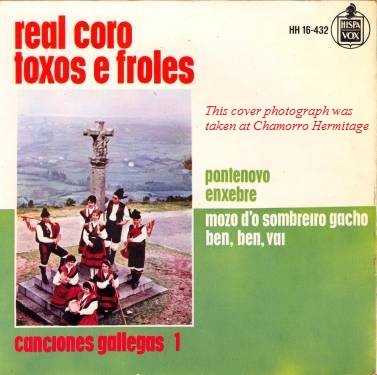
According to the article written by José E. Lage Pedreira on page 8 of El Correo Gallego, 17 May 1963, Ferrol edition, the idea of creating the choir was discussed and approved at a big get-together that took place in the locale of the Airiños D'A Miña Terra Association toward the middle of December 1914. Emilio Bidegain Lázaro who chaired the meeting moved the creation of a folk chorale "similar to Pontevedra's Aires d'a Terra" and proposed the name, Toxos E Froles (Gorses And Flowers) for it. The declared aim was to preserve and exalt Galician folklore. His motion carried unanimously and the chorale's rehearsals began in earnest at the same temporary location on January 2, 1915. Note: Aires d'a Terra's first gramophone record, dated 1904, is part of the soundtrack for this 1929 documentary (End of Note).
The first public performance of Toxos E Froles took place in Teatro Jofre on May 29, 1915. The public's response was enthusiastic and the occasion ended with the encore, Dous Amores.
As a result of their active labour of promotion the choir's fond ambitions were realized and in a short period of time across Galicia there was seen, with natural satisfaction, the birth of similar associations. These did with great effort, with overflowing enthusiasm and with a pure love for the land, such a feat of cultural promotion that in a few years, it may be said, no popular music was embraced but ours.
Toxos E Froles sang at the homages paid to Antonio Rey Soto, Fernando Álvarez de Sotomayor, Sofía Casanova, Perfecto Feijóo, at the fundraisers for impressive monuments in honour of Manuel Curros Enríquez, the Ferrolian soldiers fallen in Africa, Concepción Arenal, Rosalía de Castro, and at many other "charity or patriotic" festivals. The venue for the indoor performances of Toxos E Froles in Ferrol was either Teatro Jofre or Teatro New England across the street. The "New England" was eventually demolished to make way for the Post and Telegraph Office.
Toxos E Froles sang before the king and queen of Spain in July 1922; the monarchs were so impressed that they designated the choir royal status.
Four modern performances of Toxos E Froles follow.
 Foliada de Corrubedo
Mira Como Ven (See How He Comes)
O Galopín (The Urchin)
Foliada de Corrubedo
Mira Como Ven (See How He Comes)
O Galopín (The Urchin)
 Centenary at Teatro Jofre (duration: 1 hr 5 min)

The choir has of course performed the following three Galician classics. All three are poems set to music.
| 1. |
Negra Sombra (Black Shadow)
|
This poem published in 1880 was written by Rosalía de Castro.
|
Cando penso que te fuches,
Cando maxino que es ida,
Si cantan, es ti que cantas,
En todo estás e ti es todo, |
When I think that you have parted,
When I fancy that you are gone,
If there is singing it's you who sings,
Everywhere you are in everything, |
| 2. |
Himno Galego (The Galician Anthem)
|
The official Galician anthem covers the first four stanzas of the poem "Os Pinos" written in 1895 by Eduardo Pondal.
|
¿Que din os rumorosos
—Do teu verdor cinguido
Os bos e xenerosos
Os tempos son chegados |
What do the rumorous ones
"Girded by your greenery
"The good and generous ones
"The time of the ages |
| 3. |
Unha Noite Na Eira Do Trigo (Once Upon A Night In The Wheat Fields)
|
This poem published in 1869 was written by Manuel Curros Enríquez.
|
Unha noite na eira do trigo,
I a coitada entre queixas decía:
Os seus ecos de malencolía
Lonxe dela, de pé sobre a popa
I ó mirar as xentís anduriñas
Mais as aves i o buque fuxían
Noites craras de aromas e lúa,
Dun amor celestial, verdadeiro, |
Once upon a night in the wheat fields
And the poor girl said between plaints,
Her echoes of melancholy
Far away from her, standing at the stern
And upon watching the gentle swallows
But the birds and the vessel sped onward
Clear nights of fragrances and moonlight,
Away from a heavenly, genuine love |
| Ferrol's New England Theater (1906-1914) |