The superhero comics of my childhood fictionalized several epochs of Spain's history. The comics reflected the nostalgia of a decadent empire conscious that its "glorious past of conquest" would never repeat, conscious that its military training and equipment had become obsolete and that the tide of national liberation movements achieving independence for the colonies of stronger European powers forebode the end of its very last colonies located on the African continent.
The most popular superhero was El Capitán Trueno (Captain Thunder). Vikings and Moors were his foes. The numbers I read fictionalized the 800-year-long struggle between Christians and Muslims on the Iberian Peninsula. The swashbuckler was accompanied by a burly man named Goliath and by a teenager named "Crispín." Hostilities alternated with apparent truces and temporary alliances: in one number Captain Thunder sojourned at a Moorish palace.
The second most popular superhero was El Jabato (The Shoat). The comic imagined the epoch when Spain was a Roman colony. The only print that I remember had the superhero marooned on a craggy island strewn with human skeletons and infested with giant crabs.
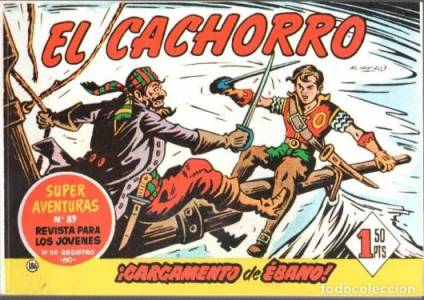
My favourite superhero was the last one of the lot: El Cachorro (The Cub). The numbers I read fantasized clashes between English corsairs and Spaniards on the Caribbean Sea. The Cub and his crew scoured the Spanish Main boarding and blowing up every pirate ship they encountered. This comic was my pick when I was a child because the reading material of primary schoolchildren portrayed England in a very bad light as a long-standing enemy of Spain. The byword "pérfida Albión" (double-crossing Albion) circulated widely in the society at large while an undertow of bitterness suffused primers and history books whenever they broached episodes of war between the two countries. The Spanish Armada was not defeated by the superior skill of English sailors—the books and the adults asserted—but by Atlantic gales. Sir Francis Drake was not a bona fide admiral—they jeered—but a vulgar brigand. Every buccaneer was a craven agent of double-crossing Albion sent to plunder Spanish convoys of gold and silver, but timorous of direct confrontation with men o' war. The sanctioned version of history also maintained that Protestant England was with the assistance of a renegade Spanish friar responsible for a widely publicized, infamous libel of Catholic Spain which the authorities and textbooks dubbed "La Leyenda Negra" (The Black Legend). The Black Legend described the Spanish conquest of America as a barbarous undertaking, virtually amounting to genocide of the aboriginal peoples, and it tabbed the domestic workings of the Holy Inquisition as an exercise in exceptional cruelty. Authority figures and textbooks remonstrated that the Black Legend was a fabrication and a dastardly exaggeration, fruit of English envy of the Spanish Empire. According to the same sources the blame for Nelson's victory at Trafalgar lay with the French admiral in charge of the joint French-Spanish fleet. The glory of Trafalgar lay with the Spanish commander who laid aside his misgivings, adhered to strict military discipline and assumed the unsound battle formation imposed by the Frenchman. Schoolchildren learned that the illegal British occupation of the Rock of Gibraltar was an open wound in Spain's soul and a flagrant violation of the Treaty of Utrecht. Note: The dispute over the Rock prompted the closure of the border fence in the final years of General Franco. The argument brandished by his government for the return of the Rock to Spanish sovereignty has been upheld by every democratic government since (End of Note). I distinctly remember and quote the following pious caveat placed by the authors of a high-school textbook ahead of their list of rankling grievances against England: "Far removed from us is the intention of arousing in our readers sentiments of hatred toward any country or peoples." Notwithstanding which they and everyone else most certainly did. I exulted to see Spain's arch-enemy trumped and trounced at sea by the hand of El Cachorro every two weeks with British regularity. Note: Albion's riposte arrived late September 1965 (End of Note).
Another action comic dealt with the Second World War. The losing Germans were treated with respect and sympathy.
Other popular comics were a compilation of cartoon strips set in a contemporary environment. Comic TBO was the archetype, first published in 1916. The backdrop to many vignettes mirrorred the social reality of the day. For example the following reliable notions about Spain can be inferred from this 1961 TBO edition: (1) there was a wide gap of income between the well off and the poor, (2) thumbing a ride was in vogue, (3) common agricultural implements were primitive, (4) water main shutoffs were frequent, (5) most roads were too narrow and traffic sparse, (6) several generations of the same family lived together under one roof and (7) many houses had cockroaches.
Curiously the same TBO issue carries an equivocal "Jewish joke" although very few Jews lived in Spain in 1961,
Jewish Story (Year 1961)
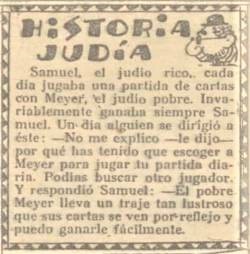
de Todo un Poco. TBO, 246, p. 12
Translation: Everyday Samuel the wealthy Jew played cards with Meyer the poor Jew. Without exception Samuel always won. One day somebody approached him, "I don't understand why you have picked Meyer to play cards with daily," he said, "you could look for another player." Samuel replied, "Poor Meyer wears such a lustrous suit that his cards reflect off it and I can beat him easily."
The "Jewish joke" feature continued at least until the year 1962, whence comes this second story,
A Nice Profit (Year 1962)
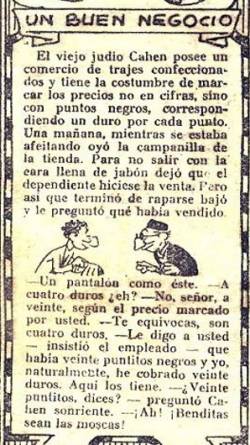
de Todo un Poco. TBO, 278, p. 14
Translation: Cahen [sic] the old Jew owns a shop of tailored suits and he has the habit of tagging prices with black dots instead of numbers, one dot standing for 5 Pesetas. One morning, as he was shaving, he heard the shop's doorbell ring. So as not to show his face full of lather, he let the clerk do the sale. But as soon as he finished shaving he went downstairs and asked the clerk what he had sold."A pair of trousers like these ones."
"For 20 Pesetas, eh?"
"No, sir, for 100 Pesetas in line with the price marked by you."
"You made a mistake. It's 20 Pesetas."
"I tell you, sir, that there were twenty small dots," insisted the clerk, "and so naturally I charged 100 Pesetas. Here they are."
"Twenty small dots, you say?"—asked Cahen smiling—"Ah! Blessed be the houseflies!"
Below, the protagonist of the vignette "La Medalla del Trabajo" (The Medal of Labour) belonging to the TBO issue of February 12, 1965, was called "Cristobalito" (Little Christopher) but most adult readers would have seen in him a caricature of General Franco (cf. the closing paragraph of the Introduction).
"Cristobalito"... or General Franco?
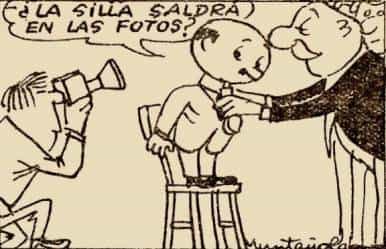
La Medalla del Trabajo. TBO, 381, p. 8.
Bubble: Will the chair show on the photographs?
| Ferrol's New England Theater (1906-1914) |