
British Pathé Reviews the Year 1964
The source for the news in this chapter has already been discussed in the chapter entitled, "Bazan Magazine for the Year 1956."
The outstanding event of the year was the launch of oil tanker Ministro Eugenio A. Blanco on December 18, 1964 (cover of Bazan, 28). The oil tanker had a deadweight of 19,660 tonnes and a displacement of 26,000 tonnes. Notes: Eugenio A. Blanco (1893-1964) was an Argentinian economist and twice government minister. The keel of this construction was laid during the second half of June 1964 (End of Notes).
This launch was significant for being Bazan's first foray into foreign markets.
The presidential tribune for the launch was occupied by the vice admiral and managing director of Bazan, the vice admiral and commander-in-chief of the Fleet, a rear admiral, a Navy commander, the mayor of Ferrol, the chief executive officer of Bazan-Ferrol along with the director, the deputy director and other top officials of the Factory. In center stage stood the attaché of the Argentinian Embassy in Spain who acted in representation of the contractor, Yacimientos Petrolíferos Fiscales de la República Argentina. The bishop of Mondoñedo-Ferrol blessed the oil tanker, and the wife of the embassy's attaché was the vessel's godmother.
The immense bulk glided majestically down the slipway until it coasted into the sea, at at that instant, the sirens of the many steamboats located in the vicinity of the shipyard hailed it joyfully.The entire ceremony, although executed as a mere working routine, came up very brilliant.
(Bazan, 28, page 9)
Following the Argentinian coup d'état of June 28, 1966, the government in Buenos Aires enjoined Bazan-Ferrol to rechristen the tanker with the name of that country's oil-exploration pioneer, Ingeniero Hermitte (1871-1955). The tanker with the new name was delivered finally on April 5, 1967. Photographs of the ceremony and of the ship's interior compartments are found in this webpage.
Ingeniero Hermitte stayed in service until the year 1993 when it was decommissioned and beached at Alang (India).
The shipyard was busy during the year 1964 in the construction of Sardinero whose launch took place on November 22, 1965, and which was the biggest oil tanker built in Spain to date.
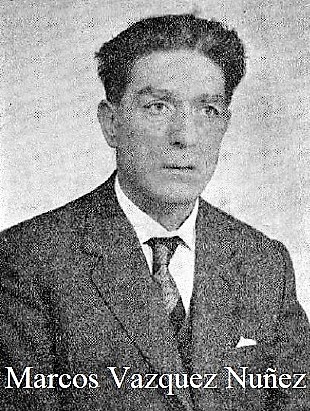
1. Marcos Vazquez Núñez was born in 1898 in Mugardos where he lived before moving across the bay to Ferrol City in 1941. He started working for the Factory in 1916 as a navy carpenter. In 1921 he decided to emigrate to New York where he stayed three years long. Then in 1924 he returned to Ferrol and to his former post at the dockyard. Note: The Ferrolian shipyard was under British management between 1910 and 1925 (End of Note).
"Please tell us something about your stay in the United States." "What is there to say? That happened so long ago! I worked very hard over there. Sometimes in the assembly line of mills. Other times in hotels as a waiter. I never ceased attending Schools to 'practise' English, whose dissimilarities with Spanish seemed unbreachable at first. I joined the Unión Benéfica Española and went to its cultural seminars, concerts, evenings of entertainment, dances, etc., socializing heavily with the entire Spanish colony."
"And what are your best memories of Bazan-Ferrol?" "There are good and bad memories. But, broadly speaking, I retain good memories. Even though I suffered several working accidents, some of which required my getting checked into the Santo Hospital de Caridad."
"Excuse me, Mr. Vazquez, but since I first saw you I am troubled by a question I wish to put to you: why does your face look so familiar? Have we seen each other before today?" "You will certainly have seen me many times before today. I am an usher of the Orchestra seating section in Teatro Jofre. It's an off-hours job for me."
"Ah, indeed! Now I remember. Do you wish to say anything else to end the interview with?" "Yes, I would. One thing above the rest: how grateful I am to the Company for having treated me so well, especially in regard to a certain illness I had, during which I got a lot of help. Similarly when I lost four teeth in a work accident. Labour law granted stainless steel tooth implants, but the Enterprise, without my having asked, decided freely and spontaneously, in view of my good record, to give me implants of gold. It's these four, do you see them?"
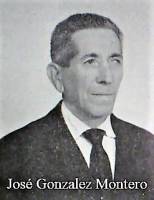
2. José A. Gonzalez Montero was born on August 30, 1898, in the Ferrolian suburb of Serantes. Montero entered the Factory for the first time as a drill operator apprentice in 1913. Subsequently he moved about the dockyard and worked at the General Stores and in the Outfitters Workshop and did an endless train of deck cadet jobs.
"What can you tell me about the work you used to do?" "That I liked it though it was grinding. Naturally when one had to work outdoors..." "What professional rank did you attain in your trade?" "Operator first class."
"Have you travelled, have you been abroad?" "No, sir. The allure of America never attracted me much. I have always dwelled here in my Serantes croft. Besides, this life half in the city, half in the countryside, enthuses me. The countryside serves as 'entertainment' when one works on his own."
"And what will you do now as a retiree?" "Whatever may be done to live many more years."
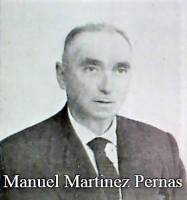
3. Manuel Martínez Pernas was born in Ferrol in 1897. He entered the Factory in March 1912 as an apprentice of the Painters Workshop. He spent the rest of his working life in this workshop except for a brief interlude working on his own outside the Factory from 1924 to 1926.
"Mr. Martinez, where did you fulfill your military service?" "Here in Ferrol, year 1919." "Have you travelled much?" "Hardly. A trip to San Sebastian (Basque Country) commissioned by the Factory, and thereafter a trip or two but invariably short."
"Which jobs in particular pleased you the most from your painters' trade?" "All of them, in general." "You are retiring with a foreman's rank, isn't it?" "True. I promoted around the year 1944, I don't remember it well."
"And what will you do now with so much free time ahead?" "I don't know yet, but I guess what everybody else does. Going for walks, having a quiet life, you know."
"Then may all your wishes come true, Mr. Martinez."
Bazan's Footnote: With this number running in the press, we learned about the sudden death of Mr. Manuel Martínez Pernas. From here we send our deepest condolences to his family and solicit from our kind readers a prayer for his soul.(Bazan, 27, page 16)
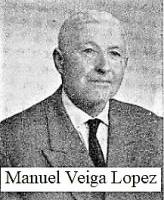
4. Manuel Veiga Lopez was born in Valdoviño on April 14, 1897. He entered the Factory in 1912 as an apprentice of the Watercrafts Workshop where he lingered a few months. Lopez got transferred in 1914 to the Painters Workshop as a varnisher, and with the same occupation to the Cabinet Making Workshop in 1923. He attained the rank of leadman in 1942 and of foreman in 1944.
"I have heard it said that you were a great sportsman in your youth, a genuine champion. How true is this?" "I was a great fan of cycling. During two years (1925-27) I took part in every cycling event of the city and even in some of the most important races organized by Santiago de Compostela. I obtained a third-place prize in the 'City of the Apostle.' In Ferrol I almost always finished first, except on my first year of competition when I made the usual beginner's mistakes. Today, at my age, I still conserve a great passion (quasi-religious) for the bicycle, thanks to which it can be said that I keep myself in good shape."
"Please describe for us the format of those cycling events or competitions." "In regard to Ferrol, the races were sometimes held on the field beside the Northern Third Garrison, at other times in the old soccer stadium of Caranza. A Tour de Catabois was also arranged with this circuit: Ferrol, Catabois, San Juan de Filgueira, Ferrol." Note: The length of this circuit is roughly ten kilometers (End of Note).
"Do those competitions mean anything to you today?" "I have to try really hard to hold back the tears from my eyes."
"And what is your comment regarding your workmates' farewell homage on this your retirement day?" "That it impressed and moved me a lot. Most of all it surprised me because I had already warned (and I thought had convinced) my workmates not to stage anything for me at all. Well, it didn't happen. They had their way, something which I appreciate infinitely now that it's over, and I know it is something that I will never forget. But let the record show that I didn't deserve such a thing."

5. Ramón Rodriguez Vizoso was born in Narón on December 28, 1901. He entered the Factory on January 12, 1917, as an apprentice riveter earning 1 Peseta/day. Note: According to Table 3 of this report by the Bank of Spain, Vizoso's starting salary was then the equivalent of 22 cents US per day (End of Note). Riveting was done with swung hammers until the modern pneumatic tool was introduced to the Ferrolian dockyard between 1926 and 1928.
Vizoso stayed a riveter until age 55 when he suffered a work accident that fractured his left collarbone and right arm.
"What specific job do you keep the fondest memory of?" "The most important for me was the one that granted me the high honour of pressing the first rivets in the ceremony of laying the keels of Furor, Ariete and Meteoro, helping out the daughter of His Excellency the Head of State who had come that day—October 18, 1944—as godmother for the launch of Tambre and Guadalete." Note: Furor, Ariete and Meteoro were fast frigates launched all three on Sepember 4, 1951. Tambre and Guadalete were minesweepers (End of Note). "Another fond memory of my working life hearkens back to 1928 when the Englishman Mr. Rovers congratulated and accorded me a special distinction for hard work, good conduct, attendance and punctuality."
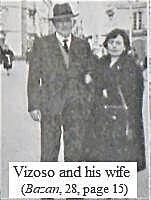
"Is there some interesting anecdote from all these years?" "On a certain occasion while riveting Furor's propeller blades to the propeller shaft I suffered a rude accident that smashed three of my fingers. But since they paid a lot for each rivet I said nothing to anybody, and despite having my fingernails and fingers smashed, I bandaged them with a smeared cotton rag we use at work and carried on in this fashion four more days; then I reported to sick bay. And I had no infection at all.
"On another occasion I fell from a deck to the engines chamber beneath, as a result of which, one of my hands snapped and inverted. So I shouted to a workmate, 'Stop, don't lob more rivets my way, I think I got a shifted hand!' Because of this notorious accident I was on sick leave one month."
"What is the moniker you earlier said you are known among your workmates by?" "By 'Stout' (lit. 'broad-chested'); the English already gave my father the same name. I inherited it. It never bothered me, quite the contrary."
"Do you retire contented?" "Yes from a certain perspective, not for nothing have I hammered away forty-eight years. But from another it kind of makes me sad."
"To end the interview, please say off the cuff whatever you wish to." "To bid again good-bye to my supervisors and workmates, to embrace them warmly and to wish them all much good fortune, happiness and long life."

Fernando Garcia Prieto was born in the municipality of Neda in 1938. He entered the Factory in 1953 and at the time of this interview held the rank of official first class in Deck Outfitters. Prieto had contested a national deftness meet for workers (Madrid, July 14-15) and had won first prize in the category of metalworking milling.
On July 18, 1964, he received the award from the hands of General Franco (photograph).
"What impression did you get receiving the badge from the hands of the Leader?" "It was for me one of the most satisfying events in my professional life, an act I will never forget."
"How did they treat you in Madrid?" "Superbly, we received all kinds of favours from the officials, and the Minister of Labour feted us at the conclusion with a meal."
"What possibilities of success do you envision your workmates to have in future meets?" "The possibilities are always there because in El Ferrol and specifically in the Factory there are very good operators who can achieve success at these competitions."
"What is your opinion regarding the ability of other workers compared with Bazan's?" "From what I could see at this contest there are very good operators in Spain, and Bazan's can be counted among them."
"What are your personal goals inside the Factory?" "Same as everyone's, to progress as much as possible."
Manuel Soto Romalde, social-and-labour legal adviser, wrote another short article entitled, "Wars and Peoples' Progress," in Bazan, 25, pages 22-23.
A previous essay of his may be found in Chapter 14, "Bazan Magazine for the Year 1962."
In the interim Romalde published a short essay entitled, "The satisfaction of having a car," (Bazan, 24, November 1963, pages 16-17) where he forecast that although owning a car was still a luxury for the Spanish worker it would cease to be so in the near future due to the same economic dynamics that had made having a radio no longer a luxury. Likewise he foresaw that the television set, "today the exclusive domain of the affluent, will soon enough join the array of goods affordable to any worker." He was proven right on both counts.
In the present article Romalde argues for an universal system of Social Security through a recollection of the Atlantic Charter (1941), the International Labour Organization's Declaration of Philadelphia (1944), Marx's concept of the reserve army of labour and the social postulates of Lord Beveridge (1879-1963). To divert the censure of "hierarchies," Romalde softens the hard socialist tint of the article with superficial rote references to Pope Pius XII, Church teaching and the Fascist Fuero del Trabajo (1938).
My translation of the article follows.
All the wars and revolutions which Humanity seems condemned to experience are always deplorable for the innumerable material or human losses that they usually come saddled with, but leaving this sombre aspect aside, and without seeking to justify in any manner the use of violence as a means of achieving the general welfare everyone longs for, it is curious to observe in how many instances, particularly of the recent past, such conflagrations have spurred the manufacture or perfection of matériel immediately relevant to the war effort but which afterward became of great value in peacetime applications. Similarly these conflagrations drilled new ideas into the minds of government heads even as the conflict raged on. These new ideas induced the rulers to start a series of radical transformations in the way of thinking or living of their peoples which contributed decisively to the peoples' own progress.Indeed if we turn back to the end of the eighteenth century we see how a series of events had to take place in France to precipitate the demise of the reign of absolutism and to establish the ideological tenets of philosophical stripe contained in the Declaration of the Rights of Man and of the Citizen which enjoyed immense influence. The articles of the Declaration, dealt with as irrefutable, have buttressed many political undertakings realized much later to the point where some articles have inspired certain documents of our day such as the Atlantic Charter or the Declaration of Philadelphia and even inspired political actions like the protection of workers through the plans and systems of modern Social Security.
Already in the famous Atlantic Charter—so called for having been signed on August 14, 1941, by U.S. President Roosevelt and U.K. Prime Minister Churchill aboard battleship Repulse "somewhere" out in the Atlantic Ocean—are explicitly stated, even in the dawn of that terrible war, the tenets to bear in mind for the economic and social ordering of the world.
Under the umbrella of these principles and with the aim of elaborating the social objectives to pursue following the restoration of peace in a world inspired by that Charter, there convened in 1944, still in an environment of full-out war, a series of meetings in Philadelphia which jelled in the Declaration that bears the name of that North American city.
This new document affirms that a fundamental objective which countries must aspire to in the realm of social policy is the fight against destitution. The document defines destitution as a circumstance of physical and spiritual need affecting a large portion of the toiling masses through no fault of their own but originating in the economic and social disarray partly caused by the war's economic disruption and unheard-of destruction. The document adds that a lasting peace will only be established if it is based on social justice covering all human beings irrespective of race, religious creed or gender, and that a practical consequence of this is the provision to everyone of an equal opportunity for having a job.
Next the Declaration of Philadelphia recites some tangible social policy proposals under the banner of "full employment" or "total employment." In one of his Christmas addresses Pope Pius XII pronounced this tenet to be the guarantor of a lasting peace, demanding wholesale cooperation among the various constituents that make up the world of labour to prevent the existence of a large mass of the unemployed (which Marx dubbed, "the reserve army of labour").
However it was the renowned Lord Beveridge, who passed away a very few years ago, the one who divulged these ideas of "total employment" most.
This illustrious personage contributed decisively to rousing the awareness of this question's importance when he affirmed that forced unemployment is not a problem that affects private industry exclusively but rather has a national character because its main cause is the reduction in a nation's total expenditures. That is why there was no forced unemployment during the last world war in the embattled countries but instead job openings galore as the State's demand for goods and services grew, with the consequent increase in the national expenditures. In peacetime, however, those expenditures are curtailed and therefore the number of the unemployed rises. But the State—Lord Beveridge keeps saying—has to do battle even in full peacetime for such lofty ideals as health care, education, social security, housing, etc., which are the cornerstone of its inhabitants' well-being, and such a struggle demands likewise the participation of a large portion of its citizens.
The tenets contained in the Declaration of Philadelphia were received with great satisfaction and in the opinion of many North American Catholics concurred with the guidelines of the Church. In this regard it is here fitting to underline that the Declaration's categorical affirmation that labour is not a commodity was enunciated earlier in our Fuero del Trabajo (Norms of Labour) the Carta Magna of Spanish workers which on the date of its proclamation, year 1938, established, also in the thick of war, a series of dogmatic principles whose posterior elaboration gave rise to the abundant labour legislation in use today in our Fatherland and which will climax very soon in the announced implementation of the new project on Social Security that is being talked about so much.
Manuel SOTO ROMALDE
Social-and-Labour Legal Adviser(Bazan, 25, pages 22-23)

Manuel Soto Romalde wrote another revealing article entitled, "Let Us Help Our Retirees," in Bazan, 26, March 1964, pages 20-21. The ornamental frieze, shown above, that heads the article's two pages and this section was drawn by Francisco Iglesias (see ARTS AND LETTERS for the year 1957).
My translation of Romalde's article follows.
Whereas retirement means for some a sort of liberation from the annoyances inherent to every job, it imports for others a certain feeling of nostalgia at having to leave the Enterprise after having spent so many years in it. In either case they all depart with fatigue reflected on their face, etched with the unerasable impression of the years' relentless passage, and with an enormous desire to rest, to try and find at last the peace and tranquility they are so much in need of.But, alas, this longed-for leisure is impaired in not a few instances for the simple reason that workers in the hour of retirement ponder already the scantiness of their pensions, giving rise to the natural comments.
It would then seem humane that along with retirement these men were allotted sufficiently generous instalments which would let them lead their new life with a certain margin of ease, for otherwise they would be forced to circumvent current legislation about the incompatibility that logically should exist between having retirement income and doing a job on the side.
Even acknowledging that retirement income rose in the space of a few years from nothing to what is offered to us today it must be concurred that there is still a long road to cover in this aspect.
Let us therefore make some comments regarding this important issue whose intention is only to try and find solutions tending to allay as much as possible the situation of those who have collaborated with all diligence in the undertakings of the Enterprise to the benefit of it and of the common welfare. Having profited every one of us from their toil it is our duty to show them our appreciation by trying to help them in this last period of their life.
Retirement may now be solicited at age 60, but what is alloted to males then is so small—40% of their final base salary—that everyone opts to keep working until age 65 when the allotment is 72%. Some even continue working without suspecting that by prolonging their activity, with the pendant of an even higher allotment ahead, what they do is shorten their real life until comes a day when, believing they can still reach their goal, they founder for having reached first the other unavoidable finish: death.
On the other hand women are allotted at age 60 what men do not yet get at age 64. It is past age 65 when pension benefits equate for both genders.
If a struggle coursed the world to procure equal wages for men and women who perform equal tasks it would be right, in our opinion, to award them equal benefits for equal circumstances at their hour of retirement, taking into account moreover that, generally speaking, though some opine the contrary, women usually live longer than men, and since the question is not to deprive the feminine personnel of the indubitable advantage it presently enjoys concerning retirement benefits, would it not be of the greatest interest to extend those to men also, thus eschewing what seems to us an unjustifiable discrimination currently in effect?
Retirement entails not only the end of active service but also of other "ends" which annul the substantial earnings derived from incentives, overtime, rewards, spot bonuses, etc., that normally boosted a worker's income. Thus it merits pondering increasing the retirement benefits in some fashion. Although it is indeed true that by the age of retirement family-related expenses have decreased, it is no less true that those diminished expenses are in many instances amply compensated by expenses related to diseases and discomforts that become too conspicuous in this phase of their life.
Retirement benefits issue from two different agencies, the Instituto Nacional de Previsión Social (National Institute of Social Providence) and La Mutualidad (Mutual Funds). The first institution pays the old-age subsidy and the second the actual retirement pension. A pension is released in tandem with retirement. A subsidy lags even if the beneficiaries have followed the permanent recommendation of the Factory's Office of Social Legislation to have the pertinent documents ready well ahead of time.
May not the processing and approval of applications be cleared faster in order that these men could count on receiving their subsidy already in the first month of retirement? Let it be borne in mind that a delay is extremely onerous for the retiree whose budget was already not very flourishing during his active service.
It is my understanding that the retiring personnel of certain Institutions receives important remunerations in one go according to their respective rank and with absolute independence of the emoluments dispensed in their new status. Could not a new formula be investigated that would let our retirees enjoy likewise a special gratuity, albeit of lesser amount perhaps? This assistance would be charged to a previously established fund and constitute a show of gratitude for past services.
These special gratuities could be made proportional to the number of years spent at the Enterprise, as a way of acknowledging a worker's seniority and of dispelling the sour aftertaste caused by the fact that a man who has worked 50 years non-stop here—and there are plenty of those—gets the same pension as one who spent 10 years only. Discarding age, La Mutualidad merely requires passing the waiting period and having a minimum of 10 years employment anywhere in the country.
And what can be said about the wholly inadequate pensions of the oldest retirees? Any succor afforded them would be a genuine act of charity and avert their compulsory reliance on relatives and even friends to subsist decorously.
Even considering that the Enterprise can not rush forthwith to succor the retirees financially due to its own economic difficulties, easily grasped, and that La Mutualidad, as long as no future directive modifies what is on offer today, will have to keep following the current statutes that guide it and similar Institutions in the subject of subsidies we must admit that any cooperation from this time forward which both should choose to stage could yield satisfactory results in the matter of easing the forlorn and dire economic situation which we know many of these oldest workers find themselves in after so many years of loyal services.
We hope that the new Law of Social Security Bases will introduce substantial changes in the current pension system. For example it envisions fusing today's two pensions—old-age: fixed amount—retirement: proportional to the base salary—into a single one that combines base salary and number of contributing years. Nonetheless until the principles that inspire the new Law are put into practice we can not assert that the workers' standard of living has improved. Note: The official philosophical dissertation known as the Law of Social Security Bases was published on December 28, 1963, but its text was not approved until April 21, 1966 (End of Note).
Furthermore, regardless of how generous the new Law turns out to be, there will always be a broad field left vacant for enterprises to enhance the emoluments unilaterally, directly or, as its articles propound, through Labour Foundations, Syndical Works, Providential Mutual Funds or Insurance entities of all kinds. In addition the Law informs that Labour Foundations constituted to that end will benefit from the same fiscal treatment and tax exemptions accorded charity or charitable-education foundations.
And all this precisely in benefit of those who have given their all and who are now asking only for a little bit of understanding and affection at a time in their lives when they are so much in need of our special protection because, as the saying goes, old folks are children twice.
Manuel SOTO ROMALDE
Social-and-Labour Legal Adviser(Bazan, 25, pages 22-23)
Follow-Up: Manuel Soto Romalde wrote a follow-up article entitled, "The New Law of Social Security Bases," in Bazan, 27, July 1964, pages 12-15.
Romalde states that the new Social Security system will incorporate the self-employed, the members of cooperatives and temporary workers and accept all income brackets. The State will handle Workers' Compensation Insurance with assistance from La Mutualidad. Accident prevention will be a top priority. "Spain has a million accidents yearly." A disabled worker will be rehabilitated and readapted to a new job if possible. Sickness Insurance coverage will banish the current 39 weeks and turn indefinite. The State will make every effort to supply injured workers with protheses, if needed, and indefinitely with medicines for a nominal price or gratis.
Romalde esteemed that the New Law of Social Security Bases was a "giant step" in the question of Social Security.
The Spanish Social Security website contains a synopsis of the institution's history which appraises the Law of Social Security Bases as follows,
The Law of Social Security Bases that appears in 1963 had for main objective the implementation of an unified and integrated model of social protection based on a financial bedrock of disbursement, public administration and participation of the State in the funding. Despite this statement of principles, many of which were stamped in the General Law of Social Security of 1966, whose entry into force was January 1, 1967, there persisted in fact antiquated deduction schemes dissociated from workers' real salary, the absence of periodical revisions and a lag in true unification due to the survival of many overlapping administrations.The Law of Funding and Enhancement of Social Protection of 1972 attempted to correct the existing financial problems, but it worsened them by increasing the scope of the protection without establishing the sources of the requisite funding.
https://www.seg-social.es/wps/portal/wss/internet/Conocenos/HistoriaSeguridadSocial
(viewed October 31, 2022)
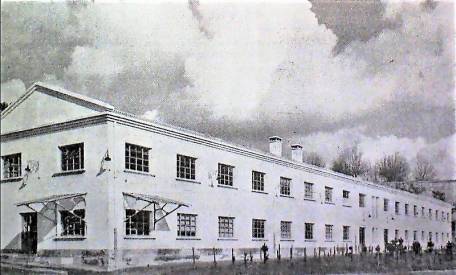
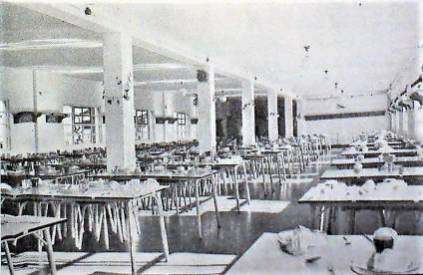
The Mess Hall of Bazan-Ferrol had two wings: the one named Arsenal served workers from the military side of the shipyard, the other named Astillero served the civilian side. Arsenal had 4 lunchrooms with 60 tables each, Astillero 4 with 30 tables each. Arsenal customers were attended by six waiters per lunchroom, Astillero's by three. Service in both wings was "most quick and diligent."
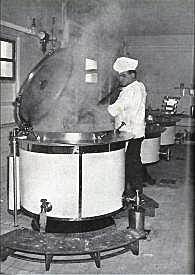
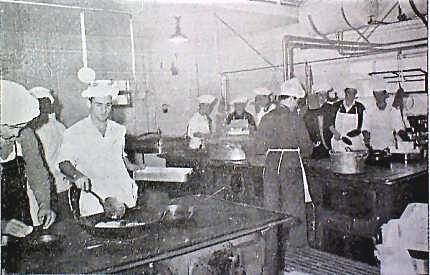
Arsenal`s kitchen had 4 huge pressure-regulated stock pots (above left) 3 bespoke ranges of four double ovens (above right) two industrial electric fryers and one expansive food-warming table. Astillero's kitchen had 2 stock pots, 2 ranges of three double ovens, an industrial fryer and a warming table.
Sixteen men worked in Arsenal`s kitchen and half that number in Astillero's.
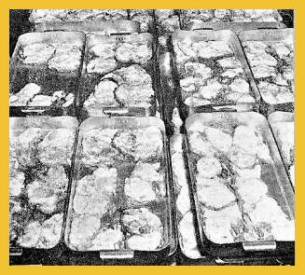
The day's menu was a two-course meal with a glass of wine and a hoagie roll included. The menu differed from day to day. Its price tag was 7 Pesetas. Note: At this time my weekly allowance was 5 Pesetas (End of Note).
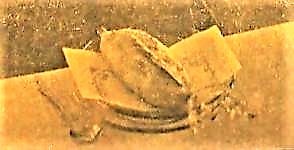
Every day the Mess Hall consumed 2,000 hoagie rolls and 400 litres or 106 gallons of wine.
If a day's menu called for eggs (probably to fry Spanish omelettes) around 3,900 eggs were used.
Customers could order extra drinks. A litre of wine (35 oz.) cost 5 Pesetas. A small bottle of beer (11 oz.) cost 3 Pesetas. A one-litre bottle of mineral water cost 5 Pesetas.
Every day around a hundred small bottles of beer were sold.
Every month the Mess Hall consumed 16 tonnes of potatoes and 1,100 litres or 290 gallons of cooking oil.
According to the article in Bazan, 25, January 1964, close to two thousand "producers" benefited daily from eating their midday meal at the Mess Hall.
Juan Manuel Castro was a frequent literary contributor of poems and stories to Bazan magazine (numbers 2, 3, 5, 8, 12, 13, 14, 15, 16-17, 18, 19, 20, 21, 26, 27). The poem below, translated from the Spanish language, comes from page 34 of Bazan, 27, July 1964.
|
Who is this dame knocking at my door,
Who now is this other one knocking,
And who is knocking now with wailing voice,
Your debt is plain to see. You may cheat HUNGER |
My Interpretation of The Three Creditors. "The Three Creditors" is a depressing poem, yet it reflects deliberately? inadvertently? the crude post-Civil-War reality of Ferrolterra (see "The Day of Ferrol City and County" in Chapter 14, "Bazan Magazine for the Year 1962"). There was widespread MISERY and there was widespread HUNGER, but society's well-off were spared both tribulations although their debt was plain to see (4.1). Eventually DEATH would also knock at their door who had "cheated" MISERY and HUNGER (4:1-3). She brought with her a magistrate's warrant (4:5-6). Let the reader pick who that magistrate might be.
Not every poem written by Juan Manuel Castro was so depressing.
He published the following "sketch of a poem" on page 37 of Bazan, 26, March 1964. Its title, "Romería Gallega," alludes to the traditional festive picnic on the feast day of a city's or town's or hamlet's patron saint.
Glossary for Romería Gallega.
Square tambourine (2.1). A square or rectangular board held between the arms and tapped with both hands (min. 2:55-2:57, 3:26-3:30 and 3:34-3:38 of this video).
Galician cookie-rings (4.2). Televisión de Galicia.
The gunpowder shells (5.1). Example.
Ribeiro wine (8.3). A renowned red wine of Galicia celebrated in many folk songs (example).
|
Sunbeams filter through the foliage
Audible are the sounds of the square tambourine,
The trail ascends like a serpent
A small forecourt, a fountain,
The gunpowder shells rise ripping or rather
The youngsters scramble about,
The Mass is said with a full orchestra,
There are flashes in the eyes,
A row—a wrangle—
The return home. Moonlight.
Youngsters go joining hands |
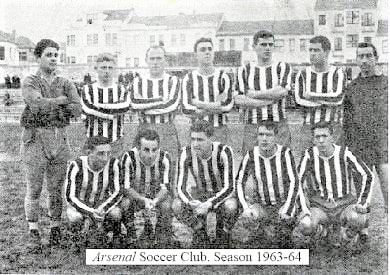
Numbers 26 and 27 of Bazan Magazine dedicated a total of five pages to the players, coach and exploits of Arsenal Soccer Club. The club had a "meritorious" season finishing fifth after Compostela, Fabril, Ferrol and Lugo.
Luis Porta the author of both articles praised the strategy of Bazan-Ferrol to draw nearly every one of its players from the Ferrolian quarry, i.e., from Factory workers, from the professional Ferrol Soccer Club, from local modest clubs like Galicia de Mugardos or Galicia de Caranza. With that roster Arsenal was a "feared visitor" in every away game.
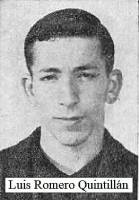
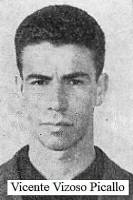
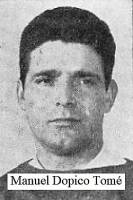
The Bazan, 26, article highlighted three Factory workers who were also Arsenal players.
1. Manuel Dopico Tomé was 24 years old. Arsenal's substitute goalkeeper, "one of the best" in the Third Division. He was a coppersmith.
2. Vicente Vizoso Picallo was 19 years old. Right winger. He was a fourth-year apprentice at the Foundry.
3. Luis Romero Quintillán was 19 years old. Midfielder with "a good shot on net." He was a fourth-year apprentice of the Fine Sheet Metal Workshop.

The Bazan, 27, interview of the team's starting goalkeeper begins thus, "No one can deny that one of the most popular figures in the Ferrolian soccer scene these last few years is Fernando Fernández, 'Nando,' Arsenal's goalkeeper and the most veteran of all the active players."
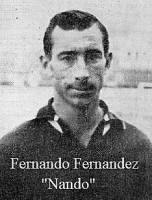
"I started to play as a 9 or 10-year-old boy. Shortly after entering the Factory as an apprentice I signed with Portuarios in the 1942-43 season." Note: Portuarios was a federated team from the old fishermen's quarter of the city (End of Note).
"How many years have you been with Bazan's team?" "Seventeen years; I signed with Arsenal in the 1947-48 season." Note: This was Arsenal's debut too (End of Note).
"What trophies did the team win with you in the lineup?" "Twice head of our Third Division Group and once National Enterprises Champion, a tourney organized by Educación y Descanso, a title we revalidated this year but I went as the back-up goalie."
"Do you think you still have some years left in the sport?" "Frankly yes. At least two."
"Of all the goalkeepers who played alongside you, whom would you point up?" "Dopico." Note: Arsenal's second goalkeeper, leftmost photograph in the row-of-three above (End of Note).
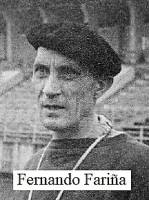
A second article in Bazan, 27, congratulates coach Fernando Fariña Barros on the occasion of his having been awarded the Plaque of the Sporting Merit by the "top hierarchies" of Spanish sport. He received his award from the hands of the President of the National School of Coaches.
The motive for this distinction was Fariña's unmatched national record of permanence coaching the same team, "something exceptional in Spanish soccer."
Fariña had been coaching Arsenal seventeen years straight, right from the team's inception.
The third sports article of Bazan, 27, praised the policy followed by Bazan-Ferrol in the hiring of Arsenal's players and predicted that the team would in the upcoming 1964-65 season equal or better its 1963-64 performance. Unfortunately the bold prediction failed utterly. Porta's article in Bazan, 29, October 1965, reports that Arsenal had because of the loss of important players through injury or conscription finished the 1964-65 season in fourteenth place, resulting in its demotion from the Third Division.
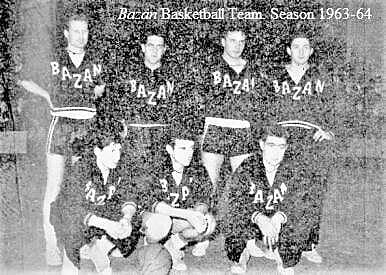
The 1963-64 season disappointed Bazan's basketball fans who envisioned a revalidation of the title of Galician champions and saw instead the opportunity dwindle as the team kept losing some away matches in incomprehensible fashion. In the end Bazan lost by just four points a crucial game away, "which they deserved to win," against the reigning Galician champions, Manuel Álvarez of Vigo City. This was their final match of the season.
Bazan has tumbled from being an outstanding team without peer in Galicia to being just another one that defends well at home but which finds it very difficult to score points away. A dearth of players? A lack of zeal in those it has? Did the turn over flop? Is there not enough training?
Many are the reasons and there is a bit of all. The fact is that while all Galician teams have improved—referring to the top teams, of course—Bazan has plummeted and the gallery that yesteryear filled the Gymnasium abandons it now.
(Luis Porta. "Ferrolian Basketball." Bazan, 26, pages 34-35)
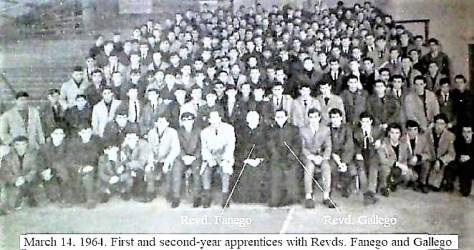
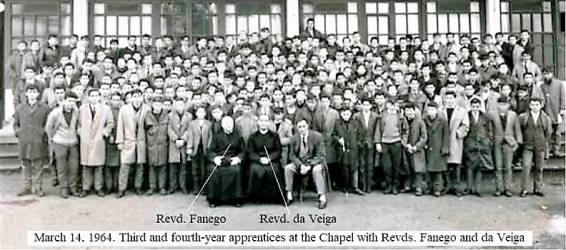
According to the article entitled, "Social-Religious Activities," of Bazan, 27, pages 22-25, the "accustomed" conferences were split in two groups. First and second-year apprentices were lectured in the Study Room under the direction of Reverend Lázaro Dominguez Gallego. Third and fourth-year apprentices were assembled at the Chapel of the Factory's Christian Schools where they heard the "most timely and learned explanations of Reverend Father José Pita da Veiga the zealous Ferrolian missionary of the Claretian Order."
As is traditional all our apprentices have left once more a deep impress of their manly religiosity and exemplary discipline by way of a magnificent behaviour and unmistakable displays of pure piety, worthy of the highest praise. We must also highlight the signal interest in and concern for the religious problems, demonstrated by the weighty and interesting exchanges between the participants and their respective Directors following the various sessions.Our compliments and congratulations for the happy success achieved in these typical Easter Conferences for the Apprentices.
(Kronik Melos. "Social-Religious Activities." Bazan, 27, pages 22-23)
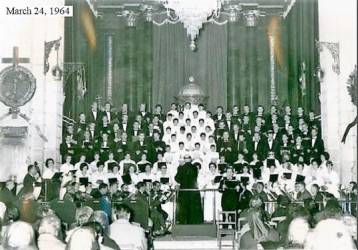
On Holy Tuesday March 24 Bazan's Polyphonic Chorale and Orchestra gave their classic Holy Week concert at San Francisco Church (photograph to the left).
The first half of the concert covered Perosi's La passione di Cristo secondo S. Marco.
The second half replayed Théodore Dubois' Les Sept Paroles du Christ (see RELIGION, Bazan Magazine for the Year 1962).
The article lauded the impressive performances of three veteran soloists, Varela, Lorente and Orozco (see ARTS AND LETTERS, Bazan Magazine for the Year 1960). The report also commended the soprano Mrs. de Llano and the treble-child Jaime Carneiro.
The concert was attended by the captain general of the Maritime Department and by the top civilian and military figures of the city who at its conclusion expressed their warmest congratulations to Reverend Fanego.
On March 27 the Polyphonic Chorale returned to San Francisco Church to take part in the customary Holy Friday service patronized by the Spanish Navy. The repertoire was also the customary one (see the religious calendar entry for Holy Friday April 20, 1962, in RELIGION, Bazan Magazine for the Year 1962).
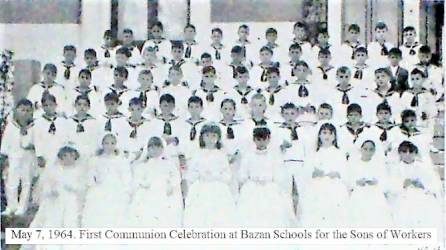
On May 7, 1964, Bazan-Ferrol hosted the day of the First Communion of fifty-one pupils from the Schools For the Sons of Workers (photograph to the right). This was the twentieth consecutive year that Bazan-Ferrol had staged the ceremony. The eight girls in the foreground of the photograph above were the sister(s) of some of the boys. Although girls were barred from the Schools For the Sons of Workers they partook of this ceremony and of First Communion with their brothers.
The Schools For the Sons of Workers were run by the La Salle Brotherhood and were in fact a conglomerate of small buildings that bore the official name, "Saint Joseph the Worker School." The citizens of Ferrol however knew it by the moniker, "Workers School," because Saint Joseph the Worker School was the inheritor of that other one started in 1916.
Saint Joseph the Worker School was launched on January 20, 1942, at the request of and sponsored by Bazan-Ferrol with the mission of educating 398 sons of its "producers." The School was located inside the walled perimeter of the shipyard. It had eight classrooms and taught four academic grades. The programme stressed four different areas of a child's education: (i) the intellect, (ii) religion, (iii) phys ed with competitive sports, (iv) music and the arts.
The 1976-77 school year represents a milestone in the School's history. A new site, facing the sea and the Astano shipyard, is inaugurated in the new Caranza suburb. From then on the school has a new name, "La Salle" ... The building is just one storey tall in keeping with the pedagogical guidelines of the epoch, the "personalized education," broad hallways and full of light...The school also becomes independent of Bazan-Ferrol. Now it is open to everyone, not just to the sons of Bazan producers as happened before. Furthermore gender segregation is done away with, the boys and the girls learn together.
(Nuestra historia. Colexio La Salle Ferrol)
The date of the First Communion celebration was always set to coincide with the religious Feast of the Lord's Ascension to Heaven which in the year 1964 fell on Thursday May 7.
The bishop of the Ferrol-Mondoñedo diocese officiated the morning Mass and the School's anthem was sung at its conclusion.
 Anthem of the Schools For the Sons of Workers
The MP3 clip was extracted from a Youtube video of the full concert given on Friday October 21, 2016, at Teatro Jofre to commemorate the Centenary (1916-2016) of the Ferrolian Workers School. The stars of the concert were the Polyphonic Chorale, child of Bazan's Polyphonic Chorale, the music band of the Northern Third Corps, baritone Gabriel Alonso Díaz, bagpipers Bruno Tembrás Freire and Xaime Villamor Andrade and the tenor Francisco Regueiro Rodríguez (1940-2019) alumnus of the Schools For the Sons of Workers (1950-54) and a former producer of Bazan-Ferrol (1954-63).
The last act of the 1964 First Communion event was the traditional breakfast in the Gymnasium followed by the distribution of souvenir diplomas and sachets of chocolates, compliments of Bazan-Ferrol. This photograph taken in 1946 shows the children seated in a room that may have been the school's cafeteria. This other photograph taken in 1950 shows them outdoors on the school grounds. The habit of setting the complimentary breakfast in the Gymnasium must have come a few years afterward.
Our warmest congratulations to these most charming "little sailors" in the happy Day of their First Communion, to their parents and relatives and to the La Salle Brothers community. And on everybody's behalf the deepest gratitude to Enterprise Management for their keen interest and for the loan of their facilities.
(Kronik Melos. "Social-Religious Activities." Bazan, 27, page 25)
The class-conscious conditioning of First Communion uniforms is worth noticing. All the boys in the leading photograph wore the "little sailor" uniform alluded to above. It would take a brave soul to spurn the rule. On the other hand it was not uncommon for upper-class boys to wear commandante uniforms similar to this one, a point already made in RELIGION, Bazan Magazine for the Year 1960.
But wait! One boy in the preceding photograph of May 7, 1964, is not wearing a "little sailor" uniform! A rebel from the Schools For the Sons of Workers or his family could not afford the expense?
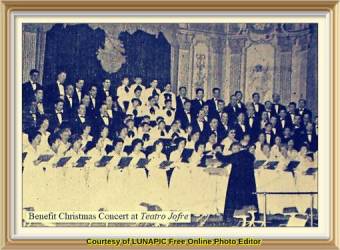
The picture on the left is an edit of the December 22, 1960, photograph found in ARTS AND LETTERS, Bazan Magazine for the Year 1960. The tool employed was the LUNAPIC Free Online Photo Editor.
On Wednesday December 23, 1964, the Polyphonic Chorale staged their usual Christmas concert at Teatro Jofre. According to the article by Kronik Melos on page 23 of Bazan Magazine, 28, May 1965, Bazan's four musical associations took part: the plucked-string orchestra, the chorale, the chamber orchestra and the band. And as usual the fundraiser was a "great success."
Another source of revenue for the Sick Workers Mutual Fund run by Reverend Fanego was the box office receipts of the regular season match between Arsenal and Ferrol played on Sunday December 20. The box office receipts were donated to the Fund. The amount collected hit an all-time record of 101,750 Pesetas. Note: On January 4, 1965, 101,750 Pesetas were equivalent to USD 1,695.83 (End of Note). "Many spectators bought tickets with the sole intention of helping their afflicted workmates," states Kronik Melos who also lauds the regular Christmas donations sent by two former Bazan workers living in Amsterdam, Mario Gonzalez and Pepe Díaz. The game's final score was Arsenal 0, Ferrol 1.
Bazan, 25, page 40, carries the following information about Spanish emigration during the year 1962 which, according to official figures, amounted to 65,326 Spaniards. Around 15% were seasonal farmhands who spent four or five months away each year.
The article remarks that traditional Spanish emigration toward Latin America had veered "in recent years" toward Europe. The main destination by far was Germany, followed by France, Holland, Belgium and Switzerland.
As a percentage of its working-age population, the Spanish province with the biggest exodus was Ourense (23%) followed by Melilla (12%) Almería (11%) and Zamora (7%).
Most emigrants send money back to Spain periodically, and this is good evidence that they remain intimately attached to their fatherland. Consequently it is logical to assume that these expatriates will after a few years return to Spain with their savings and, above all, with their work experience, prepared to participate in an economy that can engage them.
The identity of María Dolores Pérez Linos (D.P.L.) is discussed at length in the "MARÍA DOLORES PEREZ LINOS (D.P.L.) REPORTS FROM ISRAEL" section of Chapter 14, "Bazan Magazine for the Year 1962."
1. In a section entitled, "Woman's Pages," of Bazan, 23, April 1963, pages 28-29, under the heading, "Let Us Talk About Cooking," D.P.L. rates Israeli cuisine as "very bad," and adduces a similar verdict published months earlier by the correspondent of a Madrid-based magazine who declared that "whereas Tel-Aviv's restaurants might remind a customer that it is necessary to eat to be alive, Haifa's were a positive invitation to fast." D.P.L. adds that a substantial number of Haifa's restaurants was vegetarian. She compiles a long list of kosher restrictions on food. These bans mirror "the norms that regulate Israeli official and private life, which seen under a Spanish light, are incredibly harsh." However the rules did not prevail everywhere, for she confides, "at a Magyar home I have tasted an exquisite dish that combined the double heterodoxy of pork and dairy cream." Her husband was Hungarian so she formed part of the Hungarian colony. D.P.L. divides Israeli cuisine in two camps: European and Oriental. She adverts to Bulgaria and Greece which though European in fact belong to the Oriental culinary camp. Europeans cook with margarine ("butter is too expensive"). The Orientals use cooking oil. Europeans are meat-eaters, the Orientals prefer legumes. Europeans base their pastries on sugar, the Orientals on honey. Europeans spice their meals, the Orientals go for garlic. "At a Czech, Polish, German or Hungarian home they will offer you chocolate cake or apple pie, at a Turkish or Egyptian home you will make the acquaintance of sesame." D.P.L. concludes her two-page article with the observation that what Israeli and Spanish kitchens have in common is the use of retail instant soup.
2. In a similar section of Bazan, 24, November 1963, pages 38-39, under the heading, "Countryside And Countrywomen," D.P.L. expresses her admiration for the daily heroism of Israeli life. She depicts a kibbutz as "that blend of tractor and machine-gun which is the solid skeleton that supports Israel's body." A kibbutz's literature is the harvest, its tradition those who died, in whose memory woodlands are planted. "Whoever arrives here," she writes, "renders a tribute of admiration to what has been accomplished on this unwelcoming, dry and charred land strewn with stones." The first pioneers established themselves in Rishon-Le-Zion (The First Zion) "about 80 years ago" [from 1964] and that marked the start of "an 80-year war against dust, sand, the wind of the desert, the bedouins, the British, the Syrians, the Egyptians, the snakes and the scorpions." D.P.L. invites her readers to imagine countrywomen imbued with a non-religious yet "formidably mystical" vocation, who make an implicit vow of poverty and obedience, whose raiments are white blouses, shorts for work and a cotton skirt for Saturdays, holidays and for that "once in a while" when a movie is shown at the kibbutz.
Two or three hours before [we Spanish women] start our day they [the women of the kibbutz] are picking fruit or cooking or sowing wheat...and in many parts of the countryside wearing a revolver that guarantees they won't be taken alive in case of a raid, who will never have a nickel in their pocket or know what make-up is; and they feed almost exclusively on tea, vegetables and margarine...and this after 9 or 10 hours of work under so merciless a sun that five years of this way of life will take the toll of fifteen years in their organism. They realize that their lot is the toughest in the difficult living conditions of Israel, but the psychology of the "kibbutznik" is composed of generosity and pride in equal measure. Kibbutz members—men and women alike—are pleased with the material progress of the cities, be it Haifa's Metro or the nightclubs of Tel-Aviv, despite knowing that they can not enjoy the pleasures those cities offer and which their toil sustains.
D.P.L. closes the short article relating the experience of an old Russian woman who at age sixteen migrated to Israel with a group of boys and girls eager to build the "Jewish fatherland." They moved to the hostile desert, dwelled in tents for years, hauled water on the back of asses until their borings hit groundwater. Nomads plundered them, a harvest or two was set ablaze. At last they spied the first sprouts on the ground. Only half the trees planted survived, but these grew and provided shade,
And the magnificent old woman who told me this wrapped up her story—so similar to so many other stories in this country—with these words, beautiful as a Psalm: "And for the first time after so many years we heard a bird sing."
3. 1964 was a prolific year for D.P.L. the "Bazan reporter" married and living in Israel.
Bazan Magazine published three numbers, 25-27, and D.P.L. contributed four articles. Two were published by Bazan, 25, January 1964, pages 36-39. The four pages were motivated by the historic visit of Pope Paul VI to the Holy Land. His stay spanned January 4-6, 1964.
The Spanish NO-DO newsreel magazine, NO-DO Revista Cinematográfica Imágenes, covered the salient features of the papal journey in eleven long minutes.
Official Spanish Newsreel Magazine Imágenes. Special coverage of Pope Paul VI in the Holy Land
Abridged Voice-Over Translation: 0:00-2:32 Paul VI departs at dawn [Saturday January 4]. No Pope had left Rome in the past 151 years, the last one to do so was Pius VII. The successor of Peter says good-bye to the Italian land from Fiumicino Airport. Jerusalem the Holy City is now split by the war between two peoples, Jordan and Israel. 2:33-3:45 King Hussein comes to welcome the Holy Father at the Amman airport. The arrival is announced with a twenty-one gun salute. His Holiness descends from the airplane on this cold and windy day yet in an environs warmed by affection and emotion. Jordan's monarch receives the head of the Pontifical State cordially while doves flutter roundabout. The first stage of His Holiness' visit to Palestine is the River Jordan on the way to Jerusalem. Sentries on the hilltops remind us that the country is at war with Israel. 3:46-3:48 King Hussein escorts His Holiness from a helicopter. 3:49-4:35 The Pontiff approaches the site of Christ's baptism on the Jordan River. 4:36-5:40 Thousands of people waiting for the Holy Father gather before the Damascus Gate. The Holy City welcomes the Supreme Pontiff in an avalanche of enthusiasm. 5:41-6:11 The Pope celebrates Mass at the Church of the Holy Sepulchre. 6:12-6:33 The Roman Pontiff goes to the Garden of Olives escorted by torches. 6:34-7:20 The entourage enters the State of Israel [Sunday January 5]. Zalman Shazar the elderly head of the State of Israel together with the Prime Minister and other top dignitaries delivers a speech of welcome in Hebrew and offers His Holiness a present. The journey over the territory of Galilee begins, the Pope now heads to Nazareth. 7:21-7:53 His Holiness visits the Church of the Annunciation. Outside Israeli soldiers watch the frontier from the ramparts. 7:54-8:24 Paul VI arrives to Mount Tabor, scene of the Lord's transfiguration. Again the Holy Father kneels down in prayer. His Holiness contemplates from the height the landscape of Galilee, the Sea of Tiberias and the lands of Caphernaum. [garbled] the president of Israel bids farewell to "the most eminent guest who has come" to his State. 8:25-9:10 Athenagoras I the Ecumenical Patriarch of Constantinople and the Holy Father meet. The embrace of Pontiff and Patriarch seals this solemn and historical encounter. 9:11-9:39 Bethlehem the small City of the Bread in Jordanian territory welcomes the Supreme Pontiff. 9:40-10:07 King Hussein sends Paul VI off at the Amman airport [Monday January 6]. 10:08-10:55 President Antonio Segni the president of the Italian Republic together with the Defence Minister welcome His Holiness at Ciampino Airport. The twenty-kilometer journey between the airport and Christendom's Square took two hours and fifteen minutes.
4. The following D.P.L. report comes from pages 36-37 of Bazan, 25. It is translated in full.
This December [1963] marks the sixth birthday of the MAGAZINE and the fourth of my modest but resolute collaboration.
A forewarner betrayeth not; on one of my initial pages I already said that my writing pen was certainly not Concepción Arenal's; one writes what one sees, relates it using her own style, and that's how we make do.
I recall I made my debut narrating the accurate and true impressions of an excursion to Finisterre, which I embarked upon in one of those irrepressible moments when I must "take to the woods" and discover new faces and cities; an ancestral wanderlust whose provenance I ignore—and could care less about—but which remains vibrant even though youth is but a dried flower among memory's leaves. Ah, if I could travel every highway still!
Which does not lead to Rome this time but rather brings Rome to Palestine. The Pope's visit will already have taken place when my particular telling of it will be on its way to the MAGAZINE for printing. I do not know whether I will be able to resist the temptation of stamping on the envelope the label, "Exclusive Bazán Correspondent," or "On Special Assignment To The Pontifical Pilgrimage." But presently, exactly one week before the visit, I must, and though I wished to I could not forgo talking to you about the wait, about the preliminaries of the most extraordinary event in Christendom after many centuries.
It is not necessary to state that the whole world is delighted, or to say that the preparations underway here are phenomenal, spurred on by a natural desire to be more pro-Papacy than the Jordanians who, one presumes, are exerting themselves putting up scaffolds, planing, setting up arches and spotlights. Note: D.P.L. here toys with the Spanish saw, mas papistas que el Papa, lit., "more pro-Papacy than the Pope," in a syntax so convoluted that its literal translation would confuse the reader needlessly (End of Note).
The song of bulldozers reflects a general feeling of profound satisfaction. "This year Noel has been celebrated under the sign of Paul VI's visit," state the newspapers. And of course nowadays that also means under the sign of the "flashlight," for the invasion of the boys of the press has begun establishing its bridgeheads and there will be "no room at the inn" during those two nights of lying in wait at strategic locations for the Vicar of Christ...Just as there was no room on Bethlehem's Night upon the birth of Christ himself.
Do you not perceive that even symbolically everything dovetails admirably? Even the weather is genuine Christmas weather; it is not inconceivable that the snow should come to give the landscape of Bethlehem and Jerusalem its perfect nuance, for the hard, dry cold is much more intense than usual, the thermometer dips to 0°C at night. And in a phrase that unfortunately isn't mine we can say that this brilliant moon, heading to full phase, "sounds against the earth like a cataract of silver." Let us hope that it continues to do so, that if the moonlight delivers its silver the sun delivers its gold, that the fearful torrential rains do not make an appearance and that the Pope watches the sweet Galilean countryside in all its glorious beauty, the green plain of Jezreel, the lush banks of Tiberias, and the radiant blue Lake, one of the most beautiful sights this country has to offer...The Lake where Peter received the call and which today awaits Peter's successor who comes to pray in the country of Jesus inhabited by the race of Jesus.
There is something of the greatest import that I now wish to talk to you about. Seeing this visit, as I do, from the Jewish perspective, so to speak, its perceived importance is definite: Israel, not just the government and the official platform but the man on the street, expects not one Pontiff with this visit but two. Evidently Paul VI is expected, whose curriculum as a cardinal and whose first steps in the Papacy have accorded him the prestige he deserves, but John XXIII, invisible yet enormously present, is the one who accompanies him. Note: Pope John XXIII died on June 3, 1963 (End of Note).
Nothing, not words or official mourning, can convey an approximate idea of what role John XXIII played in the change of attitude of the Israelite people (and of other religions, and of the "iron curtain"...) toward Rome, toward Catholicism. No comment or editorial on the approaching visit of the Pontiff fails to reminisce about "the wept-for, vanished Pope," "the unforgettable predecessor of Paul VI," "the good Pope John." I tell you that the word, "wept-for," is not a figure of speech: I tell you that people who never had any relationship with the Church, even from afar, have shed tears for John XXIII. Lo, he said turning to the Jews, "I am your brother," and centuries of enmity, Inquisition, mistrust, hostility, vanished in an instant. Why? Because he spoke with complete sincerity, complete kindness, because never since St. Francis of Assisi perhaps was there another heart bereft of a single drop of gall and full of charity toward every created being. Here it was said of him upon his death, "a true priest at the service of men his brothers," "a Righteous one in the talmudic sense of the word," which is equivalent to our definition of sainthood, "all his exceptional qualities: intelligence, good sense, diplomatic skill, ingenuity, were at the exclusive service of Goodness."
Do you recall that when John XXIII rose to the Pontificate he said that he wanted to be "a man among men"? No doubt he was, in the sense that Jesus was a child among Nazareth's children or later the young rabbi, delicate and frail, who preached under the overwhelming columns of Caphernaum's synagogue.
John XXIII was a man who reassuringly demonstrated through the opening of channels of peace and friendship toward everyone that even in our days of atomic power and terrors dialogue and kindness are a means of understanding each other, nay, the exclusive means of understanding each other.
He was a man who gathered round his death-bed everybody united in the shared grief of Muslims, Buddhists, Communists, Protestants and the sheep of the Catholic Shepherd. An Israeli newspaper said a short time ago, referring to the Pope's visit, "After the immense prestige, truly universal, which John XXIII enfolded the Pontificate with, how out of place would now sound Stalin's famous query about how many divisions the Pope had," and it's true, now he could be answered, "Oh, he has many fifth-columns!" Among them those that in the land of Israel, on the earth once dust on Christ's sandals, ready themselves to receive respectfully, enthusiastically, conscious of being in the spotlight of Christendom that day, "he who comes full of goodwill, he who comes in the name of the Lord."
D. P. L.
5. The following D.P.L. report comes from pages 38-39 of Bazan, 25. It is translated in full.
|
... and I will go ahead of you into Galilee.
(Matthew 26:32) |
Please forgive me if this report is brief, jittery and disorderly. The emotion persists. I have seen the Pope, I must relate it to you and I am only able to say, "Domine, non sum dignus." Note: "Lord, I am not worthy" (End of Note).
Sleepless Nazareth, cold of temperature, ablaze with enthusiasm, effervescent with crowds, exuberant with arches, flags and Christmas trees, was starting to warm its alleys with the first rays of the sun when we arrived on the glorious morning of January 5. The small town of Joseph and Mary brimmed over with green boughs of white and yellow—Vatican's colours—portraits of the Pontiff, welcoming posters and date palm leaves. Although three to four hours still lay ahead before the Pope's arrival crowds thronged the streets and the balconies as if nobody wanted to miss even a minute of the historic day. Habiliments of all the religious orders, Arab keffiyehs and tarbushes, Druze, Israeli soldiers, rabbinical and Orthodox beards mingled with the blue jeans invariably worn by Israeli youth and by others not so young. Every five meters loudspeakers of Kol Israel the National Radio reeled off the previous day's news about the Pontifical journey in Jordan, and although it broadcast successively in Hebrew, Arabic, French, English and Italian, this paled in comparison to all the world's languages heard on the street, "Parthians, Medes, Elamites and the inhabitants of Cilicia and Mesopotamia"... Note: D.P.L. alludes to Acts 2:9-11 (End of Note).
The great ecumenical occasion entered its second day brought by the happy wind that clapped among the leaves of the trees of Galilee.
Suddenly a clamor worth all the silences. The radio announced the precise moment when the automobile carrying Paul VI crossed into the land of Israel, and moments later, the precise second when he stepped upon it at Meggido the city of Solomon. The President of the State awaited the Pope there; he would see him off at the City of David in the evening. Short addresses in French. The Roman Pontiff closed his with the beautiful Hebrew word "shalom" (peace). The bread and salt of Israelite hospitality were offered the Pope and he used the language of the people receiving him to reciprocate the peace blessing.
It is said by those who were physically close to His Holiness that when his black automobile with the pontifical ensign approached Nazareth Paul VI interrupted his conversation with Cardinal Tisserant, sitting beside him, and became absorbed in contemplation of the fields where once played and worked the Child whose destiny nobody suspected then ("Isn't this the carpenter's son?"). Note: D.P.L. quotes Matthew 13:55 (End of Note).
How identical, how evocative must have seemed to him the ancient village of small boxlike houses leaning on the mount, the prickly pear cactuses growing among the stones, here and there olive trees, carob trees and the "faith's arrow, hope's dart" silhouette of the cypresses beneath this sky so pure! Yet however profound the papal meditation may have been, he was doubtlessly yanked out of it by the thunder of a single acclamation voiced in thirty languages. Amid hoorays and applause, Shalom and Salaam, the children's waving of small flags, a profusion of peoples, races, religions and generations carried Christ's Representative up on their shoulders, metaphorically speaking, to the Basilica of the Annunciation, in whose Grotto, on the very spot where "the Angel of the Lord announced to Mary," Paul VI was going to celebrate one the most intense Masses of his life. Note: D.P.L. alludes to Luke 1:26-38 (End of Note).
Nazareth's official reception took place there. The Pope was greeted by the Israel's Minister of Education, the diplomatic corps headed by the Soviet ambassador, Nazareth's City Hall, bishops, a delegation from the Rabbinate and the superiors of religious orders. Paul VI went down to the Grotto to say Holy Mass, televised so that we could all attend, you and us, you beyond lands and seas and we on the broad esplanade of the Basilica. The Supreme Pontiff reappeared outdoors to impart his Blessing at the conclusion of the Holy Sacrifice, preceded by a brief oration once more in French and the singing of Christus Vincit.
A short, fleeting pause to rest while the friars offered him a refreshment (which His Holiness would be very much in need of) and then the exit, once more like the arrival. Escorted by a few Israeli police motorcycle officers, with the respect and enthusiasm of the people, the white figure left Nazareth by way of the street that henceforth bears his name, departed very slow, deliberately, smiling, greeting and blessing the multitude cheering him. If yesterday the Lord's Vicar had walked the Mysteries of Pain, Gethsemane, the Via Dolorosa, the Holy Sepulchre, today he followed his Lord's paths in life. Departing the house of the Sacred Family he travelled over the barren land of Canaan toward Caphernaum of the proud synagogue where the young Nazarene rabbi once preached. Kfar-Nahum, which means in Hebrew, "Place of Consolation," and it was of many miracles, was so loved by Jesus that He styled it, "his town." Caphernaum beholds itself in the waters of the Genezaret on whose shores today's inhabitants, the fishermen of the Lake, welcomed the Pontiff with their arms full of yellow and white flowers.
Afterward came the Mount of Beatitudes, the field of the multiplication of loaves and fishes, the River Jordan, and at last Mount Tabor whose faraway summit appeared this morning veiled by a radiant, ragged, translucent fog which resembled a heavenly fire. Then followed the renewed homage of Israel: Hebrew children, in many places with their schoolmasters at the head, and the inhabitants of all these jolly and hardworking hamlets, the French workers, the African students... I do not weary of repeating: the constant presence and memory of John XXIII embodied all this, of whom it could also be said that he went ahead of the Pope to Galilee. Note: D.P.L. alludes to Matthew 26:32 (End of Note).
And at the end of the road Jerusalem once more.
Jerusalem which in the memorable date "opened its arms to welcome the Prophets and decorated its stones to honour those sent to her," and where Cardinal Tisserant in the name of Paul VI visited the grotto of the martyrs, a place of worship erected in memory of Hitler's victims, to pronounce a prayer there and to kindle six lights, one for each million of the dead.
Jerusalem, sacred to three religions, the cradle of peace and the site of so many wars, was today a symbol of happy contradiction: it made church bells tumble in honour of the Pope, it lit Stars of David and it offered the lilies of Judea from this ever-flowered country to the Pope.
The Pontiff had entered Israel in the morning by way of the field of Armageddon where, according to St. John, the final battle of the ages will take place. At the point of entrance he invoked the name of the prophets and of the patriarchs, "the people of Abraham, Isaac and Jacob." The people of Revelation bade him farewell at Jerusalem with the same enthusiasm as we in Nazareth bade the Shepherd of Rome farewell when he continued on his pilgrim's itinerary traversing the gentle Galilean fields toward Lake Tiberias which, decked in its own natural beauty, awaited the return of Peter impatiently.
D. P. L.
6. The following D.P.L. report comes from pages 32-33 of Bazan, 26, March 1964. It is translated in full.
Some months ago a workmate wrote me asking me to satisfy his curiosity regarding the motive or basis for the religious ban among Jews to mingle meat and milk in the same meal. I am forced to answer that "I only know that I know nothing," as I-do-not-recall-who said and many others repeated after him. Note: Attributed to Socrates (End of Note).
We should have asked some richly bearded and poorly dressed rabbi, but lacking friends on that side of the road, we had to contact an acquaintance who during his green years studied in a yeshiva—a religious school—of Poland. Apparently there is no sanitary motive or expressed reason other than it is a tradition derived from the Bible verse, "Do not cook a young goat in its mother's milk," etc. Note: Exodus 23:19 (End of Note).
Presumably all the precepts of the Talmud and of the Torah made a lot of sense from a hygienic perspective when they were dictated in the days of the Revelation, but they are not meaningful today. There is not even unanimity about how many hours must elapse between consuming one and the other victual. Everybody agrees that two hours must pass between consuming dairy products and eating meat, but as to the reverse, from meat to milk, the sepharadim prescribe as many as six hours whereas the askhenazim observe four. I lament my inability to say more. Should I obtain additional information I will reply privately or from this same platform. And now to another matter.
Let us cite Richard the Lionheart, Godfrey and the "other Baldouin," not this one of today, as three illustrious visitors before I too journeyed to Saint John of Acre—not with a conqueror's bent but a tourist's—not by sea but overland—not against the Crescent Moon but under its streamer, mumbling to myself now and then, "If John of Austria were to lift his head!" "Saint James the Apostle, forgive me...times have changed." Times have changed? At Saint John of Acre there is room for doubt. It is so ancient, so timeless its stones, that one hardly remembers that Napoleon too set foot here. His cannons yawn on the citadel's height, watching over a shore they no longer protect and a sea they no longer threaten.
And what a sea! Viewed from the battlements that one day Saladin's soldiers defended, the sea sheds its current frivolous image of "Côté" and millionaires and in our ears ring the clashes of axes and swords from the many boardings which this beautiful blueness witnessed, and we recall that before a route for cruises it was a Cross' trail. André Maurois dubs the Mediterranean an "immense graveyard of Empires."
The giant fortress suffered several fates, naturally all tragic. Blood on blood and death on death. Finally it became a prison during the recent British Mandate for Palestine; fourteen Jewish soldiers were hanged inside, the last guests of dungeons which during eight centuries saw a constant come-and-go of prisoners. This section of the fortress is now a museum. Its modern annexes house today the psychiatric asylum, another tragic destiny! Such fury of power and oppression, such madness of conquest and idealism, slew and perished between these walls that we deem the sinister building to never have been anything but!
We return summarily to the merciless sun outdoors before hurrying toward the shade of the old village, the Arab city. Here we are where we wished to be. Recesses, neighbourhood enclaves, preserve the ancient names, "Templars," "Hospitallers," "Teutonic Order"... Nothing more requires the imagination predisposed to the strident, cruel, knighthood reminiscences of Acre; but lo, there is no need to fantasize for nearly everything is unchanged. Everything is as it once was, even the rubbish of the twelfth century subsists beneath the overlying layers as one would expect in an Oriental setting, picnic watermelon rinds morph into geological strata. Curiously the new houses look older than the remainder. They were built out of ephemeral need, born to succumb amid so much perpetual stone.
Everything is perfect: the rampart walls that once closed Acre off, the giant gates, the heavy chains, the coats-of-arms, the inscriptions, the covered alleys, the magnificent arches that saw passing the magnificent coats of mail with the Cross or that resounded with Turkish drums or the hooves of horses caparisoned with fleurs-de-lis or leopards of Plantagenet... A city to visit just because of the tug of its name. There is perhaps none other in Israel that so rewards our curiosity with purest gold of unforgettable impressions.
Three showpieces overlook the Muslim neighbourhood: the Great Mosque, the Museum and the Bazaar.
The Mosque is imposing. It has a delicious water fountain of postcard quality, looking like a scene from Todo Es Posible En Granada, moored to its external wall, a blue kiosk girdling with a gilded grille four or five drinking fountains flowing continuously. Next the inevitable flight of steps up to a courtyard of garden fountains and palm trees, arcades and blue tiles, designed to convey a sensation of cooler temperature, a field which Islamic civilization masters, and I do not say this with pejorative intent. The interior of the Mosque is pretty and full of colour on its glass panes and friezes. They did not request us to take our shoes off, which I must confess disappointed me because, being a naive tourist, the blunders of "local colour" annoy me a lot.
The Museum is extremely interesting. It is located inside an ancient Arab palace under Western-style organization and management. Roman ceramics and sculptures—de rigueur in this country—weapons from the era of the Crusades, garments, furniture, horse or camel saddles, and above all, Druze, Bedouin or Kurdish jewellery. Although this is all very good, the Bazaar!...
Akko's Bazar, whose ornament and major business was once Christian female slaves, sells today, like Naples, like Haifa, handbags from Madeira, Cyprus "souvenirs", as ugly as demons, the familiar Japanese camel hair fabric and—horror of horrors!—sells, yes, the beautiful Arabic amphoras, the long neck vases, but...made of plastic.
Storytellers' markets of spices and tapestries, pray tell: where is the talking bird, the singing tree, the gilded water? Aye, the same centuries that overtake and mar men embellish the stones. And in the midst of this easy and far from disagreeable disorder of the Orient, in front of coffee bars replete with male customers exclusively, pass by for every woman wearing velvet gown and white kerchief—here most Muslim women do not veil the face—pass by, I say—twenty or thirty feminine silohuettes with "bouffant" hairstyles and nylon blouses, awaiting the time of the movie show to go and be entranced by Elvis Presley...
An extremely old beggar, oblivious to the sunlight, oblivious to the houseflies, seated under a poster of the irksome singing lad, turns his blind eyes to the passersby, imploring alms: Gihsm' Illah Alr'aham Alr'ahim, "In the Name of God, the Merciful, the Compassionate."
Wrapping up...one must return to the world of "steel and lead, cement, the screw and the wired music." The wish to return to Saint John of Acre abides. Upon arriving back home we took a shower. The running water washed the dust of centuries off our bodies.
D. P. L.
7. The following D.P.L. report comes from pages 40-41 of Bazan, 27, July 1964. It is translated in full.
First is Samaria, whose people have been stamped with an indelible seal of kindness because of the man who sheltered someone wounded on the road that descends from Jerusalem to Jericho and because of the woman who gave drinking water to a Galilean who in turn offered her other waters that quench thirst eternally. Note: Luke 10:25-37 and John 4:1-42 respectively (End of Note).
Next after Tel-Aviv (called Joppa in ancient times, the port of Jonah the prophet) comes the Sharon plain, renowned for its roses, but now a sea of poppies under the splendid January sun. Clusters of veiled Bedouin women and girls saddled with gold and grime tend goat herds.
The railroad track bisects. To the right it marches onward across the plain, toward the Negev and the desert, Solomon's mines and the Red Sea. Today I am taking the track heading left. The parting of the ways annoys because one would like to go both where we are heading and where we are not.
The Bedouins and the gypsies are held in similar disrepute, but I find the lifestyle of both appealing, especially the gypsies: few constraints and long miscellaneous journeys, always wandering to and fro, and...well...away with these digressions! otherwise we shall never reach Jerusalem, like the protagonist of Lord Dunsany's tale who never reached Carcassonne.
The train transporting us starts ascending the mountains of Judea. Massively sized barren stone, cliffs, a river that carrier posies of snow amid the froth because it is very cold despite the sunlight and because it is necessary to climb a great height to reach the Holy City.
One "goes up" to Jerusalem and it is this sense of climbing that steeps the existence and the survival of Israel, and without this awareness one understands nothing at all. The Hebrew term for the waves of immigration is aliyah which means "ascent." One doesn't "come" to Israel, one "ascends." And by God, on this trail I ascend with illustrious company! This way came the Virgin on a visit to St. Elizabeth who inhabited these mounts; this way came the Sacred Family bringing twelve-year-old Jesus to the Temple for his Bar Mitzvah (religious coming of age); this way came Jesus with his disciples time and again until the final journey that preceded the true and definitive Ascent.
Every vista is an invitation to evoke interspersed with others like the awesome terrain or the anecdote: we are so close to the border that at a certain point the train crosses it outright and passes a Jordanian town whose children, in the midst of this fine mess that is the Middle East, yell greetings to the passengers as kids all over the world do. The passengers shrug off the display knowing the two countries are practically at war though officially in an armistice.
Thus proceeds the trip, and suddenly one more curve and the first tower stabs the heart almost before it does the eyes. "If I forget thee, o Jerusalem, may my flesh become the repast of wild birds; may no grass grow over my bones..." (Chant of the Wailing Wall).
But who could forget Jerusalem?
This city without which neither Rome nor Mecca would exist—this city of two nations severed by a frontier which is like a river without ford or bridge—this city that prays for the rest of the world and which the rest of the world prays for—this city burdened with its triple sanctity is like those prisoners of the Middle Ages sentenced to perish of thirst by having their hands shackled to within a few centimeters of the water jar. Each half stretches its arms anxiously toward the other. Rambling through its streets one arrives at places apparently distant in a prospect of the whole. Others close at hand turn out to be barred by barbed wire or by a border guard.
The city weighs down on the soul like no other and one can not miss that we are in a precint like no other, where every visit takes on the character of a pilgrimage. More than the end of a journey it is an end; not for naught has it been for centuries the finish line of warriors and pious people, and yet this city, overrun so many times by the edge of the sword, has seen all swords shattered. Those who came with the sound of war were unable to retain it for very long (because a century more, a century less, hardly counts in these ancient lands whose peoples were making history long before the prehistory of everyone else). Neither the Crusaders nor the Turks nor the British. Jerusalem the conqueror that makes every conquest ephemeral!
My visit to this city "besieged by mountains" and today by rolls of barbed wire seems to me, even now, unbelievable!
We went with the intention of seeing what can not be visited, the entire Old City, from the top of any one tower of this city of temples.
I doubt there is so prodigious a collage anywhere else. The domes of the Holy Sepulchre and of the Mosque of Omar, the mournful-green stain of Gethsemane, behind which lies the valley of the tombs, of Josaphat, where we shall all gather at the sound of the angelical trumpet in the last day. In the foreground the Tower of David, delicate, svelte, with the miniaturist charm of profiles in the Oriental radiance. All of it closed off by the wall that this same king built and on which Jesus wept predicting the destruction of the Temple and on which open (opened!) the gates with beautiful names: Damascus, Jaffa, long ago the passway of caravans and cortèges; through which Jesus entered on Palm Day and which today are one-way gates useful for closing off only. Behind them lies the Old City, forbidden to us. In front of them the New City, which we will discuss in detail. Between both, Mount Zion, which we will discuss in even greater detail because the graves it houses rank among the most visited pilgrimage sites in the world.
We stand on a summit. We close this article enveloped by its pure air. This dry, thin, transparent air of the mountains of Judea which fuses the earthly Jerusalem with the heavenly one to the point of making us feel simultaneously alive and revivified, flesh and bones "still" yet "already" resurrected before dying.
Jerusalem where one does not arrive but "returns to."
D. P. L.
8. "Jerusalem (II)" was written in January 1964 and published in Bazan, 28, May 1965, pages 32-33.
D.P.L. begins Jerusalem (II) with a description of the tomb of King David.
It's the city of David and we stand in front of his tomb. The ashes of Torah scrolls found in the ruins of synagogues torched on Hitler's orders surround David's memorial. Ashes from Berlin's synagogue scorched in 1933 on "Crystal Night" (which marked the start of the latest and greatest persecution) to Warsaw Ghetto synagogues ignited in battle. Fruitful ashes are these if we consider where they lie and the nation that arose out of them.The tomb of King David is the loftiest praying spot of the Jewish people since the Western Wall on the other side is presently inaccessible.
(Bazan, 28, May 1965, p. 32)
She ends Jerusalem (II) with an unexpected disclosure,
These are my final weeks in Israel. Today the landscape is severe, bald the mountains, bare the stones, but there will be plentiful yellow and white flowers covering this land everywhere in two months' time, following this winter's torrential rains. The marvel that is Israel's "postcard" will blossom: the red hibiscus set against a divinely blue backdrop.In two months' time I will no longer be here. I won't be here? Well...let's say I won't have the soil of Palestine beneath my feet, "but if I forget thee, o Jerusalem..."
Even so a prayer, a request before leaving the city thrice Holy, "Lord, grant that I shall return," return to the East—to travel anew the trail where sunlight strikes the eyes—return to this Jerusalem where pious Jews come to die and the Gods and the Prophets come to ascend to Heaven.
(Ibid., p. 33)
9. D.P.L. wrote the next article entitled, "A Bright Orchard Where The Lemon Tree Ripens," in July 1965 (at long last she posted a date of writing!). Her report was published in Bazan, 29, October 1965, pages 32-33.
In D.P.L.'s own words it is the final report of her series about Palestine.
D.P.L. focuses on the famous Persian Gardens of Haifa, sets forth the core of the Bahá'í faith and describes a visit she made in November to the garden surrounding the grave of Abbas Effendi, which lies "halfway between Nahariya and Saint John of Acre."
We visited this wonderful garden of sleepers on a perfect autumn afternoon. Yet autumn does not really exist in Israel! hardly the flight of one leaf, more peregrine than fallen, to enable us to say like Juan Ramón: "the entire autumn, arisen, in that one petal of yours." Anyway a November afternoon.We sat down on the marble steps that descend from the main tomb to hear the silence: the sky was lucid and sunless, the air sweet and windless, the minaret of Acre's mosque showed in the distance. Never would I have believed that such peace could exist, such profound, relaxing and restful peace. A Budhist would call it a propitious moment for illumination.
Then a child screams, a dog barks, a car passes, and the glass shatters, the garden floods. But at least for a moment we would have said to Time, "Halt presently. O Temps, suspend ton vol..."
It doesn't because it is always hurrying, but that does not matter too much for it has already bestowed the gift on us.
(Bazan, 29, October 1965, p. 33)
D.P.L. extols Israel forthrightly at the end of the article.
Bread and poverty are shared, there is no cruelty toward men, animals, flowers or toward any of God's creatures. Everyone "feels like somebody so long as there are others about." Misfortune finds friendship and laughter springs from personal happiness, not from someone else's pain.If I had to describe Israel in a minimum of words I would style it, "the country of kindness." No one is wealthy; no one dies of hunger; a more fortunate one shares with a lesser one in solidarity.
The style of the workday resembles America's but the night belongs once more to the East, and when the terrible blinding sun disappears from the sky, the pioneer sits down to rest beneath an immense field of stars or beneath a big warm moon. Stars and moon appear without the mediation of twilight, and serenity settles upon the small recess of land stretching from the mountains of Judea to the sweet garden of drowsiness that lies between Nahariya and Saint John of Acre.
Cypresses, jasmines, lemon trees, "you come along with me, my heart carries you." I think I have spoken about the hibiscus on another time. I know there are none here [N.T. was D.P.L. back in Ferrol then?] but when a red flower stands out against a blue firmament, at that instant, hovering over the flower like a butterfly rides the nostalgia forever.
(Ibid.)
 |
 |
 |
 |
 |
| Ferrol's New England Theater (1906-1914) |