British Pathé Reviews the Year 1963
The main source of the information carried by this chapter is the Ferrol edition of the Santiago-based newspaper, El Correo Gallego. This journal and many others are available from the excellent digital archive, Galiciana.
Unfortunately Galiciana's archive of El Correo Gallego ends on July 31, 1963. The source of news thereafter comes primarily from Vigo-based El Pueblo Gallego, Santiago-based La Noche and from Bazan Magazine for the Year 1963.
| 1. |
Manuel Pérez de Arévalo the High School's Natural Sciences teacher (see Chapter 7; November 11, 1955) was interviewed by El Correo Gallego at a cafeteria in the harbour. Arévalo was at the time the president of Town Hall's Art and Culture Commission, Ferrol's deputy mayor, a member of the Ferrolian Philharmonic, "and many other things we do not now remember," writes Jovalo the interviewer. Jovalo goes on to describe Mr. Arévalo as a renowned figure in the artistic circles of Spain, a good musician, an excellent painter, a great poet and a wonderful colloquist (see Chapter 11; March 21, 1959). The interview centers on Art, defined by Arévalo as Man's endeavour to gratify his penchant for aesthetic pleasure, "the greatest of all pleasures because its curve is the only one that is always on the rise during our short lifespan," asserts the science teacher. Despite limited spare time Arévalo managed to compose in 1962 a sonata for violin and piano, another for flute and piano and several short pieces for piano which he terms briefludes.
"In this year that ends, did you have more satisfactions than disappointments?" "I only tally the satisfactions in my life. The disappointments I foresee, they are inherent to living, so I don't consider them important." "Will this year be more fruitful than last's?" "Of course. Self-improvement is the only reason for living." "Is self-improvement easy?" "No. It requires a substantial amount of work, a lot of drive and to not be discouraged by apparent failures that come from without. Failure, the true failure, issues from within. He who goes to his defeat carries that defeat in his heart before the struggle starts." |
| 6. | The eleventh annual Epiphany Day Swim Meet organized by Regattas Nautical Club was aced by Graña, a member of the Empresa Nacional Bazán team. Second, third and fourth place went to Nautical Club swimmers. The course measured 400 meters in length. Graña clocked in at 4 m 27 s. Eleven swimmers started the race, only eight finished it. Many people watched the event. |
| 9. | Teatro Jofre was showing the 1956 French film, La Mariée Est Trop Belle," which in Spain carried the disjointed title, La Pequeña B.B. (Little B.B.). This movie had a "moral guide" rating of 3-R (on a scale of 1 to 4). This meant the movie was suitable for adults only and that it had censurable material. |
| 12. |
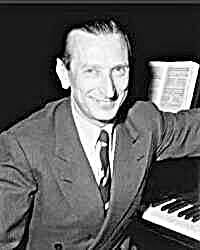
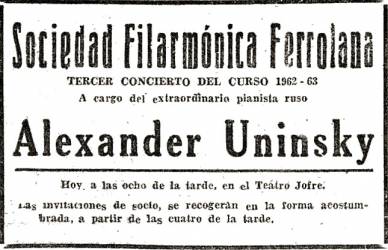
An enthusiastic article written by Java of El Correo Gallego looks forward to the visit of renowned pianist Alexander Uninsky (above) on Thursday the 17th.
Alexandre (sic) Uninsky. Russian pianist. He comes to El Ferrol when his fame is universal. He is a piano virtuoso. The dexterity of the fingers is beyond comprehension...His recitals arouse profound amazement...He earns first prize in 1924 at the Paris Conservatory...He wins the Chopin Award in 1932 in Poland...Uninsky has officially studied at the Kiev Conservatory; these are his first steps and his first triumphs. Triumphs with the highest credentials. This is the pianist whom Ferrolians will be lucky enough to hear...El Ferrol must don gala attire and fill the theater to capacity to hear such an admirable and admired artist. |
| 13. | In a charity drive dubbed "Operation Stogie" Ferrolians donated the record amount of 4,876 cigarettes and 303.55 Pesetas to buy tobacco for the "dear old men" in the Seniors Retirement Home, with the express aim of "gladdening the final days of these lives drawing to a close." The response of Ferrolians to the campaign demonstrated "what a large dose of charity Ferrol has for the weakest and most defenceless, like the 'dear old men' and the children." |
| 16. |
López Ramón the mayor of Ferrol inspected the construction of the city's future reservoir, Las Forcadas, and affirmed that by the summer of 1964 Ferrol will have a daily water supply of 84,000 cubic meters. Typo in the movie listings. House: Atenas. Movie: Romeo and Juliette. Moral guide rating: For persons more than 83 years old. |
| 17. |
The reservoir of the water fountain in Plaza de España had iced over when checked at 7:00 AM. The Vigo-based newspaper, El Pueblo Gallego, published a short note on Alexander Uninsky's concert at Teatro Jofre. Oddly enough the Ferrol edition of El Correo Gallego printed nothing on the matter. Apparently Uninsky played pieces of Scarlatti, Schumann, Bach and Mussorgsky, and the evening was a "great success." |
| 19. | Toxos E Froles (Gorses and Flowers) awarded the choir's gold medal to its hoariest member, José Area Corregada, at a festival in Xuvia, 4 kilometers from Ferrol. |
| 20. |
The university minstrels of A Coruña, "Spanish TV champions of 1961," performed at noon in Teatro Jofre. Five minors were arrested for breaking and entering a bookshop at 11:00 PM where they stole items valued at 1,500 Pesetas. The culprits were detained two hours later. |
| 23. |
An article by Java dwells on the figure of magician José Lorente de Castro (see the "JOSÉ LORENTE REPORTS FROM ISRAEL" section found in Chapter 10, "Bazan Magazine for the Year 1958").
Java also happened to be a primary school teacher who remembers Lorente as a "very intelligent" child skilled in Accounting and Mathematics. The columnist then summarizes Lorente's curriculum vitae, At age fourteen he qualified for an administrative assistant position in Bazan... At age 22 he earns first prize in 1949 at the Magic Congress of Barcelona... In 1955 the duo L'Orc y Juli tours Madrid, France, Portugal, Switzerland and the Middle East... King Hussein and the royal court applaud him... He hops from one country to the next and, someone says, Lorente uses a Damascus carpet for vehicle... They return home every year. They are here with us already. We hope to see them perform.Fun Corner. A professor lectures on the superiority of Man over Woman, and a female student interrupts him. "Surely you will not deny that God created Man first." "Professor, I too start doing my homework on a blotter." |
| 24. |
The same dog bit two women and a man in separate incidents. A minor stole a motorcycle; the owner found him casually sitting on it. |
| 25. | Usual projection of a movie in the High School auditorium on Sunday the 27th at 11:30 AM. |
| 26. | Three documentary films kindly ceded by the Austrian National Office of Tourism will be shown tonight at 8:15 PM in the local hall of Guardia de Franco. Their titles are, "Luminous Mountains," "Season In Carinthia" and "Summer Trip Across Austria." |
| 29. | British general cargo ship Silver Comet entered port for repairs on its voyage from the Canary Islands to England. |
| 30. | To mark the birthdate tomorrow of Concepción Arenal, after whom the High School is named, the film, La Gran Prueba (original title: Friendly Persuasion) will be shown in the school's auditorium. Starring Gary Cooper. Reel time is 7:45 PM. |
| 31. |
Due to a broken water pipe service to Ferrol halted at 1:00 PM. After intense repair work the flow of water was restored for one hour from 9:30 to 10:30 PM. Several minors caught yet again breaking and entering (a drugstore this time) will be interned in a Reformatory. |
New railway station |
| 1. |
An article by Marius of El Correo Gallego blames the occurrence of serial thieving minors on the influence of foreign movies that portray rebellious youth as heroes, and on the influence of sociologists, educators and thinkers of other countries who construe the rebellion of youth as a reaction to the lack of freedom and excessive discipline at home.
The sociologists and educators of such countries have sown the seed of the most despicable type of literature and of the most stupid cinema that the seventh art has produced since the epoch of Francesca Bertini. The evil is that here—with the ambition of keeping up to date—that mawkish drivel gets translated and our movie screens project from time to time the story of the "misunderstood" juvenile delinquent living in a perfectly bourgeois and respectable home.The Philharmonic Society of Ferrol announces its next musical event: Montserrat Caballé accompanied by the pianist Pedro Vallribera will give a recital at Teatro Jofre next Thursday the 7th. Caballé has sung in Vienna, Florence, Milan, Amsterdam, Lisbon, Cologne, Hamburg, and is the first soprano of the Bremen Opera since 1959. |
| 2. |
Snow overnight. Minimum temperature: 0°C. Maximum: 2.6°C.
At midmorning on Friday (February 1) some snowflakes fell mixed with rain; not many, perhaps twenty or thirty. I took a hand out of the pocket and exposed it to the air, palm up, while I walked on Canalejas Street. Five minutes on, I gathered three snowflakes: two relatively bulky, the third one not worth much really. But I hastened to a doorway and observed them earnestly. They were very pretty. I could then apprehend the sentiments of dreamy souls even though the snowflake crop was not plentiful. Some time later it snowed shyly again. But during the overnight from Friday to Saturday the matter became frankly important and come morning the city dawned covered with the typical wintry kerchief. |
| 3. | Morning game in Bazan's court corresponding to the Second Division of the Spanish Basketball League. Final score: Bazan 64, Bosco de Vigo 44. Pardo was the star of the match. Enthusiastic fans on hand and lots of nervous excitement. |
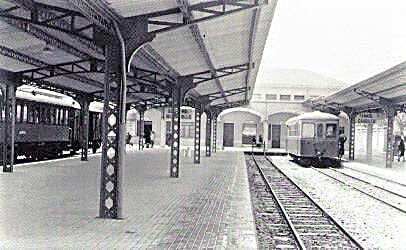
| 10. | The minister of Public Works arrived by train at 12:00 noon to inaugurate the new railway station (above). He came accompanied by the director-general of the Spanish railways, the director-general of Hydraulic Works, the director-general of Ports and other government bureaucrats. He was greeted at the station by the mayors of Ferrol, A Coruña and twelve small municipalities, by the captain general of the maritime department, the captain general of the eighth military region, the civil governor, the bishop and other top officials. After the bishop blessed the station, the official party drove to City Hall amid the constant acclamation of the numerous public lining the route. The minister spoke a few words from the balcony to an enthusiastic crowd filling the square. Indoors a glass of Spanish wine was served. Next the group headed to a luncheon at the Grand Hotel of Tourism. Over coffee the mayor praised the minister and offered him a small present. The party drove to the new Forcadas Reservoir in the afternoon. This dam will guarantee the city's water supply finally. The minister attended Sunday Mass at 7:30 PM and went afterward to a private dinner hosted by the captain general of the maritime department. He left the city on Monday. |
| 14. |
Bachelor of Philosophy and Letters Camilo Fernández gave a lecture at 8:00 PM in the salons of Círculo Mercantil e Industrial on the topic, "Tragedy, destiny and restoration of the Jewish people." A "numerous public" was in attendance. The president of the Society introduced the speaker and Mr. Fernández then proceeded to unfold his lecture in an "easygoing and brilliant fashion." At its conclusion the dissertation garnered "a great round of applause" from the audience. Work has started in the construction of a restaurant at Copacabana Beach. Manuel Pérez de Arévalo (see January 1) wrote a lengthy article in El Correo Gallego entitled, "The voice of Montserrat Caballé at Teatro Jofre," reminiscing about the soprano's recital of February 7. He appraised Caballé's "beautiful voice" to be ideally suited for the soothing lullaby, for the nostalgic lied that evokes past loves, but also for the potent, heart-rending operatic aria. Her perfect enunciation transformed a harsh language like German into the perfect vehicle for expressing a beautiful sentiment. Caballé interpreted compositions of Mozart, Schubert, Strauss, Guridí, Rodrigo and Granados. In particular she gave an encore of Rodrigo's De Los Álamos Vengo. The concert closed with a bonus song from Madama Butterfly and another from Manon. Pedro Vallribera at the piano was the perfect gentleman, denying himself to let his professional partner shine even though he has enough talent to perform solo. Fun Corner. Scottish joke. A Scotsman spends his holidays in the countryside. One evening he is caught outdoors too late so he opts, with great sorrow, to take a taxi ride back to the inn. The cab starts off but the driver suddenly notices that the brakes are seizing up. The car whisks past the inn and the driver screams, "My brakes have failed! We are going to crash unless God helps us! I don't know what to do!" "Well, for starters," replies the Scotsman, "please stop the meter." |
| 15. |
The commandant of Ferrol's maritime province has banned the harvesting of Palourde clams, pullet carpet shells, venus clams, common cockles, variegated scallops and St. James shells between March 1 and October 31. Teatro Jofre was showing the 1961 Western comedy, The Second Time Around, which in Spain carried the disjointed title, Sola Ante El Peligro (Alone In The Face of Danger). This movie had a "moral guide" rating of 3 (on a scale of 1 to 4). This meant the movie was suitable for adults only. The Forcadas Reservoir is expected to be completed by the summer of 1964. The current pace of construction is brisk. Two shifts work day and night. A lengthy article on page 5 of El Correo Gallego, Ferrol edition, furnished many technical details about the Forcadas Reservoir project. 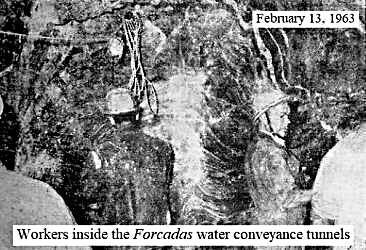
The gravity dam will be 18 meters high, 180 meters wide and its toe 15 meters thick. It will impound more than 7,000,000 cubic meters of water from the Arcadas River in the municipality of Valdoviño. The spillway channel water will be piped through underground tunnels (photograph on the left) to a treatment plant located eight kilometers away in Catabois. The treatment plant will have four storage tanks with 40,000 metric tons total capacity. A flocculation tank will add aluminum sulfate to the water to trigger the coagulation of microscopic impurities. Those coagulants plus other solid particles will next settle to the bottom of a sedimentation tank. Dirt-free liquid near the surface will go to a filtration tank where chlorination and other chemicals sterilize the water. "The water treatment plant uses the most modern technology; the filters it requires can be cleaned frequently and easily." The Forcadas project guarantees a daily supply of 350 litres per person for an overall consumer base of more than 200,000 people. Other News. Radio Ferrol will soon be broadcasting a musical scripted by the president of "Toxos E Froles" entitled, "Figueiral Figueirido," which verses on the late eighth-century legend of five brothers who rescued their sisters from Moorish kidnappers in the parish of Figueroa. |
| 16. |
Today at 8:00 PM Deputy Mayor Manuel Pérez de Arévalo will propound his own philosophical theory of Art in a conference entitled, "The temporal evolution of the arts' perspective down through the ages," at the Delegación Provincial de Información y Turismo in Corunna. This evening at 8:30 PM Bazan hosts the game between Concepción Arenal and Orense C.B. corresponding to the Second Division of the Spanish Basketball League. Meantime Bazan's team travels to Vigo this afternoon and plays Estudiantes tomorrow (score: Estudiantes 76, Bazan 41). Next Monday the 18th at 8:15 PM the High School will show four industrial films kindly ceded by the Italian Institute of Culture in Madrid. Ferrol 40 Years Ago. February 16, 1923. Ferrol's British colony will pay homage tonight to Mr. Spiers the engineer and director of the dockyard. The venue is the British School, situated near the Central Market. Many British citizens plan to attend to show their respect and appreciation to Mr. Spiers. |
| 18. | Grassroots soccer: Galicia de Mugardos 2, Canido de Ferrol 1. "The great rivalry made the match very interesting." |
| 19. | The noise made by a dawn thunderstorm awoke many people. A lightning bolt entered a house through its TV antenna, shattered window panes and charred wall tiles in the kitchen, but nobody was hurt. |
| 21. |
"Toxos E Froles" calls on Ferrolian youth to join the choir or any other chapter of its activities.
Paris of El Correo Gallego interviewed on page 4 a Ferrolian emigrant to Switzerland who happened to be in town, Pedro Arnosi Díaz. In March 1962 Díaz solicited a job in Switzerland through the auspices of the Spanish Delegación de Emigración in Corunna and two months later he went to work in a Swiss farm. Two hundred other Spanish emigrants to Switzerland boarded his train during the journey from Ferrol to Barcelona. All had a farm hand contract. The destination of Díaz and four other Spaniards was Sion. There he worked ten hours daily in a vineyard. 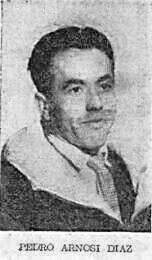
"I believe we had a bit of luck, other Spaniards work as much as sixteen hours a day, holidays included. That depends on who your boss is." "What was your salary?" "We were paid 250 Swiss francs in hand per month. The lodgings and board allowances, the accident and illness insurance, amounting to an additional 150 Swiss francs a month, were payable by the employer; the community and cantonal taxes, amounting to 16 Swiss francs, were payable by the employee." "Do you continue to work on a farm?" "No. I was able to switch over to construction work, the contracts here are six or seven months long. I went to a little town named Flanthey, about 10 kilometers from Sion. My lot improved substantially, for I am paid 750 Swiss francs per month, which enabled me to buy a scooter and a photographic camera." "Is life in Switzerland boring for a Spaniard?" "I'll speak for myself. I work from 7:00 AM to 12:00 noon and from 1:00 PM to 6:00 PM. I work Saturday mornings and once in a while afternoons. Initially life is boring. Now I attend an academy to learn French, for both Sion and Flanthey are located in the area of that language. I am literate enough to have Swiss friends who, by the way, treat me marvelously." |
| 23. |
A German training flotilla of seven warships, five corvettes and two frigates, is expected in port March 11-13. A neighbour of Plaza de España complains about the noise made by motorcycles in the early morning. Alarm clock. "You can not oversleep in El Ferrol. And what ire this provokes when it happens! We wake you up by turns in this City. First a duet of sirens every ten minutes. And if you are still sleeping, the shot of a cannon at 8:00 AM. More breaks may not be had" (Java. El Correo Gallego, page 5). |
| 28. | The common spider crab was plentiful in the bay of Ferrol this past season. Between November 25, 1962, and January 31, 1963, a fisherman and his family caught more than 1,000 specimens. The crabs' size and weight drew the attention of everyone who saw and ate them. |
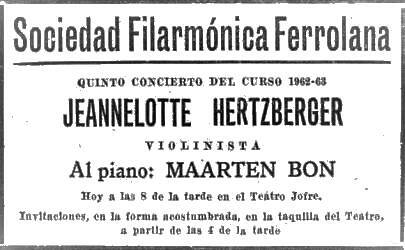
| 1. |
The Philharmonic Society of Ferrol announces its next musical event. Jeannelotte Hertzberger accompanied by pianist Maarten Bon will give a recital in Teatro Jofre next Friday the 8th. At the Seniors Retirement Home (formerly Destitute Seniors Home) a second elevator, donated by the Ministry of Gobernance, will go into service this Sunday March 3 at 1:00 PM. The bishop and local authorities will preside the inauguration. The home's first elevator was donated by Ferrol's Credit Union. |
| 2. | Street Notes. There was considerable buzz in the harbour district upon the arrival of a German vessel. "They are German," said a stander-by. "No, they are English," replied another. The truth is they were German, and when they passed through Customs it caused a certain uproar. Many curious neighbours massed about to see what was happening. In fact, nothing at all. What happened was that the Customs officers and the foreigners did not understand each other. The first ones didn't know German and the second ones Spanish. But how many curious bystanders. Even Mugardos heard the news. Note: Mugardos: a village across the bay from Ferrol (End of Note). |
| 3. |
Great expectation ahead of this afternoon's Third Division soccer game, Arsenal vs. Ferrol. Most fans predict a green-jersey win (score: Arsenal 1, Ferrol 2). Basketball: today at noon Ferrol's Concepción Arenal plays Ourense's Iris in Bazan's court (score: Concepción Arenal 52, Iris 33). |
| 5. | High School third-year student Eduardo González aced the air carbine category at the Provincial Student Shooting Championships. His tally: 15 shots, 145 points. |
| 6. | After several days of hype the movie house Capitol debuted the 1962 drama, Walk On The Wild Side, which in Spain bore the disjointed title, La Gata Negra (The Black Queen). |
| 7. |
The Chess Club informs that this Sunday March 10 at 11:00 AM former Galician champion José Alonso Leira (see July 1954) will play a simultaneous exhibition of fifteen boards at the club's locale, Café Bar Moderno. Every club member is invited to take part. More simuls are in store next month with former Spanish chess runner up Rodrigo Rodríguez as the exhibitor (photograph of the Sunday March 24 exhibition). Strong wind at night uprooted an old eucalyptus tree in the Municipal Park, toppled plywood fence panels, shattered window panes and tore off roof tiles in several houses. Town Hall convenes a photography contest for the acquisition of ten photographs destined for the Ministry of Tourism and Information in Madrid. |
| 8. |
An article written by Java of El Correo Gallego covers the Philharmonic Society's fifth concert, violinist Jeannelotte Hertzberger and pianist Maarten Bon, scheduled for tonight in Teatro Jofre at 8:00 PM. The musical duo is also a couple that married in 1959. Jeannelotte was born in Amsterdam in 1935. She formed part of Szymon Goldberg's chamber orchestra during five years. Later she studied in Paris under the direction of renowned violinist René Benedetti. In 1961 she earned the Excellence Prize at the Dutch Violinists Competition convened by the International Cultural Centre of Amsterdam, and in 1962 the Manolo Quiroga Award in the International Violin Competition summoned by the Ourense Conservatory of Music.
Tonight's concert program is: Bach: Sonata for Violin and Piano in A major. Mozart: Piano Sonata No. 6 in D major. Brahms: Scherzo from F.A.E. Sonata. César Franck: Sonata for Violin and Piano in A major. Stravinsky: Ballad and Russian Song. Tomorrow at 7:30 PM the basketball court of Bazan will host the game between Ferrolian rivals Bazán and Concepción Arenal.An eight-year-old girl was struck on her right heel by an air gun pellet. |
| 9. |
A 45-year-old man and a woman suffered serious head or knee injuries in separate incidents after falling on the pavement due to the sidewalks' disrepair; both were treated at the Emergency Clinic. Note: This is still a problem in certain parts of the city (End of Note). A 51-year-old man was found dead at 10:00 AM in his establishment, throat slit. The circumstances of his death are unknown. |
| 10. |
Yesterday's heavy rain pooled deep in a construction site opposite the house where I, my two brothers and parents dwelled. Our address was Rochel Street, number 5, 1st floor.
The depth of the rainwater pond was so remarkable that FOTO ARJO took a photograph of the spectacle (below, right) and inadvertently took a picture of the flat where we dwelled (yellow arrow). My parents' bedroom faced the street and had three hung windows clearly visible on the photograph. The flat had an attic as well; my Dad set up a makeshift drafting table there. The ground floor was occupied by a tiny shoe store. Note: My oldest brother has corrected and added to my initial description (End of Note) 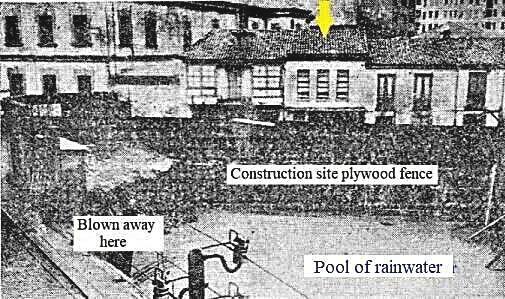
The ground floor of the house to our left in the photograph was a bar named "El Ariete" (I could be mistaken) which attracted many flies particularly during warm weather. Then they spilled over into our flat. Housefly sticky catcher tape was our response. The bar's owner was also our landlord. He and his sister lived in the house immediately to the right from the photograph's perspective; they had a big hunting dog, white, shaggy, advanced in years, named "Bren." In the next house down the street there lived a family whose patriarch had been repressed after the outbreak of the Spanish Civil War. At the top of our street loomed an old Army sappers' garrison, clearly visible, which sometimes doubled as a prison. A field of orchards spread out behind the row of houses lining the street; there were family vegetable gardens, an apple tree, a pear tree and a lemon tree. I remember a tall tree directly behind our house; its upper foliage is visible on the photograph. Out of the flooded construction site eventually emerged this building, but I was not around when that happened. |
| 12. | Fun Corner. A passerby on a deserted Chicago street is approached by a stranger. "Excuse me," says the stranger, "have you seen a policeman around here?" "No. Now that I think about it, I haven't seen one for quite a while. Is something wrong?" "Well...if you hand over your watch and wallet without any trouble everything will be all right." |
| 13. | The German flotilla that arrived from Gibraltar on Monday the 11th departed at 6:30 PM bound for Portsmouth. Many onlookers watched its parting. |
| 14. | Ferrol 40 Years Ago. March 14, 1923. The British viceconsul in the city has received an official notice that on the 24th of this month will arrive to Ferrol a Royal Navy squadron of four cruisers. Note: In fact five cruisers arrived on the 25th (End of Note). |
| 19. | To commemorate today's feast of St. Joseph, patron saint of the Seniors Retirement Home, an "extraordinary" meal will be served in the institution's dining-hall at 12:00 noon. Local authorities will be present. |
| 21. | A 27-year-old man was treated at the Emergency Clinic after receiving an axe blow when he tried to separate two men fighting. |
| 25. |
Ferrol 40 Years Ago. Sunday March 25, 1923. A Royal Navy division of five cruisers arrived at 3:30 PM. The cruisers are named Delhi, "Dusidier" (sic) "Sampson" (sic) "Drapent" (sic) and Dragon. Corrections: After doing peripheral research I suggest that the warships were most likely named Danae, Dauntless, Delhi, Dragon and Dunedin, members of the Danae or D-class light cruisers. "Sampson" was not the name of a cruiser but the surname of Sir Hubert Brand's personal secretary and paymaster, lieutenant-commander L. N. Sampson, M.V.O., O.B.E. (End of Corrections).
The commander of the division is Rear-Admiral Sir Hubert "Damp" (sic). Correction: Sir Hubert Brand, left portrait (End of Correction). The vessel captains are "Drovers" (sic) "Campbell" (sic) "Smuhct" (sic) "Ernert" (sic) and "Groven" (sic). Note: The names given are unreliable. According to the officer list provided on page 2 of issue 17338 of the New Zealander newspaper, "Star," dated May 1, 1924, the captain of H.M.S. Delhi was James M. Pipon and the captain of H.M.S. Dragon was Bernard W. M. Fairbairn (End of Note). Several fêtes are being prepared to honour the crews. The warships will depart on Wednesday March 28, 1923. |
| 27. |
Film-Club members are reminded that the movie El Puente (1959, Bernhard Wicki) will be shown in the High School auditorium at 8:00 PM this evening. Big ads in the newspaper inform that Pan Piana shops will start selling cartons of pasteurized milk on April 1. Reservations may be made. The brand is Leyma. Ferrol 40 Years Ago. March 27, 1923. The British viceconsul regaled the admiral, commanders and officers of the light cruisers in port with a luncheon at Hotel Suízo. An orchestra played the Spanish and British national anthems initially and provided musical accompaniment. During the function a British officer interpreted several English and Spanish songs at the piano. In the evening the British colony offered a party to the ships' crews in the locale of the British School. Mr. Spiers the engineer and director of Constructora Naval (which subsequently became Empresa Nacional Bazán) presided over the festivities. The water supply was shut off between 3:00 PM and 9:00 PM to enable the annual cleaning of the municipal water storage tanks. Street Notes. The municipal fire truck rushed to douse a small chimney fire in the harbour district around 7:00 PM, but the hydrant's insufficient water pressure and the lack of a fire engine made the firefighters' presence useless. "Can we imagine a fire much bigger than the flare-up of a chimney? It's better not to." |
| 28. | Nine-year-old boy was run over by a motorcycle. |
| 29. | The Philharmonic Society of Ferrol publicized tonight's sixth concert of the 1962-63 season, Prague's "Nonetto Checo," a musical group of nine professors which has offered concerts in England, Scotland, Belgium, Austria, Italy, Switzerland, Spain, Germany, Poland and the U.S.S.R. Tonight's program is Beethoven: Septet, Iša Krejcí: Divertimento, and Spohr: Grand Nonet. Venue and concert time are the customary Teatro Jofre and 8:00 PM. |
| 4. |
Ferrol's first official chess tournament opened in the salons of Casino Ferrolano (C.F. below) with the participation of two casino members, two Navy, two Círculo Mercantil (C.M. below), one Bazán and three Círculo Ferrolano de Ajedrez (C.F.A. below). Note: The ASCII 35 symbol (#) below is shorthand for "checkmate" in chess notation (End of Note).
The initial round ended as follows. Alonso (C.F.) # Pita (Navy) Segura (Bazán) # Lago (C.M.) Hermida (Navy) # Amador (C.F.) The match between Rodrigo (C.F.A.) and Mera (C.M.) was postponed. Rey Alonso (C.F.A.) # Balbino (C.F.A.) |
| 9. | An unidentified "75-year-old man" (sic) was found dead on the pavement near Teatro Jofre at 2:00 AM. Beside the corpse were found a small wallet with no I.D., a small keychain and a 9mm semiautomatic pistol. On April 12 El Correo Gallego reported that the police investigation revealed the man had on the 7th and 8th been visiting a deaf-and-dumb recruit undergoing the pre-enrolment physical exam at Navy Hospital and that around 11:00 PM on the 8th he was in a cafe-bar near Teatro Jofre where he volunteered that he had come to resolve a matter with the Navy which concerned a relative of his. On April 14 El Correo Gallego reported the dead man was a 55-year-old out-of-towner, unemployed, without fixed address. |
| 10. | Two children, three and five years old, were bitten by dogs and treated at the Emergency Clinic. |
| 11. |
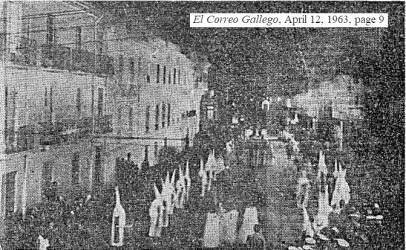
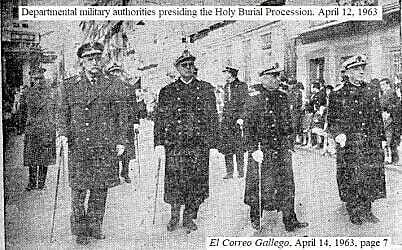
Radio Ferrol will cease broadcasting from today Holy Thursday until Sunday April 14 when it will return to the airwaves. Five of Ferrol's eight movie houses followed suit. Jofre, Avenida, Renacimiento, Callao and Madrid-Paris closed their doors until Sunday. The three movie houses that remained open projected religious films. Capitol: Teresa de Jesús. Cinema: María Magdalena. Atenas: Las Rosas del Milagro. Town Hall bans downtown traffic from 10:00 AM on Holy Friday, official vehicles are exempt. |
| 13. | No newspapers on sale today. |
| 16. |
The High School announces two public conferences. On April 22 Dr. Casanova, physics professor at Santiago de Compostela University, will deliver the talk, "Inside the Atom," and on April 23 the seminar, "Biological Effects of Nuclear Radiation." Both dissertations are scheduled for 8:00 PM in the High School auditorium. Eduardo González (see March 5) finished runner up for a third consecutive year at the Spanish Junior Shooting Championship, air carbine category. His tally lagged first place by just two points. Around 1:00 PM Navy and Infantry personnel discovered the corpse of a man around 40 years old washed up on Doniños Beach. On April 18 El Correo Gallego reported the corpse was that of a 38-year-old fisherman who on the 5th had been struck and thrust overboard by the boat's winch, both legs severed. |
| 21. | Ferrol's first official chess tournament ended with an award ceremony presided by the captain general of the Maritime Department and the presidents of Casino Ferrolano and Círculo Ferrolano de Ajedrez. Champion: Former Spanish runner up Rodrigo (C.F.A.) receives the Navy Cup and a commemorative medal. Runner up: Former Galician champion Alonso (C.F.) is awarded the Casino Cup. Third place: Mera (C.M.) receives a second Casino Cup. Fourth: Rey Alonso (C.F.A.) is awarded the Bazán Cup. Fifth, sixth, seventh and eighth place went to Hermida, Pita, Segura and Amador respectively. Lago and Balbino dropped out. |
| 22. | I received the gift of a book from the High School in the Day of the Book as a reward for my high marks in the preparatory school curriculum. Another five girls and five boys were similarly rewarded. My oldest brother was also presented with a book for his high marks in the high school curriculum. Here there were fifty-two other recipients, thirteen girls and thirty-nine boys. |
| 23. | An article written by Paris of El Correo Gallego laments the great disparity in the time display of four public clocks. In the afternoon of Sunday the 21st the clock in the foyer of the new railway station showed some minutes past 11:00 AM. A double-sided illuminated clock on the pedestrian access to the railway station showed 4:07 PM on one side and 11:42 AM on the other. Paris writes, "I went to check the time displayed by the Credit Union and that clock marked 8:45 PM." Note: The Credit Union's public clock is evident on the 1965 postcard of Chapter 5, "Glimpses of the Ferrol That Was" (End of Note). |
| 25. | U.S. Ambassador "Roberto Wootward" (sic) visited the city accompanied by the American consul general in Vigo. Correction: Robert F. Woodward (End of Correction). |
| 26. |
Big advertisement on page 8 informs that Cuban-Spanish singer Antonio Machín will be in Ferrol next Tuesday the 30th in Teatro Jofre with his "Show 1963," starring Spanish songstress Antoñita Andalucía, various other artists and "the special collaboration" of Henry the twist's devil. Town Hall orders all retailers in possession of alcoholic drinks or vinegars manufactured by three Galician distillers to notify the local authorities immediately. |
| 27. | Fun Corner. Persuasive Notice. Signboard placed at an ammunitions depot: "Smoking prohibited. Violators should be prepared to exit the premises through the automatic aperture in the ceiling." |
| 28. | Growing public alarm at the rising number of fatalities across Galicia (fourteen) caused by the "drink of death" (alcoholic beverages doctored with methyl alcohol). Four Ferrolian retailers guaranteed on pages 6-7 the purity of their merchandise: José Mateo e Hijos, S.L., Bodegas Villanueva, Destilerías Rafael González Campo and Vinos Ceniza y Compañía. No victims of methyl alcohol poisoning are reported in Ferrol. |

| 4. |
The P.Y.S.B.E. codder "Tornado" is expected to return today from the Banks of Newfoundland. Emma Orro will be Ferrol's representative tonight at the Miss Galicia Contest in Ourense. Kinso of El Correo Gallego interviewed her on page nine. Speculation: "Orro" is a very odd surname; it occurs in a fringe area of Galicia and in the Balearic Islands. It is non-existent in the rest of mainland Spain. According to this webpage, accessed on Wednesday March 8, 2023, only 208 Galicians living on or near the northern stretch of the Coast of Death carry it. My proposition is that "Orro" is a Spanish transliteration of the Scottish/Irish surname, "Orr," and that it originated sometime in the past with a Scottish/Irish sailor who landed or was rescued along that seashore (End of Speculation). "Were you born in Ferrol?" "Yes." "How long ago?" "Nineteen years ago." 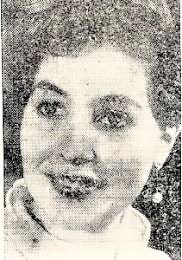
"Have you ever been in love?" "I haven't had the time yet." "What have you done until now?" "Study." "Do you like to cook?" "I love it." "Do you consider yourself Ferrol's prettiest girl?" "Not at all." "Yet they selected you." "The jury has been very gallant. Ferrol has very pretty girls." "You are no flimflam for sure. Are you heading to Orense with high hopes?" "Of course. It's only natural for youth to have high hopes." "Do you believe they will crown you 'Miss Galicia'?" "That's harder to say." "Are you afraid of the other contestants?" "They are all very pretty." "Are you spooked?" "Just a little nervous. This experience is so unusual for me." "Do your friends look at you with 'envy'?" "I don't think so." "What do men say to you?" "What men usually do." "That's not strange. Do you ponder getting married?" "Naturally." "Now that you have become the officially pretty one, do you have more suitors?" "Don't you believe it." "Some men are foolish..." "Besides studying and cooking, what other hobbies do you have?" "I read a lot; I go to the movies frequently; I like dancing..." "Do you practise any sport?" "Swimming." "Are you a soccer fan?" "No." "Would you accept a proposition to go work in the movie business or in television?" "I would have to give it a lot of thought." "Does the prospect not entice you?" "I would rather be a model." "That would not be too difficult for you" (End of Interview). Other News. The Land Use Agency of the Ministry of Housing publishes the third phase of the expropriations project for the urbanization of the Caranza outlands (page 4 of El Correo Gallego).Teatro Jofre shows the film, La Reina del Chantecler, starring Sara Montiel. "It's the hit movie that beats all records." Showtimes: 5:30 PM, 8:00 PM and 10:30 PM. This movie had a "moral guide" rating of 3-R (on a scale of 1 to 4). This meant that the movie, suitable for adults only, contained censurable material. Capitol movie house shows the film, El Día Mas Largo (The Longest Day). "Our customers proclaim the exceptional quality of this grandiose super production." Showtimes: 4:00 PM, 7:00 PM and 10:30 PM. This movie had a "moral guide" rating of 2, suitable for youth but not for children. "Kron" Circus, installed in Plaza de Sevilla, debuts today. Newspaper ad promises wild animals, clowns and a "wise elephant." |
| 5. |
The festivities programmed for the neighbourhood of Canido in honour of the Holy Cross are:
12:00 noon. The first ever official walkathon of Canido. 3:00 PM. Basketball game at Canido's city gate (photograph on the left). 5:00 PM. Pole climbing and children's games in the stone-cross square. 6:30 PM. A great party for children at the same location. 10:30 PM. Dancing party in the city gate with an "infinity" of fireworks. Java of El Correo Gallego dedicates a long article to Canido, the neighbourhood of his birth. The district has "progressed a lot." Now it has an orphanage, a kindergarden and a shelter for abandoned babies; these three centers are run by nuns. It has the Seniors Retirement Home, an institution "coddled" by Ferrolians, where "peace and relaxation reign; it is a place of rest for a life of hard work without the hope of weal"; this institution is also run by nuns. Next Java loiters by the old Canido cemetery, shut down eighteen years prior but still standing, and he writes, "A tear for the dead evaporates." "A flower on their tomb withers." "A prayer for their soul is entertained by God." Three phrases engraved on the wall of the doomed Cemetery. Your tardy agony fills us with distress. We see you in ruins.Other News. "Kron" Circus showtimes today are 4:30 PM, 7:30 PM and 10:30 PM. Tomorrow Monday two shows and good-bye. Regional Dairy Cooperative Castro advertises its pasteurized milk sold exclusively in Pan Piana shops. Daughters of Mary School pupils advertise their charity food fair. Proceeds will go "directly" to Roman Catholic missions overseas. Emma Orro, Miss Ferrol, was crowned "Miss Galicia" in Ourense despite the initial rebuff of the audience. |
| 8. | Installation of the summertime charity raffle stand has commenced on the usual spot in the downtown gardens. |
| 9. |
The city will have a Girls High School, which is not, as many believe, the one currently flanking the Boys High School but a brand new building on a separate site. Note: The Girls High School, today's Sofía Casanova High School, opened its doors in January 1967 (End of Note). Big ad on page 8 informs that Manolo Escobar will perform for one day only. Teatro Jofre, 7:45 PM and 11:00 PM. |
| 10. |
Town Hall publishes a list of vinegar manufacturers whose products were adulterated with methyl alcohol.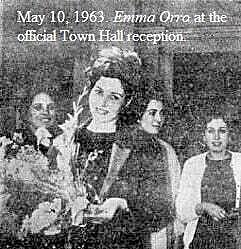
Representatives of the warehouses and makers of alcoholic drinks in Ferrol and county travelled yesterday to La Coruña for a general discussion on the loss of public confidence provoked by the spate of methyl alcohol fatalities. An official Town Hall reception was given at 1:00 PM to Emma Orro, Miss Ferrol and Miss Galicia (photograph to the right). On the 22nd she will compete for the "Miss Spain" title in Palma de Mallorca. Java on page 9 of El Correo Gallego interviewed a roving street seller of clay water jugs, lidded pots, bottles and flower vases. The merchant and his donkey had paused to take a break by Plaza de Amboage (below, right). "Your name?" "Agustín Guillén Ramos." 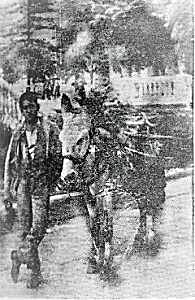
"Where are you from?" "From Salvatierra de los Barros in Badajoz (Province)." "How is business?" "I don't know what's happening, the business is faltering and getting tougher every time." "How much do the clay water jugs sell for?" "From 20 to 25 Pesetas." "Properties?" "Keeps the water fresh. It's a traditional product very much appreciated in other places. And it's aseptic." "Is it true that a small pony shot of firewater or anisette should be poured in before using?" "Those customs haven't harmed anyone to date, but the best precaution is to wash it beforehand." "Are you married?" "Yes, three months ago." "Is your wife with you?" "Not feasible, if only I could! But one has to earn dough." "Have you interrupted your honeymoon then?" "Couldn't be helped! I left in April and won't return until the last days of August." "How long do you stay in Ferrol?" "Usually between ten and twenty days." "Does the donkey have a name?" "Sevillano." "Its daily fare?" "Three kilograms of barley." "In Pesetas?" "Twenty-five." "Do you plan on having many children?" "Eighteen at least. Of course you will realize that such a question..." (End of Interview). And Java appends: I stood there looking at him, he was right answering as he did. "What questions you ask indeed, friend!," I told myself.Other News. Círculo Mercantil e Industrial is preparing a special vigil for Friday the 17th in order to commemorate the centenary of the publication of Rosalía de Castro's volume of poetry, Cantares Gallegos. The vigil will "exalt" the figure of "our most excellent poetess." Late in the afternoon a 32-year-old woman attempted suicide by throwing herself in front of a passing train on this railway bridge. The train severed her legs and she was taken in critical condition to Charity Hospital. |
| 11. |
The chorale Toxos E Froles will give a special performance tomorrow Sunday at the Seniors Retirement Home to commemorate "the 100th anniversary" (sic) of the Congregation of Sisters of Abandoned Seniors. Note: The website states that the mission of caring for abandoned seniors started in 1873 (End of Note). Tonight in the Municipal Park at 11:00 PM the first spring festival will honour "Miss Galicia 1963." A three-year-old boy was treated in the Emergency Clinic after imbibing bleach at home. |
| 12. |
Town Hall issues a warning to all property owners whose façade is left in disrepair that they will be sanctioned "severely" after a grace period of twenty working days. Fun Corner. A truck has just side-impacted a car. The policeman shows up. "Mr. Officer," says the truck driver, "the accident was unavoidable." "Why?" "The lady driving the car signaled a left turn... and she did turn left!" |
| 14. |
The president and director of I Feria de Muestras del Noroeste de España (First Exhibition of the Northwest of Spain) has invited Galician winemakers and warehouses to make a public exhibition of their alcoholic products during the 21-day fair in the month of July. Ferrol 40 Years Ago. May 14, 1923. Rainy days over the past eleven months: *1922* June=13, July=15, August=12, September=16, October=17, November=12, December=17. *1923* January=14, February=22, March=16, April=27. Total: 181 rainy days, which explains why the "grand undertaking" of assembling Ferrol's water supply has suffered so many delays: the work is halted on rainy days. |
| 15. |
Paris of El Correo Gallego notes that some vendors of wine and vinegar have taken advantage of the methyl alcohol debacle to raise the price of guaranteed goods. The Círculo Mercantil e Industrial vigil scheduled for Friday the 17th will keep to the following program: 1. "Semblances of Rosalía and emotional exegesis of her works," by José María Pérez Parallé. 2. "Plastic Impressions," by Aurora Marín and María Elena Leonardo. 3. "Rosalian Recital," by Andrés Picallo Maceiras. 4. Galician Music Interlude, by the chorale Estrelecer. 5. "Tribute of the Song," by Ramón García Rey. |
| 16. |
Olympic Mariner the last of the "Onassis" oil tankers moored in our harbour for a very long time [since 1958] will be towed away to the port of Piraeus by the newly arrived Costas Vermacos. Notes: Those "Onassis" vessels are clearly seen in the Chapter 5 photograph, "The Harbour in the Year 1958." The May 18th newspaper edition correctly altered the tugboat's name from Costas Vermacos to Vernicos Costas. The tugboat was originally named, Flying Petrel (End of Notes). The chorale Toxos E Froles will take to Radio Ferrol's airwaves tomorrow at 7:30 PM to honour Galician Letters Day. This "extraordinary" broadcast will be bilingual. It will play out from the figure of "Sar's Muse" a semblance of Galicia's literary panorama with the recital of several Rosalian poems and the chorale's rendition of some like Alborada and Negra Sombra. Note: Sar's Muse is of course Rosalía de Castro the author of "On the Banks of the River Sar" (End of Note). 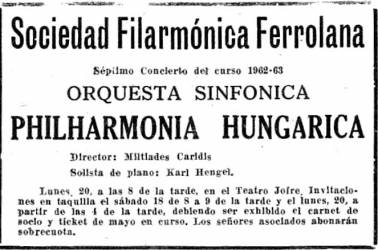
The Philharmonic Society of Ferrol closes its 1962-63 series of concerts next Monday the 20th at 8:00 PM in Teatro Jofre with Philharmonia Hungarica, Miltiades Caridis conducting and the renowned pianist Karl Engel as soloist. Philharmonia Hungarica's official program will be Béla Bartók's Hungarian Sketches, Schumann's Piano Concerto in A minor and Beethoven's Symphony No. 3, "Eroica". On page 9 Marius of El Correo Gallego interviews the director of Teatro Estudio, a troupe of High School alumni that engages in amateur theater. Last Saturday the 11th they put on Morris West's play, The Devil's Advocate, in the school's auditorium. "Satisfied with your The Devil's Advocate?" "Broadly speaking, I am satisfied with how the play came out. Personally speaking, it's a different matter." "You are not a novice in these pickles..." "No. Prior to this I directed The Living Room and aforetime I collaborated with Juan Antonio Blanco in directing The Glass Menagerie." "Give me the name of an actor or actress whom you are proudest of as a director." "I could give you many names. The truth is that everyone without exception worked stupendously. Everyone." 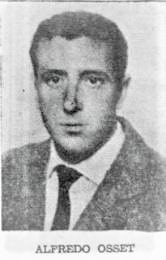
"Experienced amateurs?" "Not at all. Except for two or three everybody else stepped on a stage for the first time last Saturday." "Amazing. Did The Devil's Advocate cause you a lot of headaches?" "It's a difficult play, especially regarding its management. You probably observed the string of technical difficulties that cropped up irreparably and which we overcame despite the reduced amount of room on stage. Nevertheless the effort was worthwhile because the play is an exceptional comedy." "Tell me, Osset. Would you like to retain a large troupe without substitutes due to force majeure?" "Here in Ferrol that's almost impossible. It'd be ideal, of course. This city enjoys one advantage: willy-nilly appear always boys and girls with positive theatrical talent. In this, as in many other things, Ferrol is surprising. Anyway yes, I would like to rely on a stable troupe. It's the only way to do positive theatrical work." "Can it be done here?" "Naturally. I am sure of it." "What are the future plans of Teatro Estudio?" "To do theater. To continue doing theater for as long as we can. We try to chart a yearly work schedule. To date these things were handled somewhat helter-skelter. And we are also going to need the help of all Ferrolians in this undertaking. Especially of those who feel a firm bent for the theatrical adventure." "Will you then leave the tight space of the Institute's auditorium behind?" "Depends. If we accomplish what we pretend, why not?" "What is your next play?" "We don't know yet. I'd really like to stage Camus' Caligula, but usually we discuss beforehand the possibilities. We shall see." "Do you have confidence in the future of Teatro Estudio?" "Yes I do." |
| 17. |
Marius of El Correo Gallego explains in today's column entitled, "Día de las Letras Gallegas," (Galician Letters Day) that May 17 was designated for being the publication date in 1863 of the book of poems, Cantares Gallegos (Galician Songs).
Marius does not begrudge the almost exclusive focus of "the commemorative acts being celebrated today throughout the country's cities" on the figure of Rosalía de Castro because, he writes, she was "a great poetess whose verses have not relinquished their relevance nor will they ever do so," but future Galician Letters Day celebrations, he contends, must exalt the broader literature of the "Galician region" and not be just one more reason to remember the "extraordinary poetess alone." Galician Literature is fortunately for Galicians not Rosalía de Castro alone. In saying this we do not pretend to affirm that the birth of as outstanding a figure as the authoress of Follas Novas has not been a blessing. To deny her importance, not just in the region's literature but in Spain's or in the world's, would be ridiculous. Nevertheless Rosalía de Castro, though signifying a lot, is not everything. And there is an excessive zeal to circumscribe Galician poetry, and even what is not poetry, to the extraordinary figure of that woman. Marius goes on to reel off a list of Galicians who, he maintains, ought to be extolled in future Galician Letters dates: Mendiño, Martín Codax, Juan Rodríguez del Padrón, Benito Jerónimo Feijoo, Countess of Pardo Bazán, Manuel Curros Enríquez, Eduardo Pondal, Ramón María del Valle-Inclán, Julio Camba, Álvaro Cunqueiro, Vicente Risco, Aquilino Iglesia Alvariño. 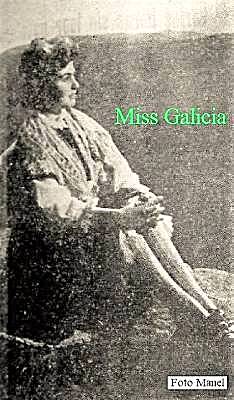
Marius ends his column thus, "With Rosalía, of course. She holds an important place in the country's literature. But she is not—fortunately, we repeat—the sole name with exclusive merits to be remembered on a date dedicated to Galician Letters." Note: Here is the list of people honoured on Galician Letters Day from 1963 to date (End of Note). El Correo Gallego carries on its back page an article written by Xan de Enfesta exclusively in the Galician language. The article entitled, "Ledicia, Memoria E Anceio," (Joy, Remembrance And Hope) informs that the Royal Galician Academy initiated the celebration of Galician Letters Day with the backing of the Ministry of Information and Tourism. The date chosen, May 17, "could not be more fitting historically and emotively," for it is the centenary of the publication of Rosalía de Castro's first book of poems, The acts of remembrance will start here in Santiago de Compostela, where her mortal remains repose in the Pantheon of Illustrious Galicians, and they will be noted especially for their emotion and significance because a large number of "generous" Galician university students will don the proceedings of this Day with sentimental and active content, a Day enthusiastically endorsed and espoused by the Faculty of Philosophy and Letters. Xan de Enfesta writes two remarkable paragraphs in memory of Ánxel Carral the great publisher of Galician literature and non-fiction written before the Spanish Civil War. Ánxel Carral was elected mayor of Santiago de Compostela in February 1936. He was executed by Spanish Nationalists that same year, A great day too, glad and sad, for the soul of Ánxel Carral who walks among us smiling and lamenting, glad because his singular and daring effort was not futile—his prodigious editorial production crams the foremost shelves of our cherished Galician bookstores—sad because doubtlessly he would long to observe with physical eyes, so sharp and down-to-earth, the progress of the Galician book in recent years; a progress that started off with his personal initiative of the Nós Printing House and which was followed some time later by Galaxia in the shape of a modern editorial business with bigger and accredited resources. Xan de Enfesta expresses the hope in the third last paragraph that the Provincial Inspections Bureau of Primary and Secondary Education will follow the example of the Ministry of Education, which introduced the study of the Galician language and literature at college level, and set a day apart for children and adolescents to familiarize themselves with Galician books at school. Thereafter it would remain for the clergy, abiding by the inspirations of the latest encyclical, Pacem In Terris, to reach the heart of their flock in their homilies for this Day by using their household language, unpretentiously and lovingly, the sweet language of Rosalía. Other News. A French destroyer is expected today at 7:00 AM to retrieve a torpedo hauled out of the sea by Spanish fishermen. The destroyer will moor at the naval base of A Graña. Note: The French vessel turned out to be the escort F-725 Victor Schoelcher; it entered port at 8:30 AM and departed with the salvaged torpedo three hours later (End of Note). |
| 18. |
El Correo Gallego carries this front page headline, "The Centenary of Cantares Gallegos Celebrated Brilliantly At The University." The accompanying article spans a significant fraction of the first two pages. It describes the official acts that accompanied Galician Letters Day in Santiago de Compostela,
The Galician Letters Day set for May 17 by the Royal Galician Language Academy had a happy and brilliant exaltation in Santiago, city so linked to the region's cultural and literary movement, city that glories in the privilege of being the custodian of the mortal remains of the redoubtable poetess, Rosalía Castro (sic), on whom focused the demonstrations of fervent love and deeply felt homage. The undergraduate students of the Department of Literature, Faculty of Philosophy and Letters, organized the events. The first one was a Mass for the soul of the poetess officiated by Ramón Taboada Vázquez in Galician at the chapel of Santo Domingo Temple where the Pantheon of Illustrious Galicians is located. After the Mass, which was followed with "singular devotion" by the congregants, a simple ceremony of depositing flowers on Rosalía's tomb took place. The second event started at 8:00 PM in the Artesonado Salon of Pazo de Fonseca. The dean and vice dean of the university, the deputy mayor, the city's military commandant, the Ministry of Information and Tourism county delegate, two professors and a member of the Galician Academy presided the literary act. After a short introduction the Academy member, "distinguished writer" Ricardo Carballo Calero, took the podium. After welcoming the authorities and the audience Mr. Calero entered upon his dissertation, "Rosalía Castro (sic) and her book, Cantares Gallegos." Mr. Calero submitted that the "Songstress of the Sar" picked the 17th of May to sign the dedication of her book to Fernán Caballero perhaps as a token of affection and gratitude to Manuel Murguía whose birthday fell on the picked date. She would thus acknowledge her debt to her husband where Cantares Gallegos is concerned. "We know that this book was printed thanks to Murguía's insistence which at length overcame the authoress' diffidence," the orator said. Ricardo Carballo Calero's dissertation continued. The structure, theme, drama and rhetoric of Cantares Gallegos imitate Trueba's "Libro de los Cantares." However what Rosalía does not borrow from Trueba is what gives her volume of poetry the rank of eminent. In Rosalía there is a social objective, an affirmation of the region, a defence of its language and an ethical thrust, absent all in Trueba's conventional and sentimental book. The notes of rugged and merry realism are the salt of Cantares Gallegos which preserve it from dissolution. Rosalía's profound psychology and the vehemence of her love for the people of her country, whom she appraises according to their reality and not in obeisance to some literaty template, craft the volume into a masterpiece of communal poetry. Ricardo Carballo Calero finished his "admirable dissertation" saying, "When Rosalía began to be evaluated in 1952 from the viewpoint of existentialism, her social vocation was displaced to the background. Today we can value her with greater justice for her extraordinary significance." The auditorium broke into a warm round of protracted applause. Continuing with the evening's central theme, "exquisite reciter" Xohana Torres (1929-2017) went up to the podium and delivered several poems from Cantares Gallegos. Her recital invested the audience in the Artesonado Salon "very deeply" and she was rewarded with prolonged applause at the conclusion of each poem read out by her melodic voice. University campus poets then ventured their own recitals dedicated to the "Songstress of the Sar." Salvador García-Bodaño (1935-2023) read his Wake of tender feelings. Carlos Casares (1941-2002) read his Words of hope for Rosalía. Arcadio López Casanova (1942-2022) read his Afternoon words for Rosalía. "These three poems...digested the love, admiration and faith in the literary and spiritual content of Rosalía Castro (sic)." The three university students garnered lengthy applause after each intervention. The dean of the university closed the act with unrestrained words of congratulation to all the participants. "The Galician Minerva," he said, "had welcomed Galicia's commotion in favour of the centenary's celebration and the university had in the same spirit obtained from higher instances the creation of a Romance Philology Department which carried implicit the study of Rosalía de Castro's language." The academic session ended amid thunderous applause. All those present at the session strode to the statue of Rosalía de Castro standing in Santiago's Horseshoe Promenade and made a simple offering of flowers. Several students read the dedicatory poems of Teixeira de Pascoaes, Luís Pimentel and Federico García Lorca. Next Arcadio López Casanova pronounced a few emotionally charged words on behalf of the session's organizers. Finally Hymn To Galicia was sung. Note: Not to confuse with Eduardo Pondal's anthem. Francisco Añón (1812-1878) wrote the letter of "Hymn To Galicia"; Galician Letters Day 1966 was dedicated to him (End of Note). El Correo Gallego carries on page 3 an article written in the Galician language by Domingo García Sabell (1908-2003). The article entitled, "Os segredos de ROSALIA," (The Secrets of Rosalía) posits five secrets ensconced in Rosalía's soul. The first secret is slyness. She is impossible to grasp. "She published her verses with apathy, without a writer's vanity, as someone mildly astracted." Rosalía is with us and yet she is absent. The second secret, according to Sabell, is a radical and ineffable solitude born of "her being possessed by the demon of creative energy," which bestowed upon her an awareness of her superiority. The third secret is anguish, melancholy. Rosalía longed to "communicate," but her remarkable poems were merely "unconnected fabric offcuts of the great tumult raging inside her soul." Over there the robust verses; here the bones and "the unfathomable mazes of passion," writes Sabell. Between them a trail no one was ever able to walk. The fourth secret is the metaphysical pull. Tenderness, outrage, nostalgia, the force of truth, the burrowing doubt. "Devoured by wolves," shouts Curros—writes Sabell—speaking truths that he himself did not suspect. Note: I have translated Curros' poem in the introductory section entitled, "Manuel Curros Enríquez and Rosalía de Castro," found here (End of Note). The fifth and final secret is a proud silence. When, on her deathbed, she orders the torching of her private correspondence and manuscripts she "exercises the lofty, elegant prerogative of a haughty, rigorous silence in sovereign fashion." That is why it behooves all of us to fall silent after reading Rosalía's verses, for silence is the obverse of the poet's human figure. In that emptiness perhaps one can grope for Rosalía who flees from us, turning her back, alone, anguished, rueful, enraged and metaphysical, her talking lips furiously shut. El Correo Gallego carries on page 4 two reports about the Galician Letters Day rites in the cities of A Coruña and Lugo. In A Coruña the plenum of the Royal Galician Academy together with Serrano Castilla the provincial delegate of the Ministry of Information and Tourism laid a laurel wreath before the grave of Manuel Murguía the husband of Rosalía de Castro. Martínez Risco (1899-1977) pronounced a brief eulogy. Next the entire party went to the home of 92-year-old Gala Murguía (1871-1964) and Mr. Castilla congratulated the only surviving daughter of Rosalía de Castro on his own behalf and the ministry's. In Lugo City the Provincial Palace hosted a literary conference in the evening. Civilian, military and religious authorities presided it. The many interventions conferred "great brilliance" to it. Mr. Castilla wrapped up the event. Other News. Cruiser Almirante Cervera departed on a mission to Malta escorted by two minelayers and two frigates. 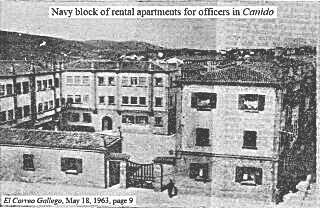
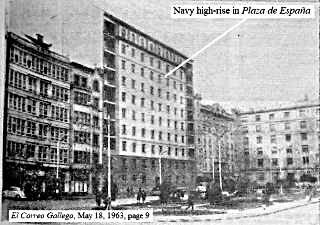
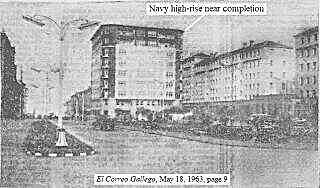
Housing for Navy officers in FerrolThe Ministry of the Navy corporation for the construction of rental housing consigned to naval officers has built 556 apartments in Ferrol City, 33 are near completion and 470 on the drafting board. The Navy buildings are a block of three-storey apartments in Canido (above, left), a high-rise in Plaza de España (above, center) and another nearing completion at the same location (above, right) with inauguration set for July of this year. |
| 19. |
Town Hall contracts Italian singer Torrebruno for the upcoming I Feria de Muestras del Noroeste de España (First Exhibition of the Northwest of Spain). Scheduled power outage in the vicinity of Plaza de España between 9:00 and 11:30 AM for repairs in the grid. |
| 21. | Soccer. In the round robin tourney of promotion to the Second Division of the Spanish Soccer League Ferrol was eliminated in a decisive game played against Abaran in Madrid. Ferrol was leading 2-1 when it had two players sent off the field, and Abaran tied the match before halftime. In the second half the referee expelled two more Ferrol players. With a four-man advantage Abaran had no trouble scoring two more goals. Final score: Abaran 4, Ferrol 2. |
| 22. | "Olympic Mariner" the Greek oil tanker (May 16) is back in Ferrol. The captain of tugboat Costas Vermacos decided to return after encountering strong winds by Sisargas Islands on the Coast of Death. |
| 24. |
Neighbour's Complaints. (1) Cars parked on the sidewalk force pedestrians to walk on the street with the concomitant peril. (2) Beating of rugs out of streetside windows between 10:00 AM and 12:00 noon. (3) Street water valves left open carelessly deprive the neighbours of running water for hours. The Esteiro neighbourhood will honour its patron saint, Our Lady of Sorrows, from Sunday June 2 to Sunday June 9 inclusive. The attractions will include minor and youth league soccer matches, foot races, urban trial motorcycle races, night music parties, a goldfinch competition, skyrocketing gunpowder shells, fireworks, street rounds of the naval infantry drum-and-cornet band and/or the Empresa Nacional Bazán drum-and-pipe band, a traditional meal offered to more than a thousand poor people on the 9th and an outdoor concert from noon to 2:00 PM the same day. |
| 26. |
There will be a special fête in the Seniors Retirement Home to commemorate the centenary of the arrival to Spain of the Congregation of Sisters of Abandoned Seniors (see May 11). The festivities will commence at 10:30 AM with a solemn Mass sung by the Bazan Polyphonic Choir under the direction of Reverend Manuel Perez Fanego the chaplain of the dockyard. The bishop and other authorities will be in attendance and "all Ferrolians" are invited to join them. The "120 dear old men" who lodge at the Home will "wear their Sunday best" and enjoy a "splendid meal" served and paid for by the High School students.
Notes: The May 28 newspaper edition gives two cases of seniors abandoned in Ferrol. (1) A very old lady is forsaken by her mature daughter who leaves home; a few days later a stranger shows up claiming her linen; the victim, alone, without anyone or anything, kept repeating, "Me teño que tirar afogar" (I have to jump into the sea and drown). "Then here, in the Seniors Retirement Home, happy." (2) An elderly lady gives shelter to some relatives in her own house, and in exchange for their taking better care of her, transfers ownership of the property to them, whereupon the said relatives kicked her out of the house onto the street; she sought shelter and found it with the sisters of the Seniors Retirement Home. The "authorities" who attended the special fête on the 26th were the captain general of the maritime department, the city's military governor, the acting mayor, the deputy mayor and the engineer-director of Empresa Nacional Bazán, among others. A group of "very beautiful girls" from the High School danced traditional Galician numbers accompanied by the bagpiper of Toxos E Froles; both received the loudest rounds of applause (End of Notes). Lost And Found. The following items await their owners in the Municipal Police Headquarters depository: a children's jersey, a bicycle, two pairs of prescription glasses, a gentleman's pair of trousers, a lady's umbrella, several keys.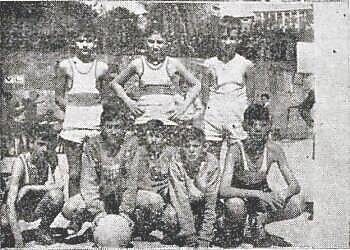
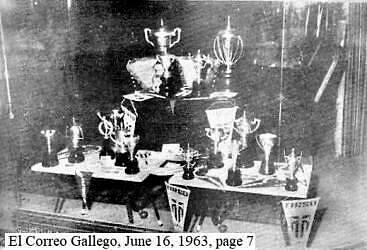
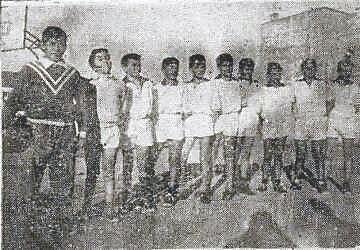
Rival school Tirso de Molina: 1963 provincial championsThe provincial championships of A Coruña were contested by eighteen schools. Ferrol's Tirso de Molina aced the competitions of table tennis, athletics, category B (14-15 years old) handball and category A (10-13 years old) handball and basketball. |
| 29. |
The High School. Students with a scholarship may pick up the third-trimester stipend today in the school's offices; the apposite list published the name of twenty-six boys and sixteen girls. Exams for new students who paid the entrance fee are slated for Saturday June 1, Monday June 3 and Tuesday June 4; the exams will consist of written, oral and map-point-to tests. The downtown gardens (Cantón de Molins) require a face-lift urgently. |
| 31. |
Cristo Rey School pupils will carry the figure of the Immaculate One in religious procession through city streets this afternoon. New train schedule. The express from/to Madrid arrives daily at 12:05 PM and departs five hours later at 5:10 PM. The so-called "Sanghay" (sic) arrives at 9:10 AM and departs almost thirteen hours later at 9:50 PM. Note: This "Shanghai Express" covered Spain's longest route, Vigo-A Coruña-Barcelona; the popular tag originated with this 1932 movie (End of Note). |
| 1. |
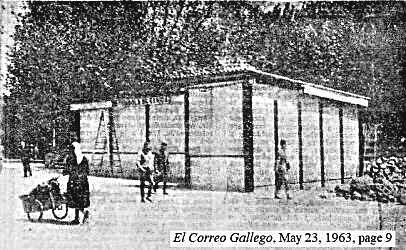
The summertime charity raffle stand (above) will officially open this evening at 6:00 PM following the bishop's blessing ceremony; "the authorities" will witness the act. A total of fifteen salesladies will work today's three 90-minute shifts, from 6:00 to 10:30 PM. "Leyma" brand pasteurized milk (see March 27) will be sold at the main Pan Piana shop from 6:30 AM to 10:30 PM daily and from 6:30 AM to 3:00 PM on Sundays. There are seventeen shops in the city currently, eight more are planned. Ramón Sánchez the Pan Piana C.E.O. foresees the delivery of "Leyma" milk to "cafés, cafeterias, restaurants, hotels, sanatoriums, hospitals, etc." beginning July 1. "The quality of the 'Leyma' brand," he says, "is demonstrated by the steadily rising demand in our city." |
| 2. |
Dutch tugboat "Occean" (sic) has departed taking Olympic Mariner in tow to the port of Piraeus (May 22) Note: The tugboat's name was in fact Oceaan; yes, two a's (End of Note). Codder "Santa Regina" has left for the Banks of Newfoundland. High School exams for grades 1-5 will be held June 5-8 and June 10-11. The exhibition of 32 oil paintings and 9 drawings by Ricardo Segura Torrella currently showing at the Art Salon of Town Hall has drawn many visitors and will continue until the 12th of this month; two paintings already wear the "sold" tag. Town Hall plenum approved the cession of municipal land for the construction of a Girls High School on a budget of 20,000,000 Pesetas. The land area is 10,000 square meters. The envisioned enrollment is 1,500 girls. The motion acknowledged with thanks the "enthusiastic" aid given by Mr. Victorino López González the Boys High School principal. Note: The Girls High School opened in the year 1967 (End of Note). Yesterday a 73-year-old man passed out while in the downtown gardens, he was driven to the Emergency Clinic and died there a few minutes later. |
| 4. |
Veteran Ferrolian painter Francisco Iglesias (see ARTS AND LETTERS for the year 1957) has had "great success" both in the critical reviews and in the affluence of visitors to his exhibition of fifty oil paintings in León (outside Galicia). Most paintings were sold.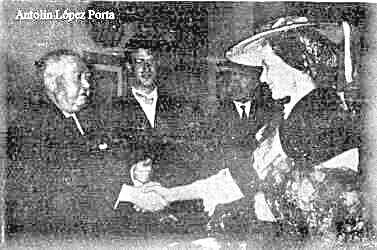
This past Sunday the 2nd the Royal Chorale "Toxos E Froles" celebrated its 49th anniversary. At 10:30 AM the society removed from their center to the cemetery to deposit flowers on the graves of the chorale's founders and of its late members. In keeping with tradition, the choir interpreted Negra Sombra to fulfill a vow and to satisfy the wish of some defunct fellows. Back in the "Toxos E Froles" locale, vice president Antolín López Porta said a few words about the commemoration and immediately received the official courtesy visit of Emma Orro, Miss Galicia 1963 (photograph on the left). She wore a traditional Galician costume and came with a Town Hall councillor, with her parents and her sister. An executive officer of the society pronounced a few words of welcome and presented her with a gift. "The act was very brief, given the special circumstances impacting the Catholic world at present." Note: Those "special circumstances" were the agony of Pope John XXIII who died the following day, June 3 (End of Note). Today at 8:00 PM the co-cathedral hosted a Holy Rosary for the soul of Pope John XXIII. "The temple was full and the faithful prayed with special fervour for the eternal rest of the distinguished defunct Pope." As soon as news of the Pope's demise reached Ferrol flags were ordered flown at half mast in official buildings and on warships. A "great number of houses" hanged mourning bows on their fronts. All school classes were cancelled and all civil servants or military officials were ordered to wear a black armband or a black necktie. |
| 5. |
Navy Command Headquarters has organized a solemn funeral today for the eternal rest of Pope John XXIII; it will be held in San Francisco Church at 12:00 noon. The authorities and committees of the Armed Forces will attend. The general public is invited. "Olympic Mariner" the Greek oil tanker (May 16) was still anchored in the Ferrolian bay. The captain of the Dutch tugboat has postponed the departure in view of the strong winds prevailing. |
| 6. |
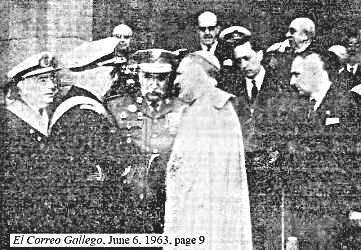 Some personalities present at yesterday's solemn funeral for the eternal rest of Pope John XXIII were: the bishop, the captain general of the maritime department, the mayor and a former mayor, the city's military governor, the magistrate-judge of the city, the rear admiral chairman of the Chiefs of Staff, the general of the Engineer Corps, the county director of the National Movement, the principal of the Boys High School, the president of the Chamber of Commerce, the dean of the diplomatic corps, the president of the port authority for public works, the engineer vice director of Empresa Nacional Bazán, the director of the Post Office, the director of the Telegraph Office, the General Police Department commissar, the director of the Bank of Spain, large numbers of military and diocesan clergy, many commanders and officers of the Navy and the Army.
"The chapel orchestra performed under the baton of señor Pérez Fanego...Many faithful filled the sumptuous temple...the act turned out very solemn." |
| 7. |
Renacimiento Theatre shows the 1960 film, Tall Story, which in Spain bore the disjointed title, Me Casaré Contigo (I Shall Marry You). "Enjoy life seeing this cheerful, funny and very fresh movie." Showtimes: 5:45 PM, 8:00 PM and 11:00 PM. This movie had a "moral guide" rating of 3, suitable for adults only. On page 9 Marius of El Correo Gallego interviewed Ferrolian painter Ricardo Segura Torrella at the gallery of Town Hall where his paintings were exhibited (June 2). A digest of the interview follows. "They say that you are a difficult painter. Is it true?" "I don't know. Sometimes I paint with relative ease." "You avoid the question, I'll make it explicit. Many people assert that you don't paint for the majority of viewers. What do you say?" "I agree with those people." "Are they right?" "Yes, they are. But so am I. And the immense minority of viewers." "Then is Art not for everyone?" "For everyone who loves it sincerely." "Are you sincere?" "I try to be. I try to be it with all my strength." 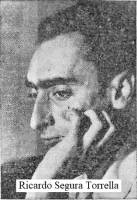
"Are you an absolutely figurative painter?" "Look, I'm a painter. Whether I am figurative or not, I suppose that nobody would take my exhibition's collection of cocks for bicycles or for young people sewing by the light of a window." "I guess not. What role does reality play in your paintings?" "Its own. It's there and I'm here, you understand? We have known each other for a long time and I appreciate it a lot. What happens is that I am the one of the two who paints. I can not act out reality. That would be an usurpation of faculties." "Then don't you think the painter must be true to life?" "Look. The painter must be true to himself. He lives in front of reality and he must build his own expressive world. If he fails to do that, he fails without remedy." "What is an ism, Segura my friend?" "That's a question for a critic, not a painter. Nevertheless, without any compromise, without definition as the goal, I would say that an ism is something like the shape and colour of a feminine attire. It exists as a property of the attire, but the attire is what matters." "You are accused of being loury. Defend yourself." "I don't wish to." "Why?" "Because it would be granting some verity to the accusation. It'd be a different matter if somebody were to accuse me of bastardizing Art, of lack of artistic honesty, of frivolity." "Would you defend yourself then?" "Perhaps. Above all I would take the accusations into consideration for they would impinge on my artistic work." "Do the critics treat you well or poorly?" "This is what happens to me. Either they treat me very well or they trash me mercilessly. There is no middle ground." "How do you view those who treat you bad?" "That they must have their reasons for doing so. An artist is subject to criticism. Furthermore I believe that Art would molder without authentic, rigorous criticism. What happens is that criticism is in multiple occasions simply subjective opinion." "Is subjective opinion useless?" "Not as opinion, but yes as criticism." "To conclude: are you satisfied with the work on exhibit here?" "With some paintings, yes. With others, not as much. Do you, as a visitor, like what you see hanging here on the walls?" "That's a question for a subjective opiner, perhaps for a critic, but not for a newspaperman..." (End of Interview). |
| 8. |
The Dutch tugboat Oceaan left port again yesterday with oil tanker Olympic Mariner in tow (June 2).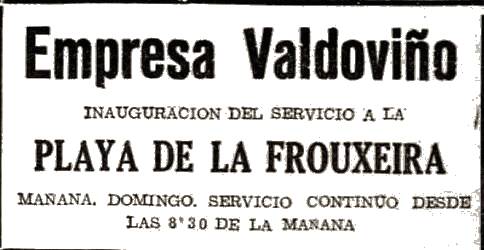 A man attempted to stab himself to death shortly after verifying the death of his 28-year-old wife. He was taken to Charity Hospital in serious condition around 4:00 AM Thursday the 6th.
Private bus company Empresa Valdoviño inaugurates its passenger service to Frouxeira Beach (Chapter 24). The advertisement to the right announces that buses will run from 8:30 AM tomorrow Sunday. The Third Annual Children's Pavement Painting Contest will take place tomorrow at 10:00 AM on Town Hall square. The original date, June 2, had to be dropped because of bad weather. Four pupils, two boys and two girls, are requested to pick up the first and second instalment of their scholarship between 11:00 AM and 1:00 PM today in the High School's offices. |
| 9. |
Next Thursday the 13th is National Charity Day. Ferrolians! Thanks to your generosity last year it was possible to distribute 236 coats and 60 jackets to "our poor" to cope with the cold, 127 beds, 632 mattresses and 870 blankets to afford them rest from their destitution, and 69 layette wicker baskets for the same number of innocent children born into "absolute poverty." Notes: Cáritas was and is the organizer of National Charity Day. Every year the celebration falls on the Thursday of Corpus Christi Week (End of Notes).
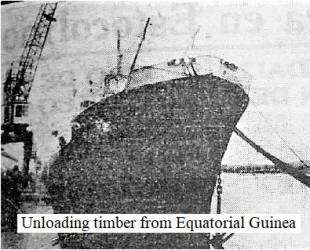
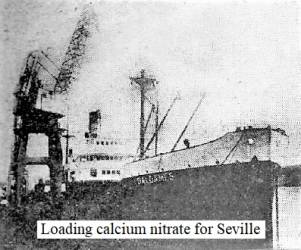
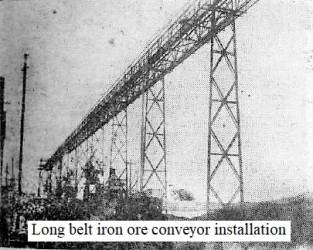
Port activity. El Correo Gallego, June 9, 1963, page 7The name of the ship unloading timber from Equatorial Guinea was Rivadeluna (above, left). The name of the ship loading fertilizer for distribution across Southern Spain was Galdames (above, centre). Renacimiento Theatre shows Ahí Va Otro Recluta (see Chapter 20, "Four Spanish Movies I Recall Watching As A Child") at 4:00 PM as a special children's matinée ahead of the main adult feature film, Tall Story (June 7). Page 7 of El Correo Gallego carries an interesting article by Java under the headline, "A bygone theater: The New England"; but the report is way too short and rests mainly on the reminiscences of Julio López Garrote interviewed below (irrelevant content excised). "Let's see, Julio. When was the New England built?" "Let's say that at the start of the century so the error will be less apparent. Or in 1895." "Where?" "Where the Post and Telegraph Office is today, beside Cantón de Molins." "Who were the owners?" Julio gives the names of four Spanish businessmen. "Do you know who decorated it?" "Angel Fernández Torres, poet and electrician. He painted an image of the Firth of Ferrol on the fire curtain and he also did some backdrops" (End of Interview). |
| 11. |
Around seventy persons felt indisposed after eating a dish prepared with canned tuna at the traditional meal offered to the poor on Sunday June 9, last day of fiestas in the Esteiro neighbourhood (see May 24). Fortunately the intoxication triggered fits of vomiting only. Many people were treated in the Emergency Clinic, including a family of six. Eduardo González Crego (March 5, April 16) broke the Category B national record at the "Absolute Provincial Championships" of A Coruña with an air carbine shooting tally of 147 out of a possible 150 points. He received a silver trophy. Second place went to a fellow High School student. Note: Category B connotes the contestants are 14-15 years old (End of Note). The summertime charity raffle stand was shut down during the last few days because of "some deficiencies" spotted on the raffle tickets sent in from Valencia (southeastern Spain). Note: The stand reopened on this day (End of Note). Town Hall seeks an electrician's report on fixing the luminous fountain in Plaza de España (see July 16, 1961). Yesterday Emma Orro, Miss Galicia 1963, joined Toxos E Froles as a member of the choir. |
| 13. | The traditional Corpus Christi procession marched through the city (see Chapter 3, "Religion In the Streets"). A unit of Artillery, two Navy battalions and two Army battalions lined the route (cf. the 1954 procession described in Chapter 2, "The Military"). |
| 17. | The water supply to the city was shut off at 3:00 PM. |
| 19. |
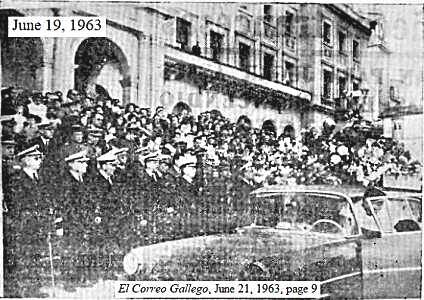
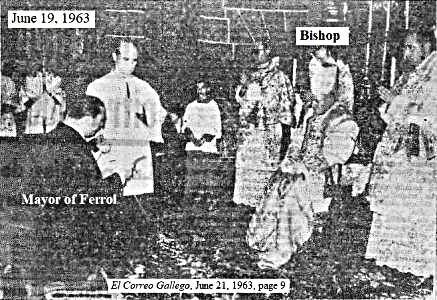
The incorrupt arm of St. Teresa comes to FerrolThe incorrupt arm of saint Teresa de Ávila will arrive to Ferrol at 7:30 PM. The "Sacred Relic" will be received with the military honours of a captain general at Plaza de Armas (Town Hall square). Authorities civilian and military plus the bishop of the diocese will welcome the relic. Subsequently a religious procession will escort it to the co-cathedral of San Julián. |
| 20. |
Special public transit service to Copacabana Beach and to the I Feria de Muestras del Noroeste de España (First Exhibition of the Northwest of Spain) will begin today. There will be twelve daily runs on the hours from Plaza de España to the Exhibition site; return trips set out on the half hours. Note: The I Feria de Muestras del Noroeste de España opened on July 10 (End of Note). Today Teatro Jofre hosts a "Charity festival" starring "outstanding local figures"; popular Radio Ferrol announcer Benito Vázquez will act as the emcee. All proceeds go to Cáritas. Two shows: 7:30 PM, 11:00 PM. Note: The festival attracted "many charitable customers" who applauded the local performers enthusiastically (End of Note). |
| 21. |
Codder Regañón left for the Banks of Newfoundland. Jovalo of El Correo Gallego laments in his column that many Ferrolians are ill-mannered even when out for a walk; he took humorously the watching of a movie "two days ago" whose reels the projectionist jumbled. Some Frenchmen on their way out of Ferrol yesterday asked if there was another route other than Carretera de Castilla. Note: Potholes galore (End of Note). Tomorrow Saturday there will be an exhibition of songbirds at 6:30 PM in Cantón de Molins (the downtown gardens). The contest is open exclusively to boys and girls. No prizes are offered, but participants will receive a bag of sweets for every bird they bring. Ferrol 40 Years Ago. June 21, 1923. The Navy commandant overseeing the ferry service has notified commuters and ferry crews that anybody employing foul language when women and children are on board will be sanctioned. |
| 22. |
Jovalo of El Correo Gallego deplores in today's column that street beggary is "picking up again." "There have appeared all of a sudden very grubby children, pesky like houseflies, who harass people at the entrance to the ice cream parlors." He also delivers the protest of "more than one Ferrolian butcher" who complains that the water supply to the municipal slaughterhouse is shut off at 11:00 AM or 12:00 noon, precisely when high pressure is needed to wash the carcasses down. Renacimiento Theatre shows the 1958 film, King Creole, starring Elvis Presley and Carolyn Jones. Showtimes: 5:45 PM, 8:00 PM and 11:00 PM. "Moral guide" rating: 3, suitable for adults. Cinema shows the 1959 Mexican film, Yo...El Aventurero, starring Antonio Aguilar. Showtimes: 4:00 PM, 6:00 PM, 8:00 PM and 11:00 PM. |
| 25. |
12-year-old boy fell from a pine tree near his home in the Caranza outskirts. He was taken to San Javier Clinic in critical condition and transferred to Charity Hospital after first aid treatment. A 64-year-old pedestrian suffered a cerebral coma and was carried to the Emergency Clinic. Another 12-year-old boy suffered first, second and third degree burns jumping over a bonfire on St. John's Eve (June 23). |
| 26. |
The following artists are under contract for next month's I Feria de Muestras del Noroeste de España (First Exhibition of the Northwest of Spain).
|
| 28. |
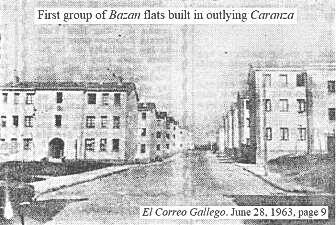
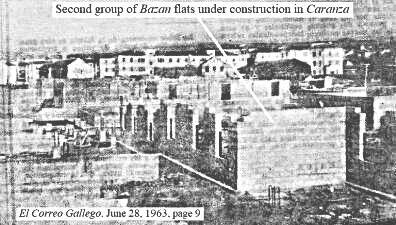
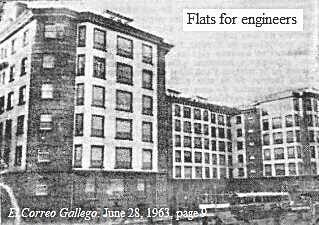
Housing for Bazan personnel in FerrolEmpresa Nacional Bazán is undertaking a big construction project of rental housing for its personnel. The first phase of the project on the Caranza brushland was completed some time ago (above, left). The second phase is currently underway (above, center). The "magnificent" building (above, right) located close to Manuel Rivera Stadium and designated for dockyard "executives" and their families has a parking lot and a children's playground. Note: Caranza flats were rented out mainly to workers and their families; higher-echelon employees such as draftsmen eventually moved into Bazan rental flats located on the south side of the railway station. The "magnificent" building alluded to above housed Bazan engineers mainly (End of Note). Java the reporter of the article reproduces a conversation with a neighbour of the first group of Caranza rental flats who asked to remain anonymous. "How many homes were built in this neighbourhood?" "In round numbers I think it's three hundred flats." "How is the interior?" "Fine. They are two and three stories high, not counting the ground floor. They lack individual gardens." "Then you do have some reservations?" "Not at all. What I mean to say is that all the massive constructions done in Ferrol are enormous blocks of houses; done probably to maximize land development. A garden-city is needed. This doesn't mean there are no green spaces. They stick to the walls and wet them more. However this is not an annoying problem because Ferrol is a humid place for most of the year." "What other pressing needs does the neighbourhood have?" "Before I forget I'll tell you that I would like to highlight the tidiness and cleanliness of this neighbourhood. We need telephone service, mail delivery, an avenue linking us to the city, a marketplace and a bigger church, the one Bazan built is too small" (End of Interview). |
| 30. |
A year ago Town Hall promised to clear the tram tracks to the harbour, but they remain there. Note: Tram service ended July 2, 1961 (End of Note). Fun Corner. "What? Are you sporting a beard now?" "No, but I have a wife, three daughters and just one bathroom." Bonus joke. "Mommy, the thermometer keeps rising and falling." "That can't be. Where did you place it?" "In the elevator." |
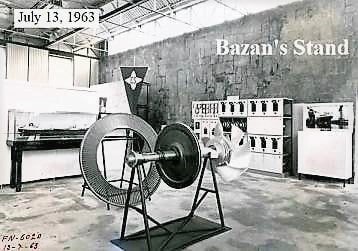


I Feria de Muestras del Noroeste de España (First Exhibition of the Northwest of Spain) |
| 2. | Twin Basque codders Bahía de Pasajes and Abra de Bilbao unloaded their cargo of Newfoundland codfish in Ferrol. |
| 4. |
Victorino López González has been reappointed principal of the High School. "His past performance is respected and admired by Ferrolian public opinion."
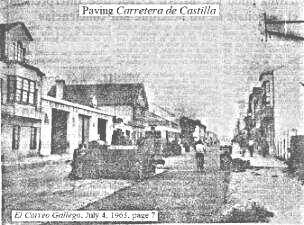
Repaving the road at long last |
| 7. |
Bazan's Polyphonic Chorale together with a military band will give a free concert on the 11th at the Exhibition grounds. Scheduled concert time is 8:30 PM.
Marius of El Correo Gallego tackles the controversial dance known as the twist in his weekly column. The topic was prompted by receipt of a neighbour's letter complaining that some youngsters danced the twist at 3:00 AM without regard for others' need to sleep. Marius sympathizes with the letter's grievance but disagrees with the writer's assertion that the twist is a "dance weapon that will destroy our youth." "The evil," replies Marius in the column, "is not the twist but the era that created it...the dance that gives both you and I a headache is a symptom...not the malady destroying certain human values...Pray with me that the twist may be a benign distemper which will give way to a lengthy and invigorating convalescence." |
| 9. | Java of El Correo Gallego analyzes the past week, Sunday to Sunday, and makes the following observations. Sunday June 30: The downtown gardens (Cantón de Molins) are inexplicably deserted, almost without artificial lighting at night, yet in the old days this was where Ferrolians used to promenade. Wednesday: "We need a full revision of the current charity school norms, all boys must be trained to be something more than busboys and all girls more than seamstresses." Thursday: The machine paving Carretera de Castilla has broken down by the soccer stadium, two workers are fixing it, neighbours say it's been like this for the last three days. Friday: Now I realize why. There is a "very significant" Public Works notice saying, "Paving termination date: August 30th." Sunday July 7: Few Bazán workers will exit the county (i.e., Ferrolterra) during the summer break, household budgets are skimpy. |
| 10. |
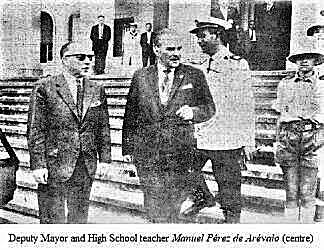
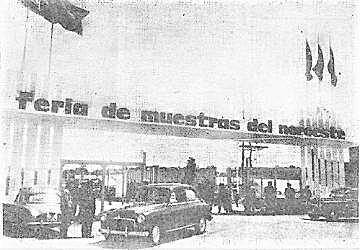
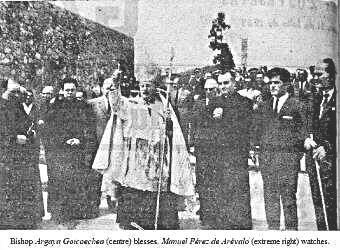
Exhibition's opening dayI Feria de Muestras del Noroeste de España (First Exhibition of the Northwest of Spain) opens. The left photograph above shows Deputy Mayor and High School teacher Manuel Pérez de Arévalo (see November 1955) welcoming the province's civil governor on the steps of Town Hall. Both headed to the railway station to greet the director general of the Trade Expansion Department of the Ministry of Industry who arrived from Madrid on the 12:00 noon express train. The party then went to the Exhibition site where the fair's director, the captain general of the maritime department, the city's military governor, the bishop and other civilian and military authorities awaited them. "The aspect of the fairgrounds was splendid under a very sunny sky and caressed by the sea breeze." Upon arrival (above, centre) and the exchange of formal greetings, the director general in charge of trade expansion together with his retinue entered the Exhibition's Events Hall. After formal speeches there by the fair's director, the deputy mayor and the visiting director general, Bishop Argaya Goicoechea blessed the fairgrounds (above, right). The visitor from Madrid and the welcoming party then proceeded to tour all the stands of the fair. "There were very good-looking young ladies in all the stands, contributing to the splendour with their beauty and their courtesy." At the conclusion of the tour the officials were invited to a "splendid" glass of Spanish wine. The group departed the Exhibition site and headed to the Municipal Park where a "splendid" banquet was served. Lengthy, lively conversation about the significance of the Exhibition relative to the problems faced by Ferrol accompanied the meal. At 4:45 PM the party left the municipal park for the railway station. There the director general of the Trade Expansion Department of the Ministry of Industry was given an affectionate send-off. Other News. The luminous fountain is back working. |
| 11. | Another mysterious dumping of what must have been a large quantity of toxic waste onto the Xuvia River provoked the death of "thousands of fish"; on Wednesday alone between 3-4 thousand kilograms of dead fish were picked up. Notes: The news appeared in the July 13th issue of El Correo Gallego. This video from the year 2022 demonstrates that the practice of dumping toxic waste onto the Xuvia River persists (End of Notes). |
| 13. |
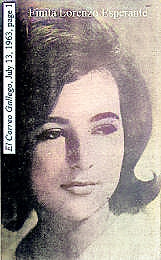 Around four thousand visitors to the Exhibition yesterday watched the joint concert by Bazan's Polyphonic Chorale and a military brass band.
The Exhibition's Olympic pool is now open to the public; the repair work is finished. Today at 10:30 PM the "very beautiful" Finita Lorenzo Esperante (photograph on the left) will be crowned queen of the I Feria de Muestras del Noroeste de España (First Exhibition of the Northwest of Spain). The activities scheduled for today at the Exhibition are skeet shooting competition at 4:00 PM, public dancing at 7:00 PM and the crowning of the Queen of the Fair at 10:30 PM. The registered amount of commercial transactions at the Exhibition for the first three days since it opened exceeds 8,000,000 Pesetas. |
| 14. |
Codder Huracán arrived from Newfoundland with payload for P.Y.S.B.E.'s processing plant (Chapter 4, "The Codders"). Fun Corner. An individual approaches the customer of a restaurant and blurts out in a distressed voice, "Have mercy on a poor blind man!" The customer looks at him fixedly and then exclaims, "You are as blind as I am." "I know; but I am begging for my buddy." "Where is he?" "Outside." "Tell him to come in and I'll give him something." "He can't come in. He is watching out for the police." |
| 16. | Movie house Capitol celebrates the "Second Popeye Grand Festival"; showtimes are 5:30, 8:00 and 11:00 PM. |
| 18. |
Spanish apprentices won three gold medals, six silver and eight bronze at the Twelfth International Apprenticeship Competition held in Dublin. Arsenio Sánchez López of Ferrol won the gold medal in sheet metalworking. Note: The July 21 newspaper added that Ireland had finished first with eighteen medals (End of Note).
This remarkable video, thirty minutes long, recaps the generous reception given by Ireland to all the national teams by way of facilities, transportation, sightseeing, entertainment, lodgings and gala dinners compassing the actual competition whose official name was, "The Twelfth International Trade Competition for Apprentices." The tournament's venue was Bolton Street College of Technology. The two hundred and forty apprentices from the thirteen participating countries, twelve European plus Japan, were billeted in Franciscan College Gormanston situated thirty-two kilometers from Dublin. Sunday July 7 was the official opening date of the contest. On Thursday July 11, in a ceremony held at Dublin Castle, Irish President De Valera presented the winners with their gold, silver or bronze medals. Japan was the tournament's top team with ten gold medals. Ireland was second with seven. Germany third with five. Great Britain fourth with four and Spain was fifth with three gold medals obtained in the trades of sheet metalwork (Arsenio Sanchez Lopez) mould-making and bricklaying. 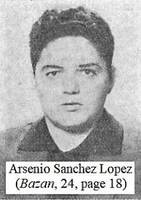
According to Bazan, 24, November 1963, Arsenio Sánchez López had already obtained a first prize in the year 1962 at Spain's Sixteenth National Tourney of Professional Training, Industrial Training and Craftsmanship. Franco himself handed it to him (photograph). On that account Bazan canvassed Lopez presumably in early 1963. The apprentice was twenty years old when the following interview took place. "Where were you born, when did you join the Factory, etc.?" "I was born in El Seijo. Note: Today O Seixo; it is located across the bay from Ferrol City (End of Note). I entered the Factory in October 1957. I spent my first two years in the Outfitters Workshop, then went over to Metal Sheetwork and presently I am enrolled in first-year Machinery Drafting." "What was your assignment at the tourney?" "My practical exercise consisted in fashioning a frame resembling a 'y' from three galvanized iron pipes." "How many apprentices did you compete against?" "Five." "What is your sincere opinion about the national tourneys of professional training?" "They are an excellent way of stimulating the formation of professionals and facilitate the exchange of viewpoints between the professionals." |
| 20. |
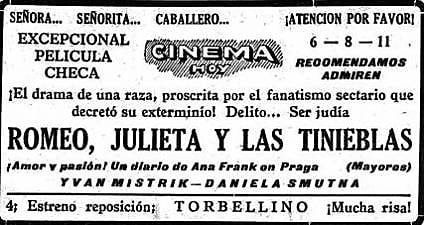
1960 Czech film at the CinemaMovie house Cinema shows the 1960 Czech film, Romeo, Julie a tma (Romeo, Julieta y las tinieblas). Robert Jeantal (see June 26) and Los Cinco Latinos are the performers today Saturday at 10:30 PM in the grounds of I Feria de Muestras del Noroeste de España. |
| 30. | I Feria de Muestras del Noroeste de España (First Exhibition of the Northwest of Spain) closes its doors officially at 6:30PM. The choir "Toxos E Froles" will be its last performers. |
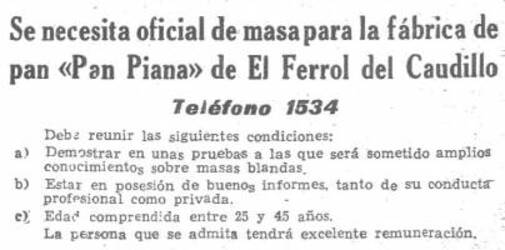
| 10. | Pan Piana advertises a dough maker position (above). Applicants must be 25-45 years old. "Excellent pay." |
| 14. | The local radio station ("Voz de Ferrol") will broadcast "especially ceded" B.B.C. tapings of an original version of "El Quijote de La Mancha." These broadcasts will start next Monday the 19th at 11:00 PM. |
| 17. | Instituto Nacional de Industria has been authorized to construct a (new) dry dock in Ferrol. The project is estimated to be finished in four years' time. The dock will measure 312 × 42 square meters, big enough to accommodate ships of up to 110,000 tonnes. The news caused great elation in the city. Note: The dry dock with slight modifications was finished in the year 1973 (End of Note). |
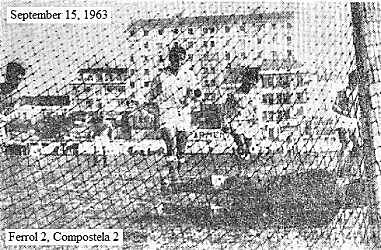
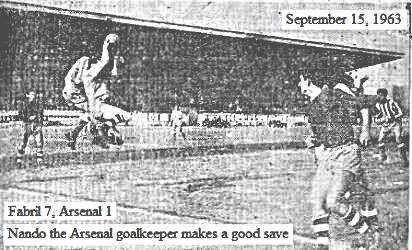
| 1. | Ferrol's Concepción Arenal Soccer Trophy: Deportivo de La Coruña 4, Sporting Vitória de Guimaraes, 0. |
| 4. | Bazan-Ferrol representatives of the 7,500 workers employed by the dockyard set forth their demands for workplace security, job security and new wage schedules during a meeting with the Minister of Labour in A Coruña. |
| 6. | The directors of the successful I Feria de Muestras del Noroeste de España (First Exhibition of the Northwest of Spain) are "constantly" receiving requests for stands in next year's fair. |
| 9. | Franco made an official visit to Ferrol amid public demonstrations of "loyalty and respect". The dictator inaugurated the new local bishopric headquarters. Following a brief concert of sacred music, the bishop and the Justice Minister spoke. The minister said that the Church and the fatherland were conjoint and that "one can not love the Church without loving Spain." The official party then went to the hermitage of Chamorro where the bishop said Mass. The dictator and his wife left the city at 8:15 PM. |
| 15. | Ferrol could only manage a 2-2 tie against Compostela at Manuel Rivera Stadium. Meanwhile Arsenal, playing away in A Coruña, was thrashed 7-1 by Fabril Deportivo. The photographs above captured two good saves, by Joaquín the goalkeeper of Compostela (left) and by Arsenal's Nando (right). |
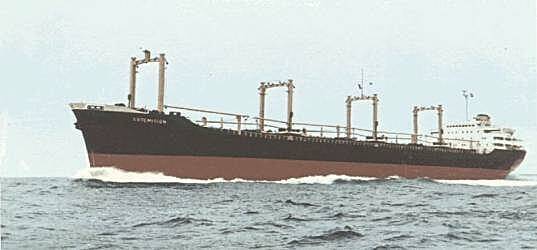
Artemisión |
| 5. | The roof of the Navy School of Mechanics caught on fire. Municipal, Bazan and Navy firefighters battled the blaze for two hours. Damage was extensive, two sleeping quarters for sailors were "totally destroyed." No one was injured. Apparently a short circuit sparked the fire. |
| 11. | Teatro Rena shows the 1961 Spanish movie, Margarita Se Llama Mi Amor. |
| 19. | Rival shipyard Astano launched the 35,000-tonne freighter "Artemisión" (above) destined for a Greek shipping company. The new ship was built in record time. It is the largest of its class in Spain and makes launch number 166 for the shipyard. |
Cross of the Naval Merit |
|
November 10. The regular Third Division match, Arsenal vs. Ferrol, was advertised as and transformed into a charity contest whose proceeds were donated to the mutual fund run by Reverend Fanego the chaplain of Bazan-Ferrol. The box office revenue was "splendid," according to Bazan, 25, and the game's final score was Arsenal 1, Ferrol 5. December 9. A factory for making slippers went up in flames amid "great explosions and fireballs." Municipal and Bazan firefighters put out the blaze with great effort. The losses are estimated at 2,000,000 Pesetas. 

December 19. The Navy imposed the Cross of the Naval Merit (above) on Reverend Fanego (far right) on the recommendation of the previous captain general of the Maritime Department. Reverend Fanego was the founder and director of Bazan-Ferrol's Polyphonic Chorale and the manager of the Sick Workers Mutual Fund (seal on the right). December 21. The annual charity Christmas concert in benefit of the mutual fund managed by Reverend Fanego was performed at Teatro Jofre. Bazan's plucked-string orchestra, polyphonic chorale, chamber orchestra and the novel external collaboration of the band of the Northern Third Corps based in Ferrol all contributed to making the Christmas show "magnificent" and "a complete success in the artistic order," according to Bazan, 25, page 27. December 27. The Ministry of the Navy ordered the urgent put out to sea from Ferrol of a cruiser and two frigates to search for missing freighter "Castillo Montjuich" (below). The freighter left Boston with a crew of thirty-seven on December 5. It is six days late arriving; it was last heard from on December 14. A BRIEF HISTORY OF THE "CASTILLO MONTJUICH"
The ship's baptismal name was "War Vigour". Furness Shipbuilding Co. Ltd. built it at the Haverton Hill Shipyard of Northern England. SS War Vigour slid into the water on June 28, 1919, and was registered at the Port of London on March 6, 1920, with a gross registered tonnage of 6,548. The ship took on these other names successively, "Andalusier", "Wolhandel", "Bois-Soleil" and "African Mariner" (reference). The Nationalist side of the Spanish Civil War sunk the "African Mariner" on January 23, 1939, salvaged it three months later and renamed it, "Castillo Montjuich," in 1940. Bazan-Ferrol refurbished it over the years 1950-51. WHAT CONTEMPORARY NEWSPAPERS SAID
The source for the following information is the online Digital Library of Galicia. According to page 1 of El Pueblo Gallego, Friday December 27, 1963, "Castillo Montjuich" left Boston with a cargo of 9,000 tons of corn bound for the port of A Coruña. The arrival was scheduled for December 21. As the freighter departed Boston it informed other Elcano Shipping Company vessels nearby that its main telegraph station was having problems. The final transmission however reported normalcy aboard. The same source stated the next day on page 4 that the last transmission from "Castillo Montjuich" had been received on December 14 when the cargo ship was situated about 200 miles "almost due north of the Azores" and some 1,200 miles from A Coruña. The rebuilt freighter was said to be in "excellent condition" with a deadweight tonnage of 10,300 and a cruising speed of 10 knots. Its captain was José María Arriandiaga, 59 years old, with an experience of 30 years at sea. Spain had solicited and received the assistance of the American and Portuguese navies in its search for the missing vessel. 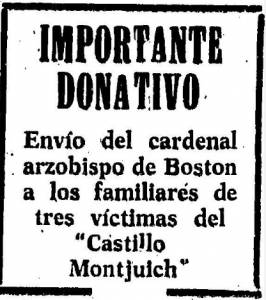
On Tuesday December 31, page 1, El Pueblo Gallego cited a spokesman for the Spanish Ministry of the Navy informing the public that the hopes of finding the cargo vessel were "almost nil." El Progreso of Wednesday January 1, 1964, related on pages 1 and 4 that "Castillo Montjuich" had left Boston on December 5 and that Roberto Berga the manager of the Elcano Shipping Company postulated at a press conference on December 31 three modes of a possible wreck: a swift sinking of the vessel by the bow, an undetected fissure swamping the cargo deck gradually through the night or a splitting of the hull. El Pueblo Gallego of August 9, 1964, page 10, fulfilled the desire of the beneficiaries of an American cash donation to make public their heartfelt gratitude to the Cardinal Archbishop of Boston "for such a generous display of Christian love and solidarity." His donation amounted to 69,000 Pesetas or $1,150 USD back then. According to this reference the sum would be equivalent to a donation of $11,700 USD today (September 2024). The beneficiaries of the Bostonian gift were residents of the province of Pontevedra related to three casualties of the "Castillo Montjuich." Out of the 37 crew twenty-seven were Galicians, four of them from Ferrol city and county (Ferrolterra). The rest were four Basques, two Asturians, two Andalusians, a Cartagenian and a Navarrese. |

Search and rescue plan for the Castillo Montjuich. Courtesy of Xan Ramírez Gómez. The vessel's final transmission on December 14, 1963, gave these coordinates: 43° 12’ North, 34° 30’ West (source). |
Reference: J. R. Soto Rodríguez, 2008: "Castillo Montjuich: ¿Una muerte anunciada?" Revista General de Marina, 254, 6, pp. 741-754. The PDF version of this reference is available for download here.
|
Acknowledgement: Thanks are due to Mr. Xan Ramírez Gómez for e-mailing me on September 12, 2024, the sketch heading this section. Next day he sent the Revista General de Marina article. |
On Wednesday January 18, 1961, the "Castillo Montjuich" carrying 7,250 metric tons of cereals struck a block of ice near Cruger Island on the Hudson River and had to be towed to the port of Albany (El Pueblo Gallego, January 20, 1961, page 2, and El Progreso, January 21, 1961, page 3).
On Thursday February 23, 1961, "Castillo Montjuich" returned from New York and docked at the port of Vigo with a cargo of 9,000 tons of American wheat, "the biggest delivery of the current year." The highly welcomed wheat was earmarked for Galicia, Valladolid, León, Zamora and Salamanca (La Noche, February 23, 1961, page 7). The off-loading was completed on March 8.
On Wednesday October 31, 1962, "Castillo Montjuich" and the Italian ship "Gemini" collided on the Delaware River south of Philadelphia. The Italian vessel in ballast endured minor damage below its waterline; the Spanish proceeded upriver.
J. R. Soto Rodríguez mentions in his article that as "Castillo Montjuich" berthed in a Basque port in November 1963 "several cracks appeared which were fixed with the oft-resorted-to but provisional and unreliable encasements of cement" (p. 744).
On the initial leg of the tragic Spain-Boston circuit "Castillo Montjuich" sailed through a "tremendous gale" and experienced "multiple failures and seize-ups of the auxiliary engines" which left the cargo ship adrift for an unspecified length of time (p. 744).
On December 1 the "Castillo Montjuich" started loading apparently 9,093 tons of American corn in the port of Boston (p. 745).
An unspecified [Spanish?] document envisioned the loading of only 8,959 tons; the National Cargo Bureau verified 9,338 tons loaded and the longshoremen's Atlantic & Gulf Grain Stevedoring Associates notified 9,093 tons. The first document anticipated a ballast of 2,221 tons in the double bottom tanks, the National Cargo Bureau verified 2,644 tons and Atlantic & Gulf Grain Stevedoring Associates notified 2,913 tons. "Let the reader compute the disparities and draw his own conclusions," writes Rodríguez (p. 746).
Boston harbour pilots declared that the "Castillo Montjuich" could in their opinion cross the Atlantic although they would not like to be on it during foul weather (p. 746).
Loaded to one inch below the maximum waterline marking prescribed for the standard ocean water density and Winter North Atlantic conditions, "Castillo Montjuich" left Boston bound for A Coruña with "a crew looking forward to spending the Christmas holidays at home but very concerned about the wretched state of the ship." Underway "Castillo Montjuich" was requested to report its position every three days (p. 746).
On December 14 "Castillo Montjuich" gave its position as 400 miles NW of the Azores and gave the all OK on board despite a low of 724 mm [965 mbar] having formed in the zone. The next transmission was scheduled for December 17. None was forthcoming (p. 746).
The Spanish government opened an exhaustive inquiry more than 1,000 pages long into the loss of the "Castillo Montjuich." The inquiry wrapped up with official approval on January 14, 1966.
J. R. Soto Rodríguez mentions in his article that the preliminary probes of the Ferrolian Department of the Navy take up 296 pages. They contain extracts of letters sent from Boston by some crew to their families expressing serious misgivings about the return voyage (p. 750).
Three third-tier machinists petitioned to stay behind in Boston but the captain eventually persuaded them to embark (p. 750).
"Countless" breakdowns had occurred during the first leg of the circuit. The captain sent from Boston via ordinary mail to Elcano Shipping Company a list of the repairs done. The shipping company received his letter on December 9 (p. 750).
Agustín Orueta Uribarri the third-last captain of the "Castillo Montjuich," in charge from October 1960 to May 1962, informed the inquiry about the "multiple failures" registered in the entire machinery of the engine room (freshwater condenser pump, other pumps, boilers, etc.).
The Inspection Office of Houston (Texas) overseeing the loading of cereals refused to issue the cruising permit for "Castillo Montjuich" until Uribarri signed a document assuming full responsibility for the safety of his crew. The vessel had not met the minimum coefficient of stability required by the International Convention for the Safety of Life at Sea.
As a corollary Uribarri solicited from Elcano Shipping Company the repairs due, but he did not receive a reply. Back on Spanish dry land he reiterated his petition and got fired (p. 750).
Antonio Leniz Mugica the next captain declared that the stability calculations he had made aboard "Castillo Montjuich" during the sole operation of loading grain he supervised yielded too short a metacentric height [hence a restoring torque too weak] and that when a "hard to port/starboard" command was executed the ship heeled (p. 751).
Relatives of the victims presented the official inquiry with letters mailed from Boston.
An oiler wrote to his wife, "The ship has cracks; the rivets on the bottom are worn; they were covered with cement which popped out in bad weather; the bilge pumps do not function; we are screwed if something should happen. Everybody wants to abandon the ship" (p. 751).
The first officer wrote to his brother-in-law, "The ship is very much worn out; I must load it with an unconventional touch because if I overreach by just a few tons at some stage of the loading process the ship might snap in two right at dockside."
The Auditor of the Ferrolian Department of the Navy concluded: "The vessel should not have risked the return journey" and "this temerity provoked the death of 37 men and the loss of a vessel and its cargo" (p. 751).
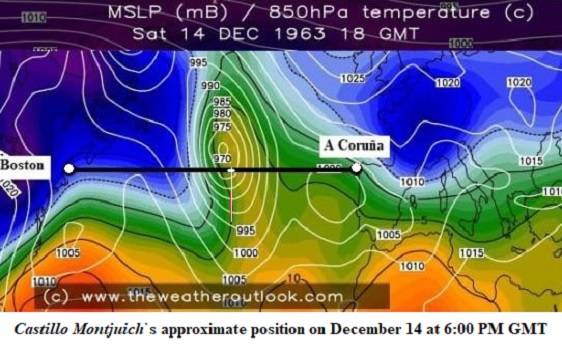
North Atlantic weather map for 18 GMT December 14. |
A sequence of sixteen historic North Atlantic synoptic weather maps was downloaded from The Weather Outlook website.
The first map of the sequence displays the synoptic situation for 00 GMT December 14, 1963.
The next fifteen maps do the same at six-hour intervals.
The sixteenth map then corresponds to 18 GMT December 17.
The sequence of sixteen JPEG files was converted to one GIF of sixteen frames thanks to the Free Online GIF Maker website. A nominal pause of ten seconds per frame and ten loops were chosen. One loop then takes 2 minutes 40 seconds to complete, and the ten loops 26 minutes 40 seconds.
Every frame displays the hypothetical route of "Castillo Montjuich" which to a first approximation is simply the thick black line stretching across the North Atlantic Ocean from Boston (42° 36' North, 71° 5' West) to A Coruña (43° 21' North, 8° 24' West).
The hypothetical location of "Castillo Montjuich" was determined by assuming a constant cruising speed. The length of the thick black line on every working JPEG screen display was almost exactly sixteen centimeters. The journey was slated to last sixteen days (December 5-21). This felicitous coincidence made the hypothetical scaled displacement of "Castillo Montjuich" equal to one centimeter per day and to 0.25 centimeters every six hours.
A white dot on the thick black line shows the hypothetical location of "Castillo Montjuich." It was obtained by pressing a tailors measuring tape flat on every working display and measuring. Certainly a rudimentary technique prone to slight errors, but a decent approximation that lets a reader visualize what kind of weather the cargo ship encountered from 00 GMT December 14 onward.
The last transmission from "Castillo Montjuich" was probably done as usual around 18 GMT (view the corresponding weather map at the head of this section or in the fourth frame of the animation below).
Weather and the ill-fated Castillo Montjuich |
| From 00 GMT December 14, 1963, to 18 GMT December 17 |
The animation shows how "Castillo Montjuich" was impacted by one and perhaps two explosive cyclogeneses.
The first storm started off as a harmless 1005 mbar low at 18 GMT December 13 (not shown) which deepened progressively to 990 mbar (frame 01) 985 mbar (frame 02) 975 mbar (frame 03) and 970 mbar (frame 04) composing a 35-mbar drop over 24 hours, meeting the definition of "weather bomb" espoused by the UK Met Office in this video.
A conservative estimate of sustained wind speed about the storm at its peak is category 10 on the Beaufort Scale. In addition "Castillo Montjuich" had to brave a SW groundswell 9-10 meters hight for at least twenty-four hours (frames 02-06).
Between 06-12 GMT December 15 (frames 06-07) "Castillo Montjuich" would be exposed to strong northwesterly winds and two clashing wavefronts (cross-wind SW groundswell and a NW wind swell) generating a most dangerous chaotic sea.
It is unthinkable that given the ramshackle state of "Castillo Montjuich" the vessel survived the twenty-four stormy hours following its transmission about the time of frame 04 when normalcy aboard was reported. Two explanations can be offered for so odd a report. The first explanation is that over the previous six hours (frames 03-04) the ship had been hugging the eye of a deepening storm and thus felt transient winds lighter than twelve hours prior (frame 02). The second is bravado, whicht riddled Spanish and Portuguese society under Franco and Salazar respectively.
A second episode of explosive cyclogenesis uncoiled between frames 06-11 as a depression initially 995 mbar deepened to 965 mbar.
| Ferrol's New England Theater (1906-1914) |
 "From the poetic perspective I have definitely finished polishing my book of poems entitled, Poems To Read Concerning My Death, which will soon go to the printers."
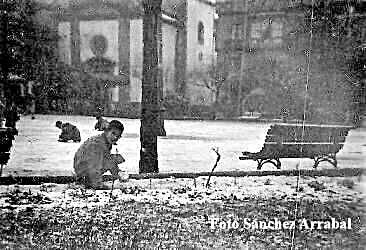
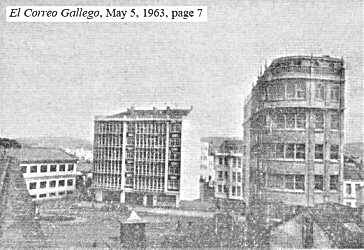 8:00 AM. A flurry of skyrocketing gunpowder shells, followed by several street rounds of
 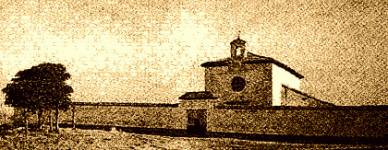 You have completed your holy mission. Now Time labours for your total transformation. Perhaps a Children's Park, a factory or a residence will be born on your lot. Soon eighteen years will have passed since your shutdown. More still pend and you will see yourself more desolate, more tumbledown. With my respect to the ones resting here, relatives and dear friends, to everyone, Canido's Cemetery must disappear at the earliest possible date. It's a ruin. It's unkempt with half-open coffin-niches destroyed and forgotten. Now you represent an obstacle to the district's growth. Your ashes, lovingly gathered, could have for destination the new, cheerful, sunny and tended-to one. Well I know the Law prescribes a delay. But it's a lifeless law. Putting some heart into it, you could go rest in
  The Sisters of Abandoned Seniors is a Paris-based congregation founded in 1839 by