British Pathé Reviews the Year 1962
The source for the news in this chapter has already been discussed in the chapter entitled, "Bazan Magazine for the Year 1956."
The year 1962 produced just one number of Bazan magazine. Around two thirds of it was devoted to the oil tanker Bilbao, which had been launched on April 15, 1961, and which stands as a milestone in the history of the Spanish merchant navy. A highlight of Bazan, 21, September 1962, is a short bibliography consulted during the pre-planning stages, Arkenbout Schokker, F.H. Todd, van Lammeren, the North East Coast Institution of Engineers and Shipbuilders and others. Subsequent articles furnish technical details about the hull, method of construction, internal cathodic protection, prefabrication, soldering, riveting, lifeboats, gangway, insulation, paving, painting, pumps, pipelines, fans, electrical installation, propulsion, etc. Oil tanker "Bilbao" was decommissioned and recycled in 1982.
By contrast Bazan, 22, February 1963, whose cover heads this chapter, is exclusively devoted to the year 1962. Consequently this chapter is a compendium of both numbers.
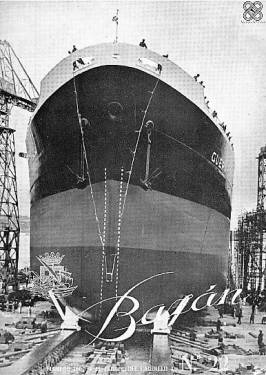
The salient event of the year was the launch of the oil tanker Guernica on May 3, 1962 (cover of Bazan, 22). Guernica was a twin of the Bilbao delivered to Naviera Vizcaína on January 31. According to this webpage both Bilbao and Guernica were decommissioned in 1982.
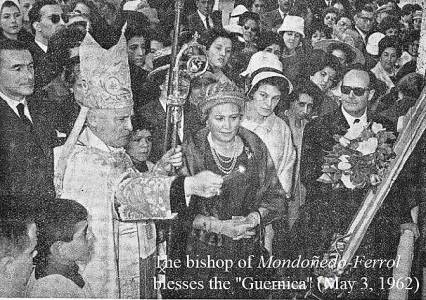
The presidential tribune for the launch of oil tanker Guernica was occupied by the interim captain general of the Department, the military governor of the city, the mayor, the admiral and managing director of Bazan, the managing subdirector, the engineer-director of Bazan and chief executive officers, the rear admiral of the Northern Navy Division, the president of the administrative council of Naviera Vizcaína, the five counsellors of Naviera Vizcaína, the chief engineer of New Constructions from Empresa Nacional Elcano, the mayor and the deputy mayor of the town of Guernica. Many other leading military and civilian authorities were present. The bishop of Mondoñedo-Ferrol blessed the vessel and the wife of one of the five counsellors of Naviera Vizcaína acted as the ship's godmother.
The ceremony was witnessed by "a very numerous public" who watched from provisional stands built apropos. The spectators cheered Guernica's smooth launch and expressed their admiration at "this new and important success of the Ferrolian Factory."
In celebration of the launch the president of Naviera Vizcaína made a "splendid donation" to the mutual fund run by Reverend Fanego. This fund gave money to subscribed needy and ill workers. Fanego underscored "the gratitude of all the beneficiaries" (Bazan, 21, September 1962, pages 64-65).
Guernica's official sea trials were carried out "with complete success" on November 6, 1962, and the vessel was delivered to Naviera Vizcaína that same day.
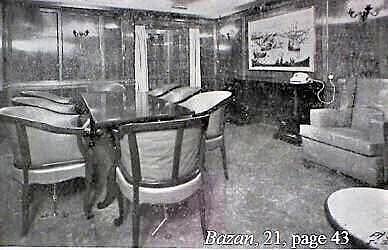
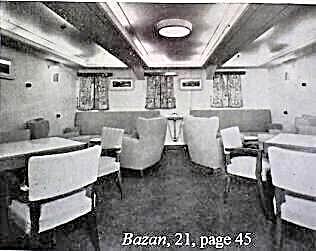
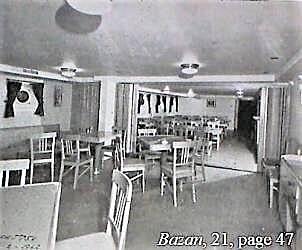
Bazan, 21, September 1962, discussed at length Bilbao's living quarters. It is reasonable to assume that Guernica's duplicated them. Underneath are displayed the captain's living room (left) the deck officers' (middle) and the crew's (right).
|
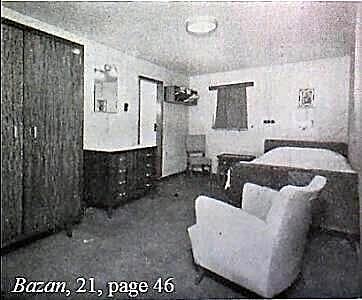
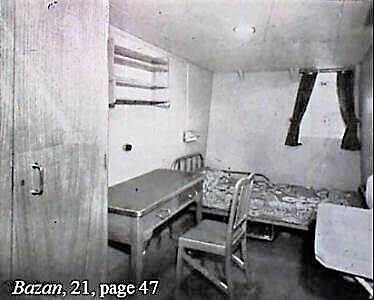
These next photographs show the First Officer's bedroom (left) and a crew's cabin (right). Officers enjoyed a private washroom adjoining the bedroom. The crew merely had a wash basin (lower right-hand item on the photograph below) and needed to use a public washroom.
|
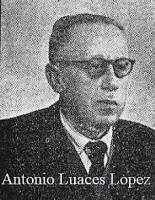
1. Antonio Luaces Lopez was born in Ferrol on June 15, 1891. He joined the Factory on June 28, 1909, as an apprentice of the Mechanics Workshop. He was laid off the same year, the consequence of the shipyard's technical backwardness and meagre productivity. The Spanish government invited British companies Vickers Ltd., Armstrong Whitworth Co. and John Brown & Co. to take charge of the shipyard. Then Luaces got hired anew, this time as an apprentice draftsman. The British employers no doubt valued his diplomas and awards obtained in the Ferrolian School of Arts and Trades.
In all Luaces spent 52 years 4 months working with Bazan-Ferrol.
"Do you remember your first job in the Factory?" "I remember it as if it were yesterday. It was taking part as an apprentice in the placement and adjustment of the slide valves of the battleship España. But I remember even more. In those distant days Mr. Monroe was the head of the shipyard and Mr. Spiere the head of the Constructora." "Isn't it true that you are a great lutenist?" "It's true that I have always felt a strong passion for music, but I ignore if I play the lute well or poorly. In my young years I joined the Airiños Da Miña Terra orchestra. I also took part in Bazan's Educación y Descanso plucked string orchestra from its foundation. Another of my great hobbies has been—and still is today—to visit towns and cities with artistic monuments." "Then it is certain that you have been a collaborator of the extinct Workingmen's Cultural Center." Note: The center was founded in 1911 and shut down in 1936 (End of Note).
"Yes, yes indeed. What days, those!"
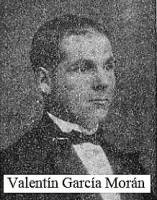
2. Valentín García Morán was born in Ferrol on December 17, 1896. He started working in the Factory as a fifteen-year-old apprentice. Battleship España had just been launched and its twins, Alfonso XIII and Jaime I, were in the stocks. "The Stocks Workshop then," recalled Morán in the interview, "consisted only of two cadmium-paneled depots approximately located where the air compressor is today."
"Don Valentín, do not take offence but you are a genuine arsenal of data." "Humbug! Do not exaggerate. Let us agree, however, that I always had a very good memory. Look, for example, I reached worker status at age twenty-one, that is in the year 1917. Well, I could draw for you this very instant the consoles I had to mark out for the Cristóbal Colón; that was my first Stocks operator job." Note: The Cristóbal Colón was a transatlantic built in Ferrol, launched in 1921, commissioned in 1923 and lost near Bermuda in 1936 (End of Note).
"Truly astonishing. And what year did you become a foreman in?" "In '45. Exactly November 11. I still remember they communicated the news to us the day before, in the afternoon." "Another item, Don Valentín, may we talk about your main hobbies?" "Music has always been my great pursuit. I enrolled as serenader with the artistic group, 'Airiños Da Miña Terra,' of which I retain unerasable memories. I will never be able to forget the trip we took to Barcelona motivated by the International Exposition of 1929 nor some of the performances we gave at the leading Galician theater houses."
"Confidentially, did you ever feel the temptation to cross the puddle, to go live in America?" "What! Can it be that you do not know I lived in America for three long years? See here, I emigrated when I was twelve years old, going to my uncle's who dwells in the selfsame Argentinian Pampa. There I learned to ride horses and to throw the lasso with skill. I returned for the same reason as everyone else, morriña (homesickness, lit. life-threatening nostalgia). Besides, I did not get accustomed to living far removed from my parents. You understand it, right?" "Totally, Don Valentín."
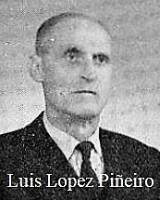
3. Luis Lopez Piñeiro was born in Ferrol in 1896. He started work in the Factory as an apprentice riveter in 1919. The end to procurements by the Navy in 1925 prompted layoffs at the Ferrolian dockyard and Piñeiro was one of those sacked. A new program of Navy procurements came along in 1927 and Piñeiro got reinstated. In 1941 he was transferred from riveter to the Electricity Workshop #1 with operator status. A year later he moved to Electricity Workshop #2 and there he stayed until his retirement.
"So a Ferrolian native, right?" "Yes, sir. And I have always dwelled in Ferrol, for I did not even do the military service because I was a supernumerary." "If you had not worked in the Constructora, where would you have liked to work?" "I would have wanted to re-enter the Company, so to speak." "You are what one dubs a loyal employee. Besides working as an electrician, have you spent your spare time doing anything else?" "Yes I have. I practised swimming assiduously and that other healthy sport which is taking long walks about the countryside. Additionally I am—always have been—a convinced, genuine and passionate advocate of Natural Medicine. A vegetarian, as we are usually called." "For the record, although I don't practise it, I too am a believer in Natural Medicine, but let's talk, if you will, about your retirement. Would you delay it if it were in your power to do so?" "Yes if I could be young again. But the reality is that the years weigh down. I asked for my retirement voluntarily. And yet what retires me, more than my will, is my sixty-five years of age."
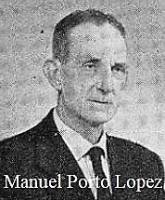
4. Manuel Porto Lopez was born in Narón on October 23, 1896. Note: The municipality of Narón adjoins the municipality of Ferrol (End of Note). He did his military service as artilleryman in Spanish Morocco. He started work in the Factory as a professional mason in 1928. Twenty years later he got transferred to the Electricity Workshop.
Lopez spent four years in the Republic of Cuba. "If it's not an indiscretion I would like to ask you why you went to America and why you returned so soon." "I emigrated in search of fortune and because a brother of mine waited for me there. And I came back because the economic fallout of the renowned and ruinous moratorium really made life very difficult." Note: The Cuban economy plunged into crisis in 1920 due to a 90% drop in the international price of sugar. There was a run on the money and the Cuban government decreed a banking moratorium on October 10, 1920 (End of Note).
"Isn't it true that you will never again contemplate a return to Cuba?" "Yes. See here, Cuba was always quite unstable. Sometimes life was nice, really nice; others very bad. Heck! That place was not meant for me, you know."
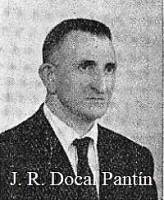
5. Juan Rosendo Docal Pantín was born in O Couto (Narón) on September 18, 1896. He began working in the Factory on February 2, 1918, as the operator of the sole mechanical saw in the Stocks Workshop. Twenty-six years later he was assigned the operation and maintenance of a sander/planer additionally.
"Mr. Docal, have you ever travelled outside Ferrol and its county?" "Very few times, and only to make short trips in the region. I went to Asturias one time."
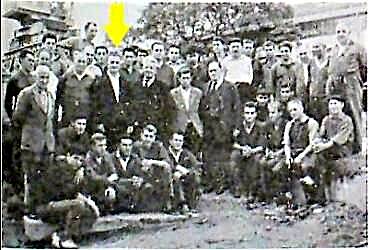
"What is your regular address?" "In Los Castros of Santa María de Neda. I dwell there since I got married. I always liked to live in a rural environment. One can supplement the domestic economy with some small-scale farming and the raising of animals."
"What are your main hobbies?" "The main one is bait fishing. Incidentally I forsook this old pastime of mine years ago due to circumstances which are not germane. But what a surprise I got on my retirement when my workmates (photograph to the right) presented me with a fabulous fishing rod armed with a complete kit of accessories plus a fisherman hat and fisherman boots! All that beside other valuable gifts."
"Naw, you have no option but to take up bait fishing once more." "Something I will do with great pleasure, believe me. Put down on your Magazine as well that I am immensely grateful to my workmates and to my superiors. They have treated me very well. I'll never be able to forget it."

6. Ramón Vazquez Gonzalez was born in Santa Cecilia (Narón) on April 25, 1897. He never left the county of Ferrol and dwelled in the city since age eleven. He did not have to do military service in 1918 because he was classified as a supernumerary. He was self-employed until January 1941 when he entered the Factory as a plumber. Seventeen months later he was transferred to the Fine Sheet Metal Workshop and there he stayed until retirement with the status of operator second class.
"Mr. Vazquez, surely you know Ferrol quite well, correct?" "Yes, sure, I should think so." "And what do you like most about the city?" "Many things, but the Municipal Park is really marvelous."
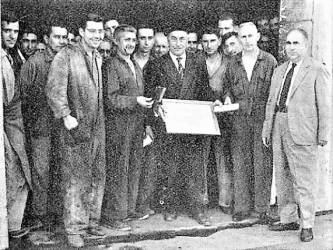
"And what do you like most about the Factory?" "Fine Sheet Metal; it's my workshop and I love it."
"What would you like to have been professionally?" "The producer I have always been."
"You are then satisfied with your lot?" "Well, yes, why not? You are already aware that a large portion of happiness is knowing how to be content with little."
"To close, please say something about the homage and the affectionate farewell you are being sent off with."
"I would like to say that I am extremely grateful to the entire Workshop; they have been very generous with me. Surely you've seen the valuable objects they have presented me with."
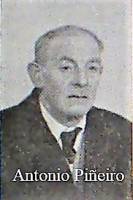
7. Antonio Piñeiro was born in Jubia (Narón) on November 12, 1897. He joined the Factory on May 26, 1923, as general help in the Outfitters Workshop. He soon attained to the rank of Specialist Helper in charge of one of the workshop's industrial guillotines, a post he held until retiring.
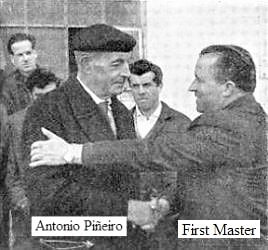
"Do you like the Outfitters Workshop?" "A lot. It's what I like most of the whole dockyard. Not to mention its personnel, which can not be surpassed."
"Have you always dwelled in Jubia?" "Yes. I like living in the outskirts where the enviroment is more rural than urban. Furthermore now, with the bus line, once the road is patched, the distance Ferrol-Jubia can be covered in relative comfort."
"Have you travelled a great deal?" "No. Only in connection with the military service; my first destination was an artillery regiment in Vitoria (Basque Country), afterward I was sent to Melilla during the disaster of Alhucemas." Note: Melilla is a Spanish enclave on the Moroccan coastline. The Alhucemas amphibious landing took place on September 8, 1925; it was a military operation designed to defeat the Moroccan insurgents based in the Rif Mountains (End of Note).
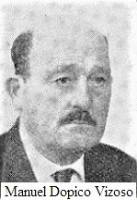
8. Manuel Dopico Vizoso was born in Narón in December 1897. He joined the Factory in 1944. He worked first in Public Works; a few months later he got transferred to the Outfitters Workshop as a Specialist the head of a group in charge of an industrial guillotine.
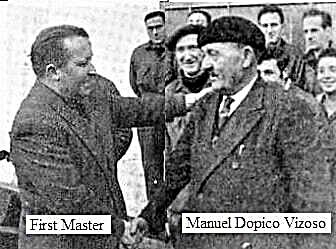
"Where did you work before entering Bazan?" "I worked wherever I could, sometimes here, sometimes there... And I did not reside always in Ferrol. I emigrated to America. I lived in Buenos Aires four long years and a few months in Montevideo. I returned to Spain. A short time later I emigrated again. This second time to Cuba. I spent more than three years in the Pearl of the Antilles. Note: "Pearl of the Antilles" is a moniker for Cuba (End of Note). However morriña (homesickness) on the one hand and awareness of my poor mother's illness on the other compelled me to return and never again depart. I also worked for some time on my own as a baker."
"Your impression of America?" "Argentina is what I liked most. Above all the good reception that we Spaniards received there."
"And what has pleased you most in this day of your retirement?" "This spontaneous and affectionate homage of farewell. I am extremely grateful to the entire Outfitters' personnel, in equal measure to the headmen and to my workmates and friends."


On December 1, 1962, the Management of Bazan-Ferrol ordered the compulsory use of a hard hat for all personnel without exception engaged in full- or part-time work in the zone of the stocks, the dry dock or on board a floating vessel. The compulsory use of hard hats could be extended to other zones as required. The ordinance's fourth article stated that an "adequate sanction" would apply for neglecting to wear a safety helmet, for its unjustifiable deterioration or state of disrepair. The ordinance's fifth article cautioned that any workplace accident the consequence of the factors outlined in the fourth article could be declared not eligible for compensation.
Bazan, 22, pages 16-18, informed that according to the latests statistics of the International Labour Office there were some 15,000,000 workplace accidents every year worldwide. Researchers had concluded that industrial accidents were "extremely deleterious" to the balance sheet of an enterprise and that failute to adapt quickly to technological progress accounted for only 10% of labour accidents worlwide—although the magazine noted that the figure rose to 25% in the case of Spain. The remainder was the result of human error: poor organization, defective training of the personnel, excessive working hours, etc., and in high proportion also the lack of attention by personnel, blunders, negligence and even the commission of imprudent acts that endanger one's or the workmates' safety.
The article in Bazan, 22, asserts that when a labour accident takes place it is "very frequently" assumed with blind fatalism, as something that had to happen inevitably someday. Generally speaking, it affirms, a worker's attitude to safety guidelines is "frankly negative,"
It is incumbent to relegate from his soul the blind fatalism that an accident will arrive someday. He must convince himself that no accident is haphazard, that they all have their causes and that if these are averted the accident is averted. This is an elementary axiom that must prevail over the fatalism that holds sway today. And in this fashion we will preclude having many producers fall innocently victim of accidents which, by their characteristics, seem to be genuinely preconceived.
Bazan-Ferrol distributed in this safety campaign more than 2,500 hard hats among its personnel. With everybody's cooperation, concluded the article, "we will make our Dockyards, which have already earned the reputation of building the best ships of Spain, recognized for being also the safest in Spain."
According to Bazan, 22, the hard hats used in Bazan-Ferrol had the following specs.
Construction Safety Helmet. Composition: Pressed aluminum with ridges. Weight: Less than 400 grams. Mechanical Resistance: (a) Withstood without denting the drop of a 3-kilogram steel ball from a height of 2 meters. (b) Withstood without rent the drop of a 450-gram pointed steel penetrator with 36° angle from a height of 3 meters.
Electrician's Safety Helmet. Composition: Plastic mixed with fiberglass. Specifications: All the above plus the following. Dielectric protection: Not inferior to 15,000 Volts. Heat Transfer: Nil after a 4-hour exposure to 40°C in the sunlight.
Bazan-Ferrol's Service of Security and Hygiene At Work published on page 16 of Bazan, 24, November 1963, a comparison of the number of serious accidents that occurred during the same five months, January to May, for the years 1960, 1961, 1962 and 1963.
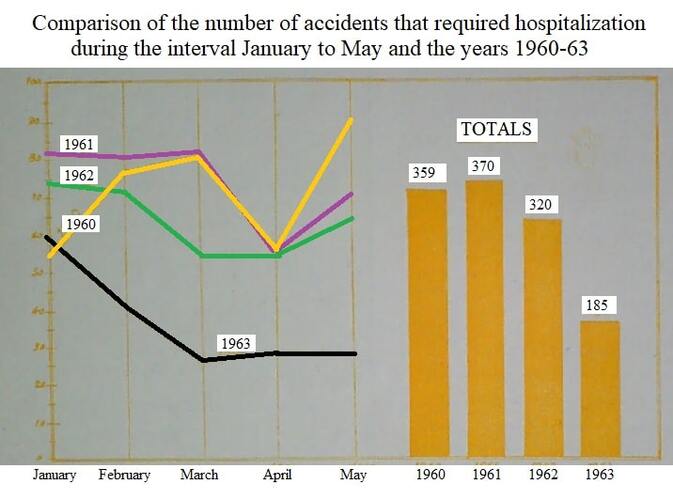
The original graph is shown on the right modified considerably for ease of reading. The original Spanish labels were replaced with English-language labels and the original penciled straight-line segments which appeared on the January-May abscissa were redrawn as four different thick colours, the orange straight-line segments correspond to the year 1960, the purple to the year 1961, the green to the year 1962 and the black to the year 1963. The histogram spanning the 1960-1963 abscissa is shown in its original orange colour, but the small white labels crowning the four bars are mine.
The graph's ordinate axis is the original one. It denotes the number of serious accidents. It is graduated from zero to one hundred in steps of ten.
The Figure purports to prove that the safety program initiated at Bazan-Ferrol on December 1, 1962, had an immediate effect on the number of major accidents. Multiplying the mean of three histogram totals by 2.3 yields an estimate of 804 grave accidents per year prior to 1963. The factor 2.3 minds Bazan-Ferrol's official summer recess of half a month (see the news of July 23, 1954, or of July 13, 1955).
A second graph on the same page 16 of Bazan, 24, November 1963, shows a steady drop year on year in the number of minor accidents during the five months from January to May. These mishaps did not require hospitalization. Their total count was 5,700 in 1960 and 3,146 in 1963.
The report by the Service of Security and Hygiene At Work details four accidents at the stocks that required hospitalization and "could have been easily prevented." On February 28, 1963, a man working on deck and wearing slick-sole shoes slipped and fell. On April 16 a worker coming down a ladder landed on a piece of lumber that had nails sticking out. On April 26 a man was struck by a falling tube. On May 6 another operator slipped and fell on a greasy, oily floor of the deck.
The next safety campaign of Bazan-Ferrol pushed safety glasses.
Reverend Manuel Perez Fanego the chaplain of the dockyard informs the reader of Bazan, 22, pages 22-23, about six desperate cases of want among families of the Bazan-Ferrol working class which spurred fellow workers to help out in detriment of the State which did nothing. The chaplain deliberately omitted the names of those concerned in order to "avoid offending or annoying anyone and to follow the Gospel's injunction to not let the left hand know what the right hand is doing." The six cases were attended to during the last quarter of the year 1962. The six footnotes seek to illustrate the value of the workers' donations.
1. October. A 35-year-old solderer, married, 20 years working at the Factory, suffers a lung disease that requires medical treatment and also afflicts a minor in the family. The financial situation is "critical." Fellow solderers aware of the predicament met and collected 2,600 Pesetas. They gave the amount to the chaplain who together with "a commission of workers" visited the family and donated the cash.
Footnote: Bazan, 21, page 78, lists the Ferrotour price of a 7-day stay in Alicante, with starting point anywhere in Spain, at 2,535 Pesetas. Ferrotour was a bid to promote domestic tourism under the auspices of "Autotransporte Turístico Español," a subsidiary company of the National Institute of Industry. The price covered travel to and from Alicante aboard night express trains, the stay at first-class hotels and arranged tours.
2. October. A 41-year-old riveter, married, wife and three children, 25 years working at the Factory, suffers an acute thrombosis which, after futile efforts and frustrating delays, requires the amputation of the right leg in 1961. After hardly a year the malady worsened and forced the amputation of the other leg. "Waves of charity and generosity swell where the news travels not just among riveters but through the entire family of Bazan." A collection drive for the distressed family raised 34,100 Pesetas.
Footnote: On Wednesday October 24, 1962, this make of car was on resale for 110,000 to 165,000 Pesetas (La Vanguardia, p. 26).
3. November. Another 41-year-old riveter, married, wife and two children, had been working at the Factory since 1937, requires "decisive" surgery for a lung disease that has bedeviled him fourteen years on. Fellow riveters raised 4,845 Pesetas for the family. Furthermore an "avalanche" volunteered to donate blood for the operation; in the end the "splendid contribution" of six workers sufficed. The chaplain adds that the surgical operation was successful and the convalescent was recovering swiftly and expecting to return to work soon, totally cured.
Footnote: On Sunday November 18, 1962, a plain colour 250×300 cm2 carpet, very high pile, was on sale for 3,075 Pesetas (La Vanguardia, p. 16).
4. November. A 40-year-old assembler, married, wife and two children, 24 years working at the Factory, has his solvency "profoundly imperiled" by illness and other family setbacks. His fellow workers raised 5,500 Pesetas for him.
Footnote: On Sunday November 25, 1962, this dining room set was on sale for 13,900 Pesetas (La Vanguardia, p. 6).
5. December. A 60-year-old stocks carpenter, married, 25 years working at the Factory, endures fifteen years with his breathing passages in poor shape. Eventually his condition required twenty sessions of cobalt therapy in Santiago de Compostela, done at personal expense. Two workmates and the chaplain made a "splendid donation" of 9,000 Pesetas to resolve the carpenter's "critical case."
Footnote: On Sunday December 23, 1962, this office storage cabinet 1.13×1.7×0.5 m3 was on sale for 8,000 Pesetas (La Vanguardia, p. 8).
6. December. A 36-year-old solderer, married, wife, four underage children, two young sisters-in-law he billets, suffers during fourteen years "a rebellious fistula that is destroying his health and the budget of this honest and extended family." His workmates collected 8,000 Pesetas and visited the solderer's home.
What a truly moving scene we have witnessed of the visiting workmates' genuine brotherly love, answered with sincere gratitude signed by the tears of a grateful heart.
Footnote: On January 19, 1963, Franco's government decreed a minimum wage of 1,800 Pesetas per month for workers more than 18 years old in the agricultural, industrial or service sectors.
In closing his article Father Fanego asserts that there are "many other" similar tragedies in Bazan-Ferrol which are "veiled by the discreet silence of anonymity."
Manuel Soto Romalde, social-and-labour legal adviser, wrote a short article entitled, "The Social Question and Social Politics," in Bazan, 21. It is questionable whether another gazette would have published it. Note: Bazan had already defied censorship printing poems written by Factory employees in the Galician language! The first one, "Noitébrego," written by Juan Manuel Castro, was published on page 21 of Bazan, 2 (End of Note).
My translation of the article follows.
It is well known that nowadays social matters draw the primary attention of all who devote their efforts to the tasks of governing people, for we must not forget that even though a country's entire resources may be brought to bear in the attempt to raise the standard of living it is paramount that the resultant benefits be allocated not arbitrarily but equitably among all who dedicate their activity in one way or another to the achievement of that goal.The more reigns harmony among the diverse social sectors the higher will the probability be of attaining this collective well-being desired by everybody which will come about only through the implementation of an adequate social policy that lends proper attention and assistance to the legitimate aspirations of the economically disadvantaged.
Let us clarify first all the concepts of the term, "social policy"; they are not interpreted correctly in most cases.
Social policy, as all policy in general, is actuated by the impulses of a specific ideology, i.e., by a fundamental concept of what the aims of the State are. In this sense one can not say that a legislator is "apolitical" just because he does not espouse a particular ideology. That fact would not divest his work of its political nature since it must always reflect the legislator's preconceived idea about the law in question.
A social policy exists because there is a social question. But what is the social question? The social question is the problem posed by disequilibrium among the social classes, an imbalance that constitutes an injustice not instigated precisely by the victimized class.
But in order to speak properly about the social question it is necessary to add to this objective aspect another purely subjective one: the consciousness that the class victim of the social disequilibrium has about its own situation constituting an injustice which can and deserves to be redressed.
Consequently it is logical to assume that where no such consciousness exists it is impossible to speak of the social question as a sociological fact. Indeed if we should imagine that the disadvantaged classes in the present situation were to endure their privation with exemplary Christian resignation doubtless the injustice would subsist, since those classes would not partake of the goods owed them in the concert of society, but that injustice would not be perceived as a problem.
Neither can one speak about a social question in those societies where the most unjust and arbitrary privileges and inequalities were accepted as normal and sanctioned by their religion as, for example, slavery and the caste system.
The social question then points to a psychological ingredient, and hence purely psychological factors will contribute to aggravate the problem.
We all know that there are certain political ideologies that have contributed to such a deterioration because they have infiltrated the masses adroitly to arouse them and to incite them to rebel against the established social order. But this true fact can not warrant the fatuous conservative viewpoint which attributes the root cause of the social question to those ideologies.
Indeed through all the epochs of history we come across mobilizations and manifestations, more or less severe, of the social question. The plebeian movement to acquire full legal and political rights in Ancient Rome must be considered at heart a social movement. In fact we see constant antagonism between patricians and plebeians, and as concessions are made to these, a new social class arises: the wealthy and influential plebeians who, besides vying with the poor in more than one occasion, keep up a regular struggle with the patricians.
There were also great agrarian reforms in Rome such as those advanced by the Gracchi brothers, affluent plebeians so esteemed they were able to intermarry with the noble Scipiones family.
Another social action in the history of Rome can be considered to have been the frequent slave rebellions, like the one headed by Spartacus the celebrated gladiator who drew out the war with Rome three years until Crassus defeated him at Silano and the majority of the vanquished opted to commit suicide.
The Middle Ages also were an era of intense social strains due to the oppression of the waning feudal regime which became more acute with its prostration, as always happens in the social history of mankind. In many occasions Gospel and biblical texts served as an ideological banner to the multitudes who styled themselves, "the people of God." Popular leaders, Bible in hand, roused them. Meantime the texts, warped and interpreted by those leaders passionately, gave rise to a harvest of heretical currents of thought among the toilers of town and country.
But the social question par excellence is the one that owes its origin to the formation of the proletariat and the capital economy, two factors linked intimately which have without a doubt contributed noticeably to awaken the conscience of governments to dictate measures intended to remedy the situation of the working classes, spanning the breadth from the simple protection that mainly for humanitarian reasons was extended to women and children the victims of the inhumanity and unbridled selfishness of their employers to the complex labour legislation currently enacted in all civilized countries.
Manuel SOTO ROMALDE
Social-and-Labour Legal Adviser(Bazan, 21, pages 66-67)
It is impossible to impute any ulterior motive to the above article, but it can be construed to be flagging the inroads that Marxism was making in the working class of Bazan-Ferrol.
The official website of Comisiones Obreras (Commissions of Workers) dates the start of opposition to state-run unions in Spanish factories to the year 1953. The first "commission of workers" was created by Asturian miners in the year 1957. The preceding section, "SIX TRAGEDIES AND WORKERS SOLIDARITY," demonstrates that Bazan-Ferrol had commissions of workers operating routinely already in the year 1962. Since the workers of the dockyard got very little from the state in return for the huge amount of wealth they created through the construction of oil tankers especially it is understandable that Marxist ideas and ideals would find a fertile breeding ground among the workforce of Bazan-Ferrol.
Ten years after the publication of "The Social Question and Social Politics" the Fascist regime in power murdered two workers of Bazan-Ferrol on Friday March 10, 1972, in what has become a signal date of remembrance for the Galician labour movement.
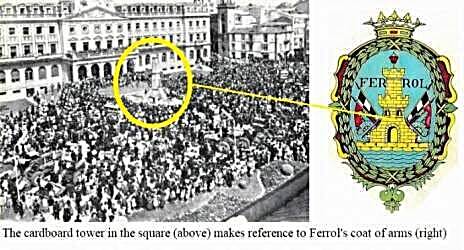
The above photograph comes from Bazan, 22, page 31. Ferrol's coat of arms comes from this webpage.
Bazan, 22, page 31, is entitled, "The Great Event of September 2." To comprehend the event's significance the reader must recall the dichotomy of Ferrol City addressed in the Introduction. Ferrol is a "Castilian" city emplaced in a Galician milieu. This "Day of Ferrol City and County," first celebrated on September 2, 1962, was a public official statement that the Castilian kernel (the city) could not ignore the Galician stalk (the county).
Bazan, 22, exalts the occasion this way,
Our Magazine could not silence such an outstanding event. Several reasons demand it, a few of an affectionate tenor, such as the fact that a high number of producers enrolled in the rank and file of the Company resides in those nuclei of population that border the estuary.No one can deny the reality of the Ferrolian county as a natural geographical unit. It is not an artifice created for political or administrative purposes, based merely on the physical proximity of the men and territories that embody it. ... Rather it constitutes one whole laced firmly with the close bonds of interdependence ... family ties ... and shared material and spiritual interests.
On February 23, 2017, Enrique Barrera Beitia wrote this article for the online newspaper, Galicia Ártabra, which sheds light on the soft political resistance that underlay this celebration of the "Day of Ferrol City and County."
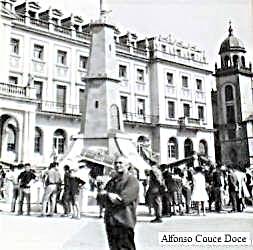
According to Beitia's article the provincial governor of those days handpicked Ferrol's mayor and one third of the aldermen; another third of aldermen was picked by the state-run union and the remainder was elected by Ferrolian heads of family. This last third, nicknamed "Third of the Families," allowed a few "independent" and closely monitored aldermen to enter Town Hall. In the year 1960 an alderman so elected was the forensic pathologist Alfonso Couce Doce (1928-2015). He was notorious for treating poor people free of charge at his private clinic. Furthermore, according to La Voz de Galicia (September 3, 2015) Couce also secretly treated and cured those workers shot on March 10, 1972, who managed to evade the police and reach his dispensary. This alderman conceived the "Day of Ferrol City and County" on September 2, 1962. That day the Galician term, Ferrolterra, (lit. land of Ferrol) came into being officially.
Returning to Beitia's article, Couce headed a victorious three-man slate in the 1964 election of the "Third of the Families." His two political partners were a conservative lawyer and a philo-socialist. The secret police detected the presence of Comisiones Obreras in the slate's list of scrutineers and began to shadow Couce who resigned in 1968 after rating an official post of forensic doctor.
The victorious "Third of the Families" candidature of the year 1968 mustered a newspaperman and two other men with socialist ideas, one of whom was Bazan's head of the Steel Management Office. The civil governor, aware of their socialist leaning, tolerated the newcomers but replaced the Falangist slate with a contrived civilian one that would counterpose them.
The winning candidature of the year 1971 convened a Bazan worker member of HOAC (Workingman's Brotherhood of Catholic Action) a female member of JOC (Christian Workers Youth) and a local retailer. The three had a good relationship with the leftists of Ferrol and their candidature spurred many Bazan workers to vote for the first time.
Bazan, 21, provides on pages 63-66 a calendar of the religious activities in which Bazan-Ferrol was involved during the year 1962.
Bazan, 21, page 79, carries the following bit of news.
The Basque shepherd is a popular character of the U.S. pasturelands. A hundred and fifty Basque shepherds take care of three hundred thousand sheep in California's San Joaquin Valley. Nine hundred and fifty are contracted by the Western Range Association. Their nominal monthly salary is $180, but it generally creeps over $200 and rises to $255 in Nevada due to the harshness of the climate. They enjoy two weeks of holidays a year. Ninety-one shepherds returned to Spain last year with total savings of 30,000,000 Pesetas. Note: "Last year" of course was 1961 (End of Note).
The Reporter Was An Executive Secretary of Bazan-Ferrol. On page 32 of Bazan, 13, October-December 1959, Perez announces her inception of a Woman's Page in the magazine and boasts being the most capable to do the task "because let us be frank: it is time to reveal that a woman skulks behind these discreet initials present in the letters so well-known to Management." Note: Those initials were D. P. L. (End of Note).
She was motivated to create the Woman's Page by a "remote vocation to become a newspaperwoman which never gelled nor was ever definitely discarded." Note: Her very first contribution to the magazine was page 27 of Bazan, 12, July-September 1959, where she reports on the international tours of the Grupo De Danzas De Ferrol (End of Note).
She wished to make the page "somewhat original" and promised "not to occupy herself with Soraya or with Princess Margaret." She added tongue in cheek, "We will start from the premise that there are more women in the world than these two ladies and Brigitte Bardot, despite what the newspapers lead one to believe." Ironically Perez affirmed in the same article that most women didn't give "three cumins" about Baudouin's marriage, but retracted herself on page 49 of Bazan, 16-17, July-December 1960, when she lauded Baudouin's marriage to the Spaniard Fabiola.
Perez's Woman's Page spanned four numbers in total: Bazan, 14, 15, 16-17, 18.
Then there was silence until Bazan, 21, September 1962,
D. P. L., our dear pal and contributor, sends the next article to us from Haifa, a beautiful city on the Israeli coast.A whim of meddlesome Cupid has deprived us of the physical presence of María Dolores Pérez Linos—Loló for further identification—so as to relocate her on the eastern shore of the Mare Nostrum [lit. "Our Sea," i.e., the Mediterranean Sea] where she has just been married by the Catholic rite last December 2 in that city's Stella Maris Church.
But her spirit remains unaltered amongst us; who said that partir c'est mourir un peu? Her agile pen takes up the charge of kindling her memory through the gift of her entertaining prose tinged now with a legitimate "saudade."
At the bringing forth of this her first collaboration from the territories of Israel we congratulate Loló from the bottom of our heart and we make fervid vows for the marriage to bestow upon her all manner of happiness.
The Editors
The following report comes from pages 86-87 of Bazan, 21. It is translated in full.
Dear readers of the Woman's Page:
Hi, pretties! A long time without parleying, but this does not mean forgetfulness, and with the greatest pleasure I resume my collaboration, now "transmediterranean," a term that goes divinely in the Magazine of a Shipbuilding Company. And obviously it seems proper to start by telling you a little about Haifa, for if I don't, it doesn't even seem I'm here.
I hold to the opinion that if a song ever hit the nail on the head it has to be that one which says, "Nowhere like in Spain." Yes, I know that we are always complaining over there about how everything is so expensive, that all the effort to save money is futile, and that if it weren't for the overtime payouts we'd always be under the weather, and so on and so forth. But I would like you to see what it's like to go shopping here. You take the wallet full of these oversized banknotes that circulate in Israel and you figure that you can afford to buy minimum an automobile, but what transpires after you've done all your shopping is that you are left without car or enough money to pay the bus fare.
Setting aside the high cost of living, and setting aside the fact that it does not rain even by a stroke of luck in the summer and that it is a stroke of luck when it does not rain in the winter, Haifa is a gorgeous city replete with trees and gardens every which way (length, beam, overall height and draft, as everybody knows).
Exceptionally groomed due to the contribution of...well...due to the contribution of taxpayers as is true everywhere (and here more so), but besides these, to the efficient, invisible, ubiquitous Israeli police, always on the ball, and it is also due (be amazed!) to the excellent civic education of the population, the children especially. This term, "civic," has for us the connotation of a procession in honour of the Marqués de Amboage and smacks of cliché, but it is not a trifle. Note: Ramón Plá y Monge the Marquis de Amboage (1823-1893) was a Ferrolian emigrant to Cuba who became rich and donated a third of his fortune to the "truly poor" citizens of Ferrol and to the purchase of supernumerary exemptions for draftees originating from impoverished Galician families (End of Note).
The children of this country do not ever pick a flower or trash a garden although playing on park grass is allowed and includes wading barefoot in some park ponds during the summer. You will of course quip, "And with such a disciplined citizenry, what need is there of that admirable police?" Ah, if Haifa be a hill, not every plant growing on it is oregano; 16,000 Arabs dwell in it...
Something I like seeing when I venture out early in the morning, which I do when it's strictly unavoidable because getting up early is baneful despite what the hygienists tell us—does the refrain not say, "Be in bed by ten o'clock"? Note: Perez's humorous bend; the Spanish refrain enjoins being in bed by 10:00 PM but here Perez advises being in bed by 10:00 AM (End of Note).
Well, proceeding, something I like to watch is children directing traffic in front of their school until the smaller pupils have all entered. The children are not invested with the authority to fine, but the grown-ups obey them as they do genuine traffic police, and this is an excellent apprenticeship for the kids.
Boys and girls and young ladies mark time in drills instead of marking the bed sheets of a set; there is no housekeeping service here or Social Service but there is military service. They get their bedding set at an army garrison. There are no exemptions from military service except for religious motives, and the young girls who object on the grounds of an Orthodox conscience must tread carefully so as not to be caught smoking or heading to the beach on a Saturday or eating a ham sandwich because if it is ever confirmed that they do not observe the Torah and the Talmud, i's dotted, t's crossed, off they go to the Army (or Navy or Air Force, paratrooper units included) even if they have turned thirty years old...and a day.
The cooking recipes are very simple; you lift open a can for the meal, you lift open another for the dressing. Naturally the appetite is lifted most with such a diet, but no doubt cooking is made a lot simpler.
Alright, speaking seriously, since many people here were raised in very good diapers, meaning they came from European countries where cooking is an art, as it is in Spain, there are houses and even a restaurant or two where the food is very good. So I will share a recipe with you some other day.
Summarizing, the main hassle with Haifa is that although it is closer by airplane to Ferrol than Jubia was in the days of the tram, it is still a tad far. Note: "Jubia," today's Xuvia, is 7 kilometers away from Ferrol (End of Note).
The Mediterranean Sea contains more water than is suggested by a map, and I was raised on caldo de grelos (broccoli rabe stew).
Still a Galician is someone of whom it is not yet established whether he has morriña (homesickness) because he emigrates or whether he emigrates because he must have morriña to feel whole. Either way he adapts to any place and takes along his accent, his lexicon, his songs...and Spain everywhere. And that, to a very modest degree, is what this eternal friend and workmate of yours is doing here.
D. P. L.
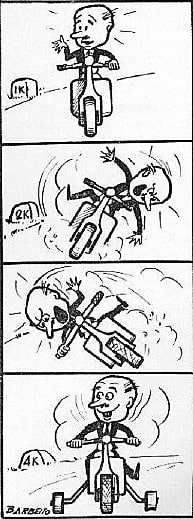 |
 |
 |
 |
 |
|
 |
||
| Ferrol's New England Theater (1906-1914) |