A Timeline of Life in America: Flashback to 1960
The source for the news in this chapter has already been discussed in the chapter entitled, "Bazan Magazine for the Year 1956."
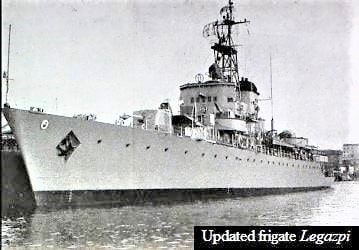
The notable event of 1960 came early in the year. At 12:45 PM on January 14, 1960, the shipyard delivered the "modernized" frigate "Legazpi" to the Spanish Navy. The bare hull of the frigate had been launched in 1945 with the rank of gunboat. It was not delivered to the Navy until the year 1951.
On September 26, 1953, Spain and the U.S.A. signed a series of agreements known as the Pact of Madrid which bound the American side to help with the modernization of the Spanish Armed Forces. Mª del Rocío Piñeiro Álvarez explains in her article, "Los Convenios Hispano-Norteamericanos de 1953," published in Historia Actual Online, 11, pages 175-181, year 2006 (PDF) that the pact had a duration of ten years split in two installments. The economic aid received during the first five-year period boosted the supply of food and raw materials to an impoverished Spanish populace, but overall American aid was sparse until the start of the second installment in 1958. The main thrust of the Pact of Madrid was the establishment of American military bases in Spain.
According to this webpage it was not until the start of the second installment that Bazan-Ferrol began refitting two gunboats, "Legazpi" and "Vicente Yañez Pinzón." Their hull remained intact but the bridge was reconstructed and new hardware added, most notably sonar, aerial radar, marine radar, gunfire-control radar, wireless telegraphy and identification transponder. Still the military effectiveness of these modernized vessels was limited by their slow speed relative to the speed of potential enemy submarines. On the plus side the updated frigates turned out to be an "excellent platform" for training and the "Legazpi" took part in several joint Spanish-French naval exercises. The frigate was decommissioned in the year 1978.
On March 25, 1960, sister frigate "Vicente Yañez Pinzón" was delivered and on September 7 the third modernized warship, the destroyer "Furor".

U.S. Ambassador John Davis Lodge (b. 1903, d. 1985) presided the delivery of "Legazpi" on January 14. He was accompanied by the Spanish Minister for the Navy, by the captain general of the Maritime Department, by U.S. Major-General Stanley Joseph Donovan (b. 1910, d. 2001) chief of the Joint U.S. Military Affairs Group, by the captain general of the Eighth Military Region, three rear admirals, the military governor, a brigadier-general, the civil governor, the bishop of the Mondoñedo-Ferrol diocese, Ferrol's mayor, the director and two chief executive officers of Bazan-Ferrol and "numerous" commissions from the Spanish Navy and from Bazan-Ferrol.
Ambassador Lodge delivered a brief speech and unveiled a commemorative plaque. This was followed by an "important speech" from the Spanish Minister for the Navy. Both "illustrious" speakers were roundly applauded and their words evinced once more the "sincere and loyal friendship" existing between the countries.
Following the act the Spanish Minister for the Navy offered an official meal at Navy Command Headquarters to the American ambassador and other top officials.
The following clip records the launching ceremony. The full newsreel, ten minutes long, was first shown on Monday January 25, 1960.
Official Spanish Newsreel NO-DO 890 A
Voice-Over Translated: Delivery of the frigate "Legazpi" to the Spanish Navy takes place in El Ferrol del Caudillo, and Admiral Abárzuza the Minister of the Navy reviews the company of the Northern Third Corps that renders him honours. U.S. Ambassador Mr. Lodge attends the act and the ceremony unfolds at the loading dock of the arsenal. The frigate is modernized according to the plan agreed between North America and Spain. Officials and sailors go aboard to take up their posts. The national flag is hoisted first and afterward the ensign of the Minister of the Navy. Mr. Lodge expresses his satisfaction at participating in this ceremony and afterward unveils a commemorative plaque. The Navy Minister says that this delivery represents the end of the inaugural cycle of modernization and the beginning of a new era for our Navy.
On January 15, the day after "Legazpi" was delivered, the oil tanker "Ribagorzana" was launched. It belonged to the same Series "T" as the "Valmaseda" and it was delivered to "Empresa Nacional Elcano" on August 11.
On May 13 the freighter "Tintoré" was launched. It was destined for the cargo line, "Catalana Marítima, S.A."
The vessel was "almost entirely" welded together (i.e., nearly ousting the use of rivets altogether).
The two photographs are courtesy of Xan Ramírez Gómez.
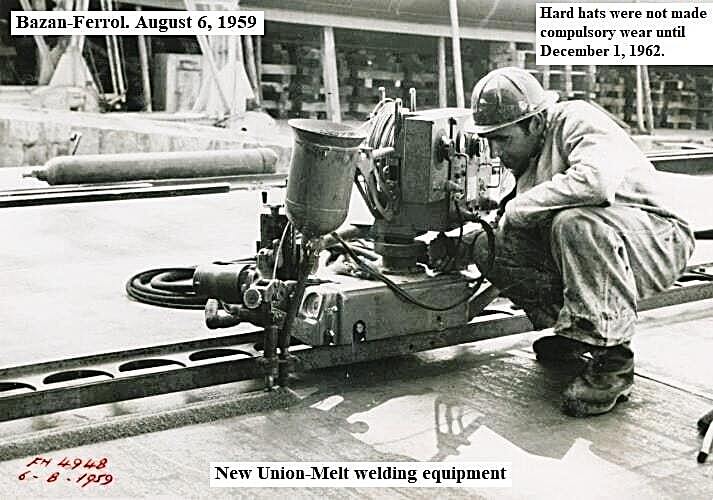
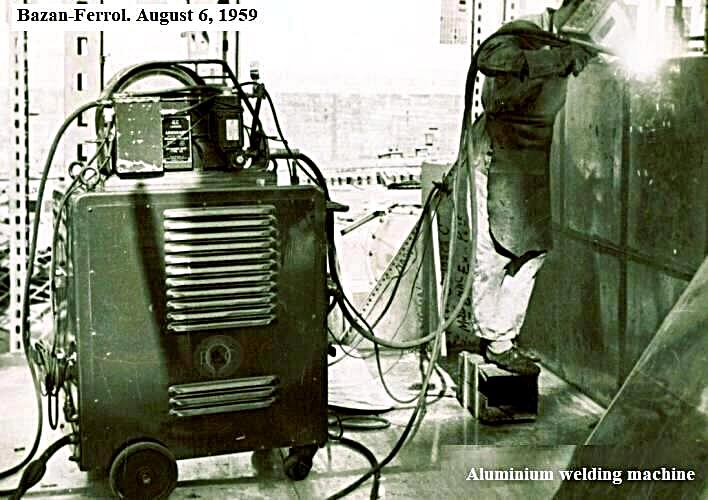
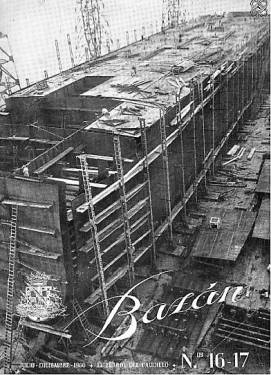
The greatest attention of the shipyard during the year 1960 was focused on the construction of the oil tanker "Bilbao" (see the photograph heading this chapter).

1. Manuel Novás Fraga started in 1916 as an outstanding apprentice of Stocks when he was nineteen years old. He had a "fast and brilliant career" in slightly more than fifteen years: foreman, master second class, master first class and technical assistant in the Works department. He was sixty-three years old when this interview took place.
"You are a Ferrolian, right?" "Yes." "Which one of the many projects that you intervened in left you with the fondest memory?" "The launch in 1944 of the first four "Pizarro" class gunboats which was brought about in record time and which came out perfect. This in spite of the fact that, as a consequence of the world war, we were forced to make use of tallows and greases of very bad quality." "What are the main requirements for good stocks?" "That its bed be solid, to count on good crane service and that it have, if possible, adequate facilities for efficient, quick and smooth prefabrication. Our current stocks, which is magnificent, meet those and even other requirements. Perhaps I would annex a storehouse for the blocks, outriggers and transverse cradle beams in disuse." "Let us now, with your licence, pass to talk about man: who is the ideal worker, in your view?" "The one with the highest sense of responsibility on the job." "And what is the best way to order about?" "One based on the producer's psychology, constantly seeing first the man and second the partner in the task at hand." "What quality do you miss most in today's worker which the older ones had? And which least in the worker of back then relative to today's?" "I miss in today's worker the desire of the older worker to beat nobly the product quality of the best mates in the workshop. I do not fail to appreciate notwithstanding that the modern worker has a much more fine-tuned professional instruction."
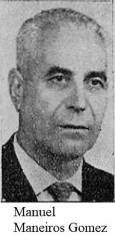
2. Manuel Maneiros Gomez was born in Ferrol in 1894 and he joined the Factory in 1917 as a member of the Stocks Carpentry shop.
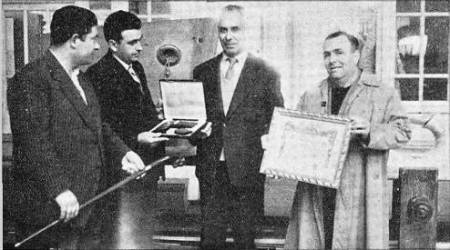
Thirteen years later he was sent to the Hall of Scrive Boards temporarily to design the hawseholes of the cruisers Canarias (decommissioned in 1975) and "Baleares" (sunk in 1938) but the transfer became permanent.
The following interview took place on March 31, 1960, the day of his retirement, right after co-workers had presented him with a gift and a framed diploma.
"You were a good carpenter of scrive boards. Would you have liked to make a living with some other profession?" "No. I am very glad to have been what I was." "Point to us one of your favorite hobbies." "Music." "Another one." "To travel, but it's so expensive!" "Do you retire gladly?" "Well, in fact, yes. However it grieves me, and I must declare it so, that retirees get paid so little, notwithstanding which I do not forget that they were paid even less aforetime." "Would you like to tell us your opinion of the Hall?" "Scrive Boards is a very tidy workshop, very well lit, very welcoming, although extremely cold in winter. Its personnel is first-rate, a good example of their kindness is this farewell homage. Will I be grateful enough to my workmates for this most honourable distinction?" "Do you know what your workmates told us? That they are very sorry to not be able to give you the farewell you deserve, that today's act is but a small token of affection and a minimum proof of how much you are cherished." "It's a great workshop. This Scrive Boards is a good shop," repeats Mr. Maneiros very moved.
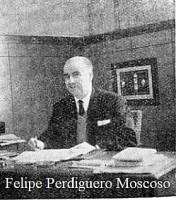
3. Felipe Perdiguero Moscoso joined the Factory in 1941 as the official in charge of the Company Store. Note: In 1941 the name of the Ferrolian shipyard was "Constructora Naval," a name that stuck long after Bazan-Ferrol was constituted in the year 1947 (End of Note). The following interview is found in Bazan, 14, pages 20-21.
"How many people benefit from the Company Store?" "Approximately 32,500. But not everyone makes a constant or identical use of their rights as a beneficiary. The following percentages speak volumes: cooking oil, sugar and soap are picked up by 98% of the beneficiaries; rice by 60%; potatoes and chickpeas by 45% and the beans and lentils by only 40%." "As Company Store manager and an expert in how it works, would you like to pass on some important advice to the beneficiaries?" "Yes, with great pleasure. It is extremely important that upon collecting their purchases from the counter they should double-check the number of parcels or bundles that corresponds to each one. It is the only way to avert that they leave behind, forgotten, some articles of their own or that, on the contrary, they carry off others that belong to the beneficiary standing beside them on the counter. Here I wish to make a norm of the Company Store public, which is to reward the honest gesture of whoever returns one or more parcels carried off by mistake with the total of the returned merchandise." "Tell me, Mr. Perdiguero, how many persons, in some sort of record-beating trial, do you reckon could be tended to in one hour?" "So that you may have a very approximate notion, I will tell you that in more than one occasion, due to circumstances which are not germane, we managed to serve close to four hundred and fifty persons in just one hour." "A final question. What has been the biggest delivery of goods in the Company Store and the most useful to the beneficiaries?" "In the year 1949, amid a great shortage of potatoes in this locality, a supply of this product was effected from Holland, of the best grade and which amounted to 400,000 kilograms that were distributed among the beneficiaries in a short period of time under a system of rationing."
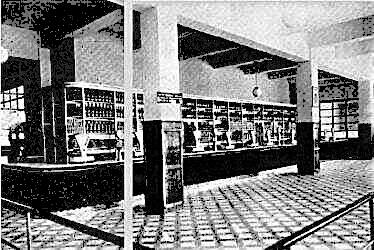
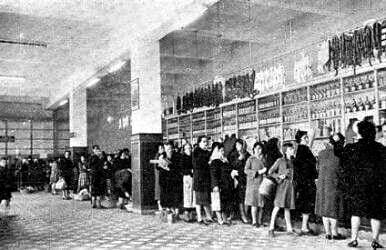
Franco's government decreed the compulsory creation of company stores in January 1941 to ensure that the workers of industrial centers had a minimum supply of food and staples. Note: The decree was published officially on January 30, 1941. It ordered the following enterprises to establish and fund company stores: all coal mines, the mining companies of seven provinces, all railways, contractors of public works, ironworks with a payroll of fifty or more employees, the cement industry, textile industries operating in provincial capitals or in population centers bigger than 20,000 inhabitants. Its second article made the director of an enterprise personally responsible for the correct functioning of the company store. Rationing and prices were set by the government. The decree's opening paragraph acknowledged "the difficulties of the moment in procuring a normal supply of consumer goods" (End of Note). Since the Ferrolian shipyard was under martial law at the time so too was the Company Store. This was a propitious circumstance for it expedited the store's access to sources of food through the administrative channels of the Navy.
The first bureaucratic necessity was to conduct a census of the entire personnel of the Factory, families included. The census yielded a total of more than 25,000 beneficiaries spread across 6,000 families.
In April 1941 the Company Store started off in cramped premises. Long lines of beneficiaries waiting to enter formed outside. Just two staples were offered: ½ litre of cooking oil per person per month; ½ kilogram of rice per person per month. Gradually the offer expanded to the official rationing quotas, namely, 1 litre of cooking oil per person per month; ½ kilogram of rice per person per month; ½ kilogram of sugar per person per month; ½ kilogram of dried legumes per person per month; 5 kilograms of potatoes per person per month; 400 grams of soap per person per month.
Cooking oil was stored in four big tanks installed in separate premises some distance away. More than 25,000 litres were dispensed monthly. The four tanks could hold 150 metric tonnes overall. Note: This is probably an error, it implies a holding capacity of 150,000 litres of cooking oil, half a year's supply! There is good reason to suppose that the true figure hovered around 400 litres per tank (End of Note).
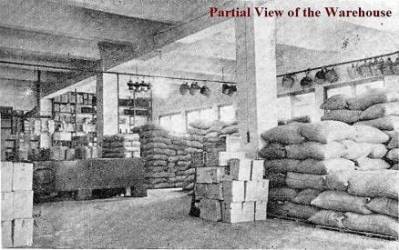
In August 1948 the Company Store moved to a new building ample enough to host all previous transactions in one place. The patron saint assigned to the new facility was St. Joseph (the Worker).
The beneficiaries of Bazan-Ferrol walked up a short ramp (the street has quite a steep gradient) and entered a spacious chamber of 24 meters long × 6.8 meters wide. The warehouse (photograph to the right) lay behind the public chamber and was big enough to accommodate trucks.
The Spanish government freed up the sale of dried legumes in 1950 and of sugar in early 1952. Finally on April 1, 1952, the rationing system was officially ended. Nevertheless the establishment kept offering goods at discount prices. The limitations on the sale of "basic staples" pertaining to the period of rationing were preserved, and the sale of all other items was monitored closely to forestall hoarding.
In 1958 the Ministry of Labour ordered company stores to broaden their sales to include shoes, clothes and fabrics. Note: The decree was published officially on May 17, 1958. Its twentieth article ordered company stores to supply at minimum these "basic" items: cooking oil, soap, sugar, rice, bacon, flour, beans, lentils, chickpeas, potatoes, ham and sausages, canned food of all kinds, eggs, coffee and substitutes, condensed milk, cheese, butter, chocolates, common table wines, dried fish, canned fish, pasta for soups, biscuits, macaroni and suchlike, coal for domestic use (i.e. for cooking and heating), clothes and work shoes, casual footwear and fabrics. The first and twenty-third articles of the decree stressed that consumer goods were to be sold at cost value, without a profit margin. This decree abrogated the statutes of January 30, 1941, and April 6, 1946 (End of Note).

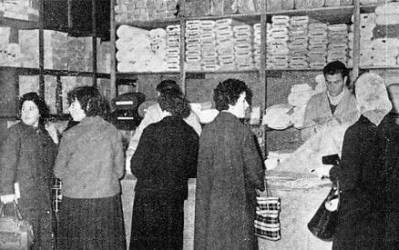
Accordingly Bazan-Ferrol rented the upper floor of the building and set up counters for Shoes and Textiles. These new sections opened in September 1958.
Bazan, 14, states that 30,956 pairs of shoes, 82,245 items of clothing, 75,043 meters of fabric and 1,093 umbrellas were sold upstairs during the year 1959.
The magazine adds that more than 1,500 persons frequented the establishment daily.
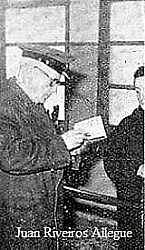
1. A beneficiary presented her passbook to the security guard at the door (photograph to the left). Note: "Her passbook": Salesclerks and other figures of authority were always men in those days and the customers women (End of Note).
The guard checked it and returned it.
According to page 24 of Bazan, 14, the security guard at this time was an elderly man named Juan Riveiros Allegue. He had been born in the hamlet of Doroña (min. 2:16-2:34 of this video) and had joined the Factory in 1947.
The magazine states that he was "a pleasant man" who loved to read and whose conversation entertained. He had spent eleven years in the Republic of Cuba and knew an "infinite number of things" about the country. He had also lived for "some time" in the United States where "he was able to practice the English language a little bit, which today he speaks with considerable ease."

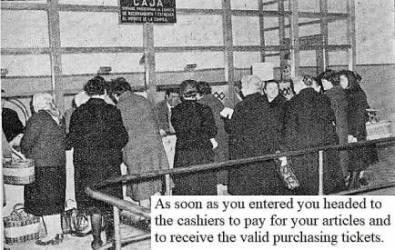
2. Once allowed inside, the beneficiary went first to one of the five window tellers (photographs on the right).
There she paid the full amount of her purchase(s) and the teller gave her the appropriate coupon(s).
3. Coupon(s) in hand, the beneficiary now went to the counter to pick up the articles she had paid for.
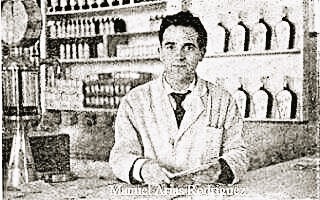
According to page 24 of Bazan, 14, Manuel Arias Rodriguez, a clerk at the food and drink counter downstairs, became "famous" first for having been an outstanding soccer player between the years 1945-1948 with teams "Canido" (a neighbourhood of Ferrol) and "Arsenal" (sponsored by Bazan-Ferrol) and second for being a very fast sorter of coupons, capable of collating 1,500 randomly packed ones into six homogeneous heaps in a record time of 42 minutes, an ability that earned him the nickname of "human machine." He was at this time in the Bookkeeping Office assigned with the task of checking whether the net worth of the merchandise transacted over the course of a business day matched the amount of cash collected by the tellers.
It is interesting to note that the seven bottles with distinctive shape visible on the shelves directly behind the clerk are sold today as memorabilia.
4. If one or more articles had run out, the beneficiary notified the Claims Desk. Careful note was taken and assurance given that the out-of-stock article(s) would be held in reserve for her after the next truck delivery.
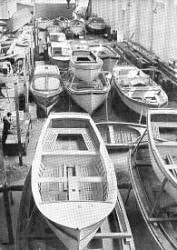
Bazan-Ferrol had a workshop for the construction of watercrafts: robust workboats, gondolas, whaleboats, dinghies, sculls and recreational boats. This workshop, 80 meters long, was equipped with bandsaws, circular saws, drum sanders, a lathe, multi-use universal woodworking machines, etc. A 10-ton mobile crane moved matériel about.
A few meters away stood the Repair/Maintenance shop. It was smaller, had two 4.5-ton mobile cranes and a loading ramp with a flatcar roped to an electric drum winch. The flatcar was the means to beach or launch the boats.
The two workshops shared a staff of thirty men.
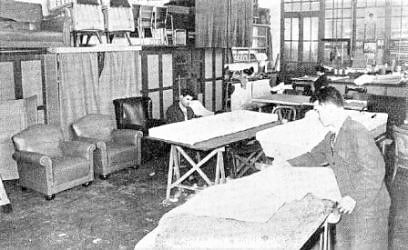
The Cabinet Making Workshop made all the furnishings of ships or company offices. It was divided into three sections: Fine Woodworking, Upholstery and Varnishing. The first section was equipped with many individual workbenches, bandsaws, scroll saws, mortisers, drills, tenoners, wood moulders, sanders, lathes, gluing presses, etc. The second section had sewing machines, ironing tables, fabric cutting tables, etc. The three sections were staffed by fifty officials, some of them women, everyone perfectly trained for the job.
There is additionally in these workshops that indescribable, arresting scent of the most diverse timberland. A little, one might say, like the presence of faraway forests within the white walls.And visiting these workshops is so pleasant!
(F. Vila. "Two Aspects of Working with Wood: Watercrafts And Furnishings." Bazan, 15, pages 11-13)
And now we know the ultimate destination of the timber from Equatorial Guinea! (September 12, 1954).
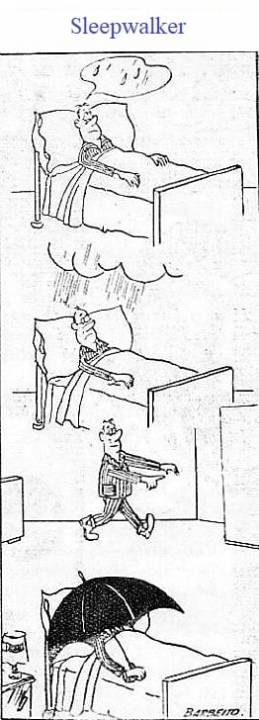
Juan Manuel Castro, featured in ARTS AND LETTERS of the year 1957, also composed poems in the Spanish language. This one comes from page 34 of Bazan, 14.
|
Into the half-light of my room
The brain objects to this intrusion,
Let it rain, let it rain,And Round and round the wheel
The echoes resound leaping over the balcony
Damned deafness! It does not let me hear!
Not even a housefly do I hear in my room. |
Note: The four italicized lines (2.8-9, 2.11-12) are the opening lines of two popular nursery rhymes (first one, second).
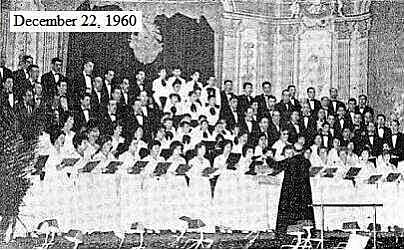
On Thursday December 22, 1960, Teatro Jofre hosted the traditional fundraising concert for the mutual fund that assisted 120 needy and sick Bazan workers financially. Reverend Fanego the chaplain of Bazan managed the fund. All the musical groups of Bazan took part in the concert. The event was sold out and the proceeds ran to 15,685 Pesetas.
This festival had first been held in the year 1951 and repeated every Christmas season thenceforth. Isaac Fraga Penedo (1888-1982) the owner of Teatro Jofre ceded the hall at no charge year after year.
The mutual fund at this time succored a total of a hundred and twenty workers divided into three groups: (i) eight classified as "chronically disabled" who received from the government a monthly pension of from 192 to 300 Pesetas, (ii) twenty-six on sick leave lasting longer than five years whose monthly pension varied from 167 to 500 Pesetas, and (iii) eighty-six on sick leave lasting less than five years whose monthly pension ranged from 192 to 1,250 Pesetas. Note: According to this webpage a television set cost around 6,000 Pesetas in 1960 (End of Note).
The concert was a resounding success, the public's response enthusiastic. The Bazan performers had to concede three encores: Bolzoni's Minuetto, the Portuguese carol, Natal, and Rossini's Tarantella.
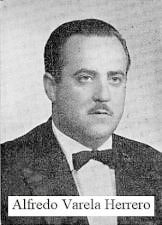

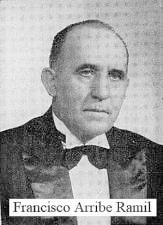
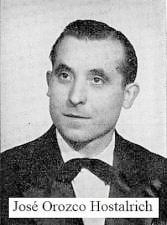
The above photographs come from pages 26-27 of Bazan, 15.
Alfredo Varela Herrero. Baritone. Born in Ferrol. He joined the Factory as an apprentice accountant and was at this time an official first class in the Accounts Receivable Department. He joined the musical groups of Bazan-Ferrol in 1941, year of their foundation, and was an outstanding figure from the start. Together with Lorente (second from the left) and Orozco (fourth from the left) he created an independent musical group called, "Amigos de la Zarzuela," (Friends of the Spanish Operetta) which broadcast "select fragments" of the genre over Radio Ferrol for "many weeks." Note: I first heard the notes of Glenn Miller's Moonlight Serenade as a small child listening to the opening music of Radio Ferrol's late-night program (End of Note).
Felix Lorente Barbat. Bass. Born in Portugalete (Basque country). The magazine does not disclose his profession. He joined the Polyphonic Chorale in 1950, one year after he arrived to Ferrol. In the year 1954 baritone Antón Navarro (1926-1999) brought his travelling lyric theater to Ferrol. He was so impressed with Lorente that he invited the Ferrolian to perform in the operetta, Marina.
Francisco Arribe Ramil. Lyrical Tenor. Born in Ferrol. He was at this time a painter in the Electricity Workshop. In his youth he sang in the "Toxos E Froles" (Gorses And Flowers) folk choir. He joined the Polyphonic Chorale in 1941. He was a great fan of zarzuela and opera.
José Orozco Hostalrich. Dramatic Tenor. Born in Denia (Alicante). He joined the Polyphonic Chorale in 1950. The magazine does not disclose his profession. He was the father of two "beautiful girls" and a "very intelligent" boy whom he expected—tongue in cheek—to become one day as famous a tenor as Mario del Mónaco (1915-1982).
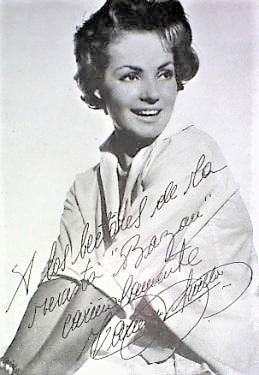
The above photograph comes from page 32 of Bazan, 14. The dedication on the photograph reads: "To the readers of 'Bazan' magazine with fondness. Carmen Sevilla."
The magazine's caption states,
BAZAN Magazine in the name of its numerous readers thanks Carmen Sevilla a lot for her spontaneous mailing and for her kind dedication on this her impressive and so "eloquent" portrait.We avail ourselves of this pleasant opportunity to reaffirm ourselves as the most loyal fans of her art and matchless beauty.

Alberto Permuy Martinez entitles his article, "A Great Campaign by Club Arsenal" (Bazan, 14, p. 26). Throughout the 1957-58 Third Division league Arsenal fluctuated between the eighth and fourteenth places in the classification table and finished tenth. During the 1958-59 league Arsenal rose in the standings and finished seventh. In the current 1959-60 season Arsenal "has always been battling in the top five spots of the table except once when it was sixth." Permuy ascribes the team's steady improvement to management's strategy of recruiting local talent from grassroots clubs.
Perhaps the most inexpensive team in Spain and definitely so in their league, Arsenal, composed of amateur players who hardly earn more than a modest gratuity, defeats other teams whose professionalism, extravagant in the Third Division, did not spare them a negative result. Arsenal's performance can not have been more brilliant defending with enthusiasm, zest and total commitment the team colours and the Company where they work.
At the time Arsenal was fighting for second place and a corresponding berth in the playoffs for promotion to the Second Division.
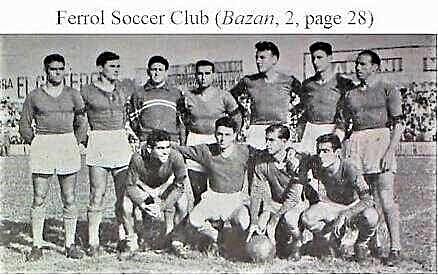
In Bazan, 15, p. 29, Permuy lamented the automatic descent of professional Ferrol Soccer Club to Third Division at the close of the same 1959-60 season (April 17, 1960). He blamed the coach and the lack of physical training and morale for the "catastrophe." The 1960-61 season saw Arsenal and Ferrol compete in the same division of the Spanish Soccer League.
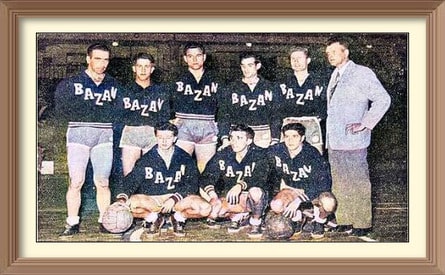
On page 29 of Bazan, 16-17, the reporter and Reverend Fanego bemoaned the "alarming plunge" in attendance to basketball games, which in turn impacted the revenue of the mutual fund set up to assist needy workers and their families. Concerts since 1951 and sports since 1955 were the main sources of income. Regarding soccer, Arsenal's charity matches returned 181,039 Pesetas between the years 1955 and 1960 inclusive.
In regard to basketball, the chaplain recalled the "magnificent attendance and revenue" garnered by "that unforgettable match, Bazan versus Selección Nacional." Note: It was played in February 1954. The match started at 7:30 PM and the final score was 69-57 (End of Note). "Everybody is aware of the alarming plunge suffered by our basketball in the last few years," said Fanego. The income from charity basketball declined steadily: 17,400 Pesetas in 1958. 8,921 Pesetas in 1960. "But now the outlook is truly bleak." Fanego pointed to the "heartwarming" 3-team Christmas tourney where not even the participation of the "Old Glories" aroused fan interest. The tourney returned 2,883 Pesetas only.
"Very lamentable," the Bazan reporter concurred. "Let's trust the good old basketball days of the Company will return for everyone's benefit."

On March 7, 1960, the dockyard celebrated the religious feast of St. Thomas Aquinas (biography).
The morning Mass was officiated by Reverend Fanego in the Chapel of the Christian Schools of the Factory. It was presided over by the Sub-Inspector of Schools, the Inspector and Head of Phys Ed, two other inspectors, another sub-inspector, instructors and monitors. The pupils of "all courses" attended. In his homily the chaplain exalted St. Thomas Aquinas and proposed him as a role model for Bazan's apprentices: "assiduous dedication to study, the love of work, the greatest regard for the Christian virtues and especially for the angelical virtue of purity." The article written by "Khronik MELOS" (Bazan, 14, pages 22-23) states that Fanego proposed that "science and virtue must be the two wings with which our young men rise above the muddy fields of modern life."
The Mass was followed by "several athletic trials and hard fought basketball games" at the gym. An "artistic/musical" contest among some apprentices and watched by all was held in the afternoon also at the gym.
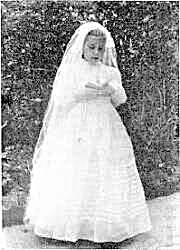
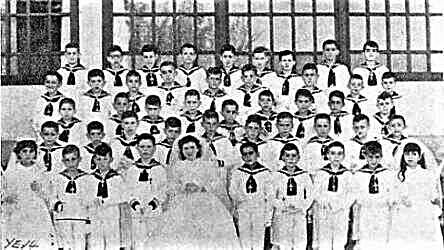
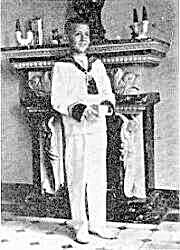
Reverend Fanego officiated the Communal Mass in the Chapel of the Christian Schools of the Factory. All four hundred pupils took part in "the religious and emotive act impregnated of angelical candor and innocence" (Bazan, 15, p, 24). Following the early morning Mass those children who had done their first communion were escorted to the gym and offered a "traditional, splendid breakfast" courtesy of Factory Management. Note: The traditional First Communion breakfast was hot chocolate with fried dough sticks (End of Note). At breakfast's close the children were presented with a "precious" souvenir diploma and a pouch of chocolates.
All the boys shown above wear a traditional sailor outfit which I too wore at my First Communion. However a few children wore commander uniforms similar to this one. Unbeknownst to me then, the differing uniforms were a childhood demonstration of Marxist class theory.
A child's reaction to the dogma of transubstantiation, a term coined by St. Thomas Aquinas, can only be revulsion. Of course the suggestion of eating the actual body of Christ lost potency in catechism class when we did "practice runs" using unconsecrated communion hosts that tasted like cones of ice cream. And of course the "blood of Christ" turned out to be specially bottled wine which priests alone were supposed to drink and which some altar boy occasionally helped himself to when the priest's back was turned.
I wager few boys and men believed the dogma of transubstantiation because a "blasphemy" often heard in Ferrol and elsewhere was, "Te voy a dar una hostia" (lit. I'm going to give you a host, fig. I'm going to punch you).
I read this story in a religious booklet called, "El Mensajero," whose subscription, I believe, was monthly. The booklet carried short stories written for children. I remember two—and vividly their illustrations—but only one is germane.
Somewhere in Africa, ran the story, missionaries had erected a makeshift church in a small village. A hostile tribe came to attack the village and the missionaries fled for their lives. A young African boy ran to the deserted church, retrieved the chalice with consecrated hosts from the tabernacle and climbed on the roof to escape the turmoil. The raiders shot darts at the boy and set fire to the church. He perished covering the chalice with his body.
The illustration showed an African boy protecting the chalice on a roof of straw. His white shirt had bloodstains and flames licked the straw.
I suppose the story was intended to instill a spirit of martyrdom in children, but the effect was mixed, for how could missionaries who said transubstantiation was true flee without the consecrated hosts?
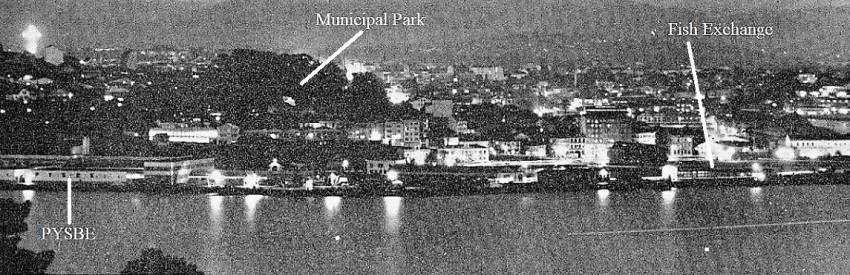
From Thursday October 27 to Sunday November 6, 1960, the Roman Catholic Church launched a mission to re-evangelize Ferrol city and county. The religious drive lasted eleven days and touched all administrative centers: military, educational, industrial, etc. Besides them the normal outreach nuclei swelled in "extraordinary profusion" during those days. An extraordinary cross 92 meters high was lit at night on the heights of Canido (above photograph, top left-hand corner) for the duration of the Great Mission.
The Factory hosted three days of "religious conferences" chaired by a prelate from Asturias and another from the Basque Country. "The entire personnel listened with magnificent attention and interest to the ardent discourse of these missionaries." The conversion effort reached also those Bazan workers posted at A Graña and Caranza.
Bazan's involvement was not a surprise to anyone. Bazan, 5, p. 13, already served notice that the Factory had a policy of staging similar missions in-house every year (1950 photograph).
The Asturian prelate finished his assignment emplacing the "Most Blessed Sacrament" to public exposure in the gymnasium during a "Holy Hour." At the end of the sixty minutes the "Most Reverend Bishop" lifted the sacrament (i.e. a chalice filled with consecrated hosts) and blessed the audience with it. The "fervour and religiosity" of the auditorium was "truly impressive."
Similar "extraordinary piety, order and discreetness" pervaded the Communion Mass for apprentices officiated in the Study Room of the Schools conveniently converted to "a makeshift and spacious Chapel." Although attendance here was apparently voluntary, "almost the whole body of apprentices approached the Sacred Table."
The identity of José Lorente is discussed at length in the "JOSÉ LORENTE REPORTS FROM ISRAEL" section found in Chapter 10, "Bazan Magazine for the Year 1958."
Lorente's next report was from Egypt and was published in Bazan, 11, April-June 1959. This photograph shows Lorente, his wife, a guide and three helpers in Egypt with the Great Pyramid of Giza in the background.
On pages 28-29 of Bazan, 14, January-March 1960, Lorente interviewed Archbishop Makarios III who a few days prior had been elected the first President of Cyprus (December 13, 1959). The interview started at the concerted time, 12:30 PM sharp.
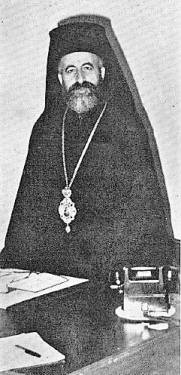
"Your Eminence, are you gratified that Cyprus is at this time already an independent country?" "Some Greeks and some Turks possibly will not be happy, but the immense majority, that one which sacrificed on both sides so much to reach this solution, is glad. I count myself among them, and I am also gratified, very gratified."
"Was Your Eminence always sure of obtaining the Island's independence or were there moments when you doubted the victory?" "I didn't know how or when, but I always knew that Cyprus would become independent."
"Does Your Eminence regard the Island's independence as the definitive solution to the problem that for four years plunged it into the Revolution?" "Yes! Cyprus' independence is the definitive solution to the Revolution, for the people of Cyprus have achieved their aim with this independence."
"What is from Your Eminence's perspective the biggest problem that the newborn Republic will have to face?"
Before answering this question, the Archbishop asked the interpreter why the Spaniard kept saying, "Your Eminence," at every turn. Lorente explained. Makarios smiled and wrote his explanation on a notepad.
"I expect there won't be any problems, but if one shows up, it will be of an economic nature during the first year of independence. We have drawn up the annual balance sheet and we find that there is no money for our public works program. But we hope to receive foreign aid."
"In regard to foreign affairs, may Your Eminence disclose whether Cyprus will lean toward the Western bloc, the Eastern or maintain a neutral stance?" "Cyprus is a country that has to ponder its domestic development before anything else. That is why we will be a neutral nation, and since we want to have friends for neighbours, Cyprus will not join any bloc."
"Does Your Eminence not believe that the current strength of the Cypriot Communist Party may alter this initial line?" "No. My government represents legitimately the people of Cyprus who elected it freely. The Communists are a minority and will have to abide by the decisions of the government."
"Does Your Eminence not worry that having cordial relations with Israel might bring Cyprus some disadvantage regarding its relations with the Arab world?" Note: Spain did not have diplomatic relations with Israel (End of Note).
"Our diplomatic relations will be decided by the President and by the Vice-President who is a Turkish Cypriot, as you know, and we have not yet decided what kind of relations we will have with Israel. Of course I repeat once more that Cyprus simply desires to have friends all around."
"Will Cyprus remain in the Commonwealth?" "We have not reached a decision to date. Moreover it will not be the government's prerogative alone because whatever agreement we reach on the matter will have to be approved by the people in a referendum."
"In regard to finances, may Your Eminence disclose whether Cyprus will stay in the area of influence of the Pound sterling or move away?" "We will remain in the domain of the Pound sterling over the next ten years. It is too early to foresee what we will do afterward."
"Another question with Your Eminence's license. Has Your Eminence ever been to Spain?" "On my voyage to America the boat called on a Spanish port. I was infinitely disappointed that the haste in departing did not allow passengers to debark. I have also transited Barajas on more than one occasion, I saw Spain from the plane. And I hope to eventually see Spain in situ." Notes: The port was probably Barcelona. Barajas is the name of Madrid's International Airport (End of Notes).
"Is the possibility then open that Your Eminence will one day deign to visit our country?" "Since Spain is such an interesting country I hope to visit it informally soon."
The interview finished, Archbishop Makarios III the "Provisional President and President Elect of the Republic and Supreme Head of the Orthodox Church of Cyprus" bid farewell to José Lorente with these words, "On this occasion I wish to express my gratitude to the Spanish people for their positive attitude to the cause of Cyprus' independence at every turn."
José LORENTE
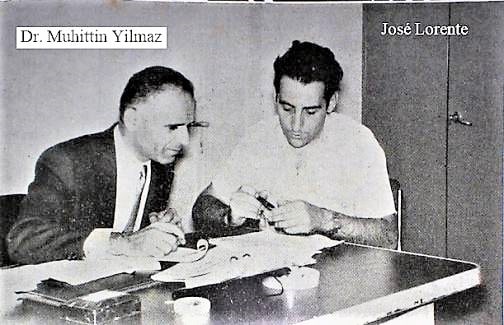
On pages 34-37 of Bazan, 16-17, July-December 1960, Lorente interviewed Dr. Muhittin Yilmaz the director and main announcer of Radio Ankara's short-wave programs in the Spanish language broadcast at 11:30 PM nightly. Lorente states that Yilmaz's radio voice sounded "friendly, with clear and perfect Spanish diction."
Dr. Yilmaz had also directed the Turkish national delegation to the Fourteenth International Competition of Folk Dances and Songs held in London. Twenty-four countries, he said, took part. Turkey won the first and third prizes in the dance category, Yugoslavia finished second. Spain was second in the singing category.
Dr. Yilmaz was appointed attaché of the Turkish Embassy in Spain for the period 1954-56 after coursing university studies in Istanbul and in the Sorbonne (Paris). He took adavantage of his spare time in Madrid to study Spanish Literature. He received a Ph.D. degree in Philosophy and Letters from the University of Madrid for his thesis, "The Elements of Nature in the Poetry of Góngora," completed under the supervision of Prof. Dámaso Alonso.

"Which dances earned you the awards?"
"We won the first prize with the Dance of the Swords and Shields. This dance has six figures that symbolize duelling before the discovery of firearms. The figures represent in succession, (1) homage to the people that send their sons to war, (2) swearing over the swords, (3) duelling, (4) the calling of a truce, (5) the trading of swords according to the terms of the truce, and (6) the recovery of a weapon snatched away with trickery and a reconciliation as the finale.
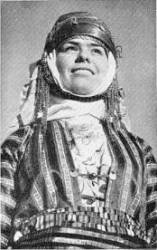
"The group from Gaziantep earned the third prize for their Halay dance (photograph above, right). A spry, dynamic dance interpreted by men and women, resembling your jota aragonesa somewhat."
"Do you mean to say that there is a certain similitude between the folklore of both countries?" "Yes, a considerable amount."
"What do you attribute this similarity to?" "The resemblance of both folklores is a clear reflection of the two countries' local colour. I understand by local colour the history and battles sustained by our nations to ward off their respective enemies. And the very interesting rhythm that defines the virile existence of both peoples. Folk dances reflect all this without, it seems to me, the sway of an epoch."
"How would you define, señor Yilmaz, the meaning of the word folklore?" "What expresses in a concise manner the inner world of a people, its happiness, its sorrow, its reaction to circumstances, which we convey by means of rhythm and music, i.e., folklore. In a broader sense it is a synthesis of dances, music, literature, traditions. In other words folklore is the résumé of a people's psychology."
Lorente affirms in his report that the Spaniard who visits Turkey will immediately take notice of a Turkish style of singing called Gazel which is very similar to Andalusia's cante jondo because both use wailing melodies, extended notes and the stretching of a syllable into a guttural flourish. In regard to lyrics they are identical, both express only love and grief.
Lorente asked Dr. Yilmaz his opinion on the matter and he replied, "Here is the most characteristic Saracen musical heritage. These songs with bitter aftertaste have their origin in our folklore, in Anatolia, a region of sadness and love. Anatolia did not know happiness for centuries. The country lay racked by endless wars. Many men fell dead in these wars; their wives and fiancées who waited for them in vain got together to vocalize their bitterness in songs that reflected the love and sorrow besetting them. In parallel emerges, as in your flamenco, the virile and joyful variant which has for cradle the song of victorious warriors who, aloof from anything in life unrelated to war and love, offer a trophy to their beloved. Thus love suffuses both variants and is expressed as joy or sadness according to the circumstances."
"Señor Yilmaz, something has intrigued me since I arrived in Turkey. It concerns a certain dance of spry rhythm where each dancer holds two spoons in each hand and bangs them together like castanets for percussion accompaniment. The castanet's shape suggests indeed that its origin may have been a spoon. Is there any connection between the Spanish castanet and this 'musical' spoon of Turkey?"
"There is nothing written on the subject as far as I know. What I can tell you is that both your castanets and our spoons have a certain link to Arabian zills."
"What is the Turkish name of the dance?" "Kaşik Oyunu which means 'dance of the spoons.' The dance is indigenous of Southern Anatolia and is a subset of Silifke. Nowhere else in the Middle East are spoons used as musical accompaniment to a dance."
It was the "Hekmek" hour (that's how they dub the ingestion of chickpeas here) when I said good-bye to señor Yilmaz.Without entrusting myself to God or to the devil I entered the first restaurant I found along the way, and there, the waiter watched me in astonishment as I, mesmerized by the originality of musical spoons, unconsciously began to play those set on my table.
José LORENTE
 |
 |
 |
 |

 |
 |
 |
| Ferrol's New England Theater (1906-1914) |