
British Pathé Reviews the Year 1958
The source for the news in this chapter has already been discussed in the chapter entitled, "Bazan Magazine for the Year 1956."
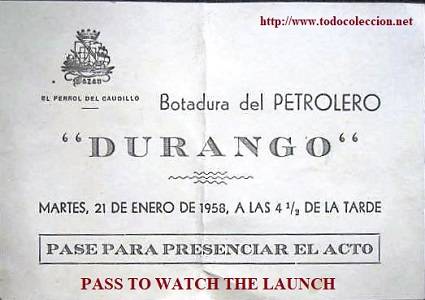
The notable event of 1958 came early in the year. On January 21, 1958, Durango the fifth boat of Series "T" was launched "between heavy showers." Bonifaz the fourth oil tanker of the series had been built by Astilleros de Cadiz and had been launched on September 27, 1957; it was delivered on February 12, 1959, and it sank nine miles off Cape Fisterra on July 3, 1964, due to a collision in heavy fog.
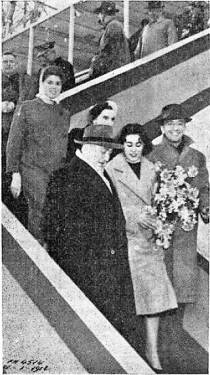
Dr. Jacinto Argaya Goicoechea the bishop of the diocese Ferrol-Mondoñedo blessed the "Durango". Present at the ceremony were the Captain-General of the Maritime Department, the military governor of the city, the commander-general of the arsenal, the mayors of Ferrol and Durango, the magistrate-judge of Ferrol, the top Navy commander and other high-ranking military officials, the head of the High School, a professor from the University of Santiago de Compostela, the vice president of "Naviera Vizcaína" shipping company, whose daughter (photograph to the left) acted as the ship's godmother, more prominent staff of "Naviera Vizcaína," the president of "Empresa Nacional Elcano" plus its top management, and the president of "Empresa Nacional Bazán" accompanied by its chief executive officers and numerous high-ranking staff.
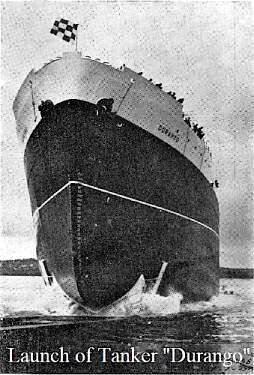
"Despite the truly wintry weather," the magazine goes on to say, "there was a big crowd in attendance, and here we make special mention of company employees and workers together with their relatives, of the apprentices and of the pupils of the Schools For the Sons of Workers."
The main technical specifications of oil tanker "Durango" were: 171 meters length overall; 32 meters beam; 12 meters air draft; 9.2 meters extreme draft; 26,100 tonnes loadline displacement; 19,670 tonnes deadweight; 7,250 BHP normal maximum power; 14 knots service speed. The vessel featured a Gyro compass, automatic pilot, radar, sonar, telephone and telegraph services, loudspeakers, running and signal lights "for crossing the Suez Canal," individual cabins, spacious living, dining and recreation rooms, plus air conditioning that was set to 27°C for the summer and to 20°C for the winter with a relative humidity level of 55%.
"Durango" was the Factory's one hundred-and-ninth construction. It was delivered to "Naviera Vizcaína" on June 12, 1958. Eventually "Naviera Vizcaína" sold it to a Panamanian concern in 1978, and on June 25, 1982, the ship sank off Mozambique due to flooding.
On October 29, 1958, Bazan-Ferrol launched its seventh oil tanker, the "Compostilla," whose characteristics were similar to the "Durango" and whose godmother was the wife of the Captain-General of the Maritime Department.
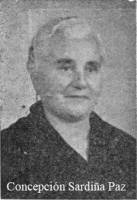
1. Concepción Sardiña Paz joined the Factory in 1929 as a member of the cleaning staff. Shortly afterward she was transferred to the dockyard infirmary full time. She had recently retired when this interview took place. "What prompted you to start working in the shipyard?" "The death of my husband who worked in the Foundry and my being left alone with five small children to take care of. Someone had to feed them." "Do you remember your starting daily wage? And the last one before retirement?" "The first one was 3.40 Pesetas. It was not enough to live on. I had to supplement it with income from other jobs. Now when I retired I was making close to 50 Pesetas a day.
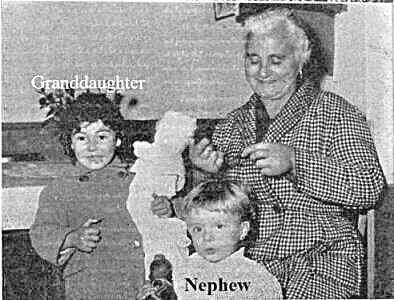 It still would not have been sufficient except for the circumstance that all my children are married and I dwell alone. Well, in fact, a dear seven-year-old granddaughter (photograph to the right; together with a visiting nephew) lives with me since a few months back." Note: According to the news entry for December 8, 1955, a loaf of bread weighing 1 kilogram then cost 5.20 Pesetas. Taking the persistent high rate of inflation into account that price would have risen to approximately 5.70 Pesetas by the year 1958 (End of Note). "Would you like to say something about your main hobbies? For example, do you like going to the movies, listening to the radio, reading..." "I like listening to the radio. I hardly go to the movies, it fatigues me. I love listening to those game shows on the radio that are so in vogue today." "Since you seem to us a very sensible and a very feminine lady, we would like to know your opinion about the women of 'today'. Are they very different from those of 'yesterday'?" "Truly they are not like those of 'yore'; they seem to me, generally speaking, to be less feminine and more brash. For me, what happens is that these women of 'today' 'know too much', without my wishing to imply that I do not consider them upright too." "Do you have many friends? Few? Are you someone who likes to chat?" "I have many friends and I love to 'gab'; unfortunately I do not have the time for it. You are men, and men prefer in some sense to ignore that there is always a 'pile' of things which need to be done around the house."
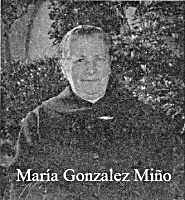
2. María Gonzalez Miño was the overseer of an important section of the cleaning staff until she retired. She was born in "the traditional borough of Esteiro the most beautiful and merriest of the city" (her words). Note: "Esteiro" was a popular neighbourhood of Ferrol associated with Bazan workers and military barracks. There were three other boroughs of Ferrol recognized by everybody when I was a child, namely: "Ferrol Viejo" (fishermen's quarter) "La Magdalena" (well-to-do district) and "Canido" (an outlying district the site of the municipal graveyard). I too was born in Esteiro bordering on La Magdalena (End of Note).
She joined the Factory after her husband passed away in July 1939 and was soon assigned employee status. The interviewer takes note of the fragrant perfume she was wearing and of her elegant bearing before asking, "You seem to be a person of good taste. Are you a fashion enthusiast?" "Yes! Very much so! Of everything that is fashionable! I sincerely think that we have made considerable progress in this regard, as in many others. Even in the way of life. Believe me because you are young and you can not recall it: the way of life back in my day was not 'living'." "Then you would not have liked El Ferrol of other epochs, right?" "That's not it at all! How could I not like my old Ferroliño (Galician affectionate diminutive), my beloved Esteiriño! (Galician affectionate diminutive). What I meant to say is something different. I had in mind a list of stupid prejudices fortunately vanquished today and which I do not wish to enumerate now. But I also want to underline that what I like best about El Ferrol is its modern look. This gorgeous, snappy Ferrol we can count on since a little while back." "Surely you are a moviegoing buff, isn't it so?" "Exactly. And I like comedy movies that make you laugh as much as the dramatic films. Every one, every one. I also enjoy promenading, although this has nothing to do with the cinema." "How do you view a woman's work in the factories?" "In the only manner, in my judgement, that it can be viewed halfway through the twentieth century: very well. And I believe that it should become much more prevalent in Spain." "And to bring these kind answers of yours to a close, would you like to reveal to us your best memory, the most cherished souvenir of your life?" The Bazan reporter notes that although she keeps smiling, her eyes wet slightly and her voice softens: "The memory of when my husband was yet alive and our children were still small."
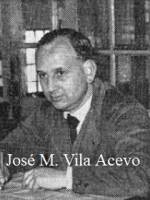
3. José Manuel Vila Acevo was born in 1915, joined the Factory in 1930 as an apprentice and obtained the rank of master in 1956. At the time of the interview he was in charge of the New Machine Workshop.
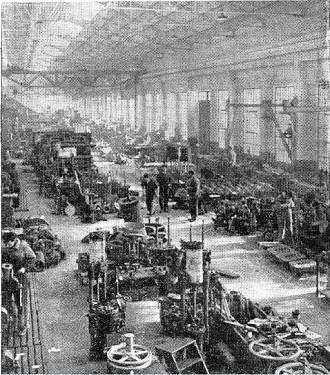
Bazan, 9, dedicated one section to this New Machine Workshop, so called because it began functioning in June 1951 on land reclaimed from the sea. The workshop had two floors and a surface area of 2,365 square meters. It faced south. A payroll of about 120 professionals made all kinds of valves "extremely varied in type and size, some valves strapped with complex high-precision mechanisms," electro-hydraulic steering gear, engine RPM and order telegraphs, repair work, etc. The plant had "a great number of modern and excellent machines" conveniently laid out to achieve the greatest efficiency in their individual utilization as well as in the overall process of production. The plant's second floor housed twenty-seven lathes, drafting tables and "a big drilling machine." Note: Perhaps a radial drilling machine (End of Note). The main floor housed boring machines, more lathes—some vertical, others turning-revolver—milling machines, chisels, files, brushes, hand drills, etc., and a herringbone gear hobbing machine, "perhaps the only one of its kind in Spain." The product quality-control area was located on the main floor also. Two overhead conveyors "screeching in their monotonous come-and-go" moved loads back and forth to the place of need.
"Was the creation of this New Workshop really necessary?" "Yes, the old one was not sufficient." "Does the New Workshop specialize in something?" "Yes, mainly on the making of order telegraphs, steering gear components and a compendium of valves." "Do you miss the old workshop?" "Indeed. There lapsed my apprenticeship and my youth." "What virtue would you point to as the most outstanding of today's operator?" "His tremendous self-assurance in the elaboration of workpieces and the exactness of their dimensions. Of course the precision of today's machines grants him an advantage over yesterday's operator." "And the most outstanding defect, also?" "Perhaps that he works too quickly, but the blame can be pinned only on the piece rate system." "Have you dwelled in Ferrol always?" "Always." "And never had the temptation of moving to another geography?" "No. Ferrol always tugged at my heartstrings a lot."
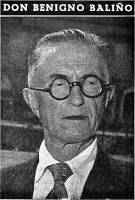
4. Benigno Baliño was born in 1893 and joined the Factory in 1920 as helmsman of the tugboat Consort. Toward the end of his career he attained the rank of foreman. He had recently retired when this interview took place.
"Do you feel a genuine vocation for seafaring?" "Yes, I felt it my whole life long." "When did you embark for the first time?" "For the first time, and in earnest, at age sixteen when I enrolled as sailor apprentice on board the Villa de Bilbao." Note: The Villa de Bilbao was a corvette built in Great Britain in 1845, delivered to the Spanish Navy the following year and decommissioned in 1930. It was permanently stationed at Ferrol after 1917 (End of Note). "And would you not have preferred to belong to the Merchant Marine and travel all over the world?" "I belonged to it during the years 1918 and 1919, but I missed El Ferrol a lot and preferred not having to depart or sail far away from our bay." "Would you like to relate to us one of those 'old sea dog' anecdotes?" "During the past global contest [sic] one time when we were transporting cargo with the Consort some American reconnaissance planes appeared over us and did not abandon us for over more than fifteen minutes. So, out of fear, everyone on board, without exception, lost their appetite for the entire day."
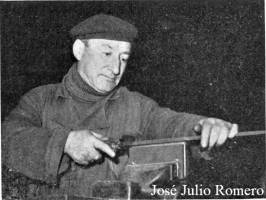
5. José Julio Romero was a popular worker in the Electricity Workshop who made the Bazan reporter laugh with his wisecracks prior to the formal interview. "What is your professional status?" "Worker first class." "Your fellow workers say that you are the most popular operator of the trade. Do you share their opinion?" "The truth is I don't know what to say...but if they say so...Perhaps my playing the bagpipes livens the spirit of the workshop. Fact is, and I don't say this because I am standing in front of you, I do play the bagpipes and play them very well, eh..." Romero said he had founded the choir "Ecos Da Terra" (Echoes of the Land) and also been a member of the legendary Ferrolian chorale, still in existence, "Toxos E Froles" (Gorses And Flowers).
The interview finished with Romero relating a hazing he underwent. "When I was an apprentice working in the 'Reina Victoria Eugenia,' a worker ordered me to go 'see' if there was 'current' in a lamp holder. Note: Reina Victoria Eugenia was the name of a battle cruiser built in Ferrol; it was launched on March 21, 1920 (End of Note). Since I did not know what a 'current' meant or how one 'saw' it, I asked him how to go about it, and he answered telling me to stick the finger in the lamp holder. Neither mousey nor lazybones I did just so and...I almost kicked the bucket. With the tremendous shock I received I learned what 'current' meant, and what's more, I can assure you that for the rest of my life I took on a lot of respect for it."
Rafael Suarez Pedreira followed the lead of Juan Manuel Castro in 1957 and composed this Galician poem for Bazan, 6. The illustration was drawn by Francisco Iglesias (see ARTS AND LETTERS for the year 1957). I have coloured his black-and-white illustration on page 30 of Bazan, 6, using Hotpot's Artificial Intelligence Picture Colorizer with a colorization factor of 12 (URL=https://hotpot.ai/colorize-picture). "Hotpot" is the name of a private company founded in the year 2019.
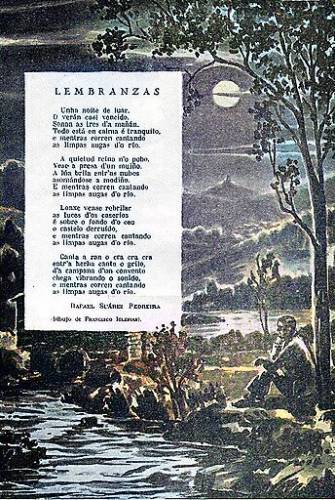
|
A night of bright moonlight.
Quiet reigns in town. |
The bourgs' house lights
Sings the frog, croak, croak, croak, |
Luis Eugenio Lopez Rey penned a Spanish poem on page 30 of Bazan, 5, which attempts to link a woman's character to the colour of her hair. Perhaps the poem discloses instead the author's biases and piques, particularly when he brands the redhead "ugly" (?) on the first line of the final stanza.
|
Blonde
She is shy, sweet, good-natured,
Melancholy and serene,
To herself and to her hearers
Openhanded and generous, Chestnut
She is lively, peppy, amusing,
Qualified, capable, bustling,
If she has blue eyes,
If black, the intellectual arts |
Brunette
She is competent, cautious and patient
Being an eminent diplomat
She gravitates toward her home;
She is orderly Red
She is headstrong, irritable,
She is also easily crossed,
Most generous and sincere
Ugly, she will spend her life |
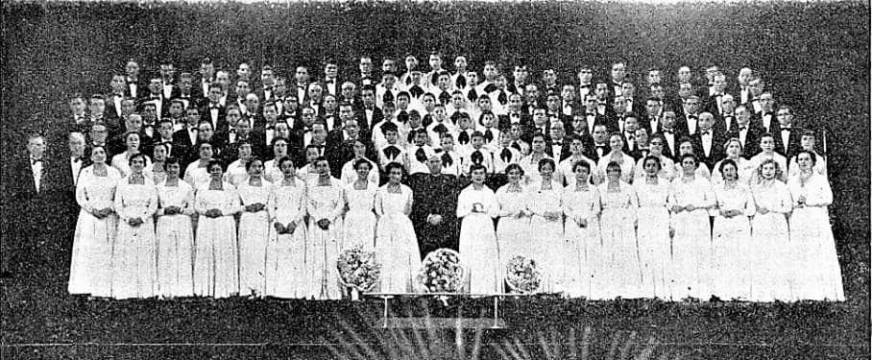
The above photograph comes from page 24 of Bazan, 8.
On July 16, 1958, Bazan's chorale and orchestra accompanied the Mass that the Spanish Armada dedicates every year to its Patron Lady of Carmel in Ferrol and at all naval bases.
The chorale sang Missa Secunda Pontificalis, a piece composed in 1906 by renowned Italian composer Lorenzo Perosi.
On September 15, 1958, the chorale travelled to Mondoñedo, a small town yet the see of the Ferrol-Mondoñedo diocese. This region of Lugo Province, called Bretoña, was settled by Romano-Britons fleeing the Anglo-Saxon conquest (Wikipedia). The see's original name was Ecclesia Brittaniensis and Maeloc its first bishop.
The chorale repeated the program of July 16 for the Mass celebrated by Cardinal Benjamín de Arriba y Castro in Mondoñedo.
In the evening the chorale of Bazan plus the band of the Northern Third Corps based in Ferrol offered a free concert at Mondoñedo's promenade before thousands of people, about two thousand were Ferrolians. The vocal portion of the program included Verdi's Triumphal March, Wagner's Tanhäusser Grand March and Morera's Sardana de los Monjes. The marines separately honoured the Cardinal with Gaudot's two-step instrumental, Lugo-Ferrol, appropriately enough.
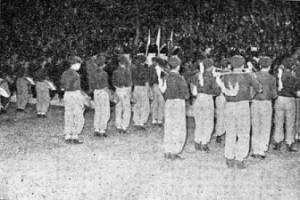
The photograph of the apprentices' music band (above, left) was taken on May 1, 1958, during the closing ceremony of "The Workers' Olympiad" at Santiago Bernabeu Stadium in Madrid (see the SPORTS Section).
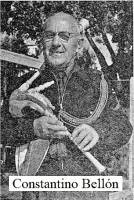
Originally Bazan's band of apprentices consisted of buglers and drummers exclusively, but in February 1958, band director Constantino Bellón Lago (above, right) added nine novice bagpipers.
Bellón was born in February 1896 in Valdoviño. He joined the Factory as a ticket checker/collector at age twenty-eight; he asked to be transferred to the Cabinet Making Workshop in 1927 where he started as general-helper and eventually rose to the status of worker first class.
Mr. Bellón is an excellent musician. He plays the alto and tenor saxophones, the oboe and the Galician bagpipe. This instrument typical of our folklore garnered for him diverse and long trips abroad. And as well the assignment from Company Management in the year 58 to found and organize a band of Galician bagpipers made up exclusively of apprentices ... Mr. Bellón is without doubt the most popular operator of the entire workshop.(Bazan, 15, p. 17)
Bellón was very pleased with the results obtained in so short a time, for the nine apprentices initially "lacked the most rudimentary musical knowledge." On May 1, 1958, they and their fellow band members headed the nighttime parade in Madrid and then took turns at providing musical entertainment with a group of "some seventy teachers" from other parts of Spain.
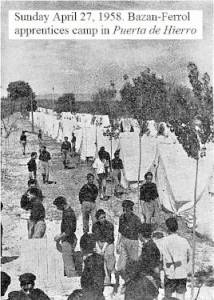
The buses transporting Bazan-Ferrol apprentices to the annual national championships of Educación y Descanso arrived to Parque Sindical Deportivo in Puerta de Hierro near Madrid around 10:20 PM on Friday April 25, 1958. They arrived late, the tournament's official inauguration had already taken place on Thursday afternoon.
The team that "Empresa Nacional Bazán" brought to the Games combined workers from two shipyards, Ferrol and Cadiz. The Ferrolian contingent outnumbered the Cadiz component by far. The few Andalusians lodged at a downtown hotel in Madrid while the many Galicians camped outdoors (photograph on the right). Overall Bazan was the biggest team of the tournament, consequently it is not too surprising that it should have racked up the highest number of points and ended up champion for the fourth year running.
The meet of 1958 was nicknamed, "The Workers' Olympiad." It also went by the name, "Syndical Sports Games." Around ten thousand workers from over four hundred industrial, commercial and agricultural enterprises across Spain participated. The final day of competition was Wednesday April 30.
Official Spanish Newsreel Magazine Revista Cinematográfica Imágenes Nº 696 entitled, "The Workers' Olympiad" (year 1958)
NO-DO Revista Cinematográfica Imágenes Nº 696 covers in ten long minutes the salient features of the Workers Olympiad. The film recorded on min. 2:05-2:18 the 100-meter sprint won by José Luis Bejar of Bazan-Ferrol (see below).
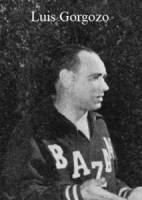
Luis Gorgozo, 41-year-old firefighter of Bazan-Ferrol, was the shot put champion in the veterans category and the "multiple trials" champion in the same category.
The "multiple trials" event for the veteran athletes comprised long and high jumps, hammer throw, pommel horse and vaulting box jumps, a 500-meter track race and a 50-meter free-style swim. The marks obtained by Gorgozo were long jump: 4.82 meters, high jump: 1.35 meters, hammer throw: 18.18 meters, 500-meter run time: 1 minute 23 seconds, 50-meter swim time: 43 seconds.
Gorgozo was asked, "Did you encounter many difficulties getting your double title of national champion?" "Quite enough. Although we were all fairly senior there were several very good athletes. I was successful only thanks to the enthusiasm which I never lost for a moment." "How did the Madrid press treat you?" "Very well. It talked a lot about us, complimenting us, something they do every year. So much so that they picked us favourites to win the teams category in these Workers Games. That is, I think, the best accolade they could have made."
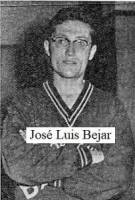
José Luis Bejar, 19-year-old machinist of Bazan-Ferrol, finished first in the 100-meter sprint with a time of 11.6 seconds. The reader can actually watch this race between minutes 2:05 to 2:18 of the video, NO-DO Revista Cinematográfica Imágenes Nº 696, found above.
Bejar also finished first in the 200-meter sprint with a time of 23.6 seconds.
He was asked, "What was your greatest joy participating in the Games?" "To have been champion in both trials as well as our final triumph in the teams category." "What trophies did they give you as champion?" "Two award box cases with two commemorative plaques of the events, the same as what all the national champions received."
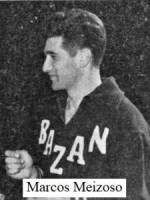
Marcos Meizoso, 22-year-old carpenter of Bazan-Ferrol, was the shot put champion in the youth category and the "multiple trials" champion in the same category.
The "multiple trials" event for the young athletes comprised long and high jumps, hammer throw, pommel horse and vaulting box jumps, 1,000-meter track race and a 100-meter free-style swim. The marks obtained by Meizoso were long jump: 5.67 meters, high jump: 1.50 meters, hammer throw: 20.45 meters, 500-meter run time: 3 minutes 2 seconds, 50-meter swim time: 2 minutes 9 seconds.
According to this dispatch sent by telephone from Madrid by Santiago García on the final day of competition, April 30, and which appeared in the May 1 edition of the Catalan newspaper, La Vanguardia, the Games had left an "indelible" impression because of the expressly constructed sporting facilities, particularly the olympic grade swimming pool, because of their successful organization and for having brought together in "bonds of friendship and awareness" during seven days of "unforgettable" sporting activity ten thousand "authentic workingmen" from the various territories and peoples of Spain.
The reporter took special note of the "feminine representation" at the Games, particularly of the "graceful" Galician synchronized swimmers, and he gave the names of all eleven. "They are all sales clerks or office workers, share a lot of enthusiasm for artistic swimming and know by heart all the feats of Esther Williams."
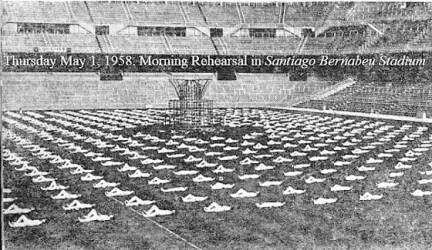
Around 10:00 AM on Thursday May 1, eight hundred Bazan-Ferrol apprentices were taken by bus from Puerta de Hierro to Santiago Bernabeu Stadium to rehearse that night's mass gymnastics show before 120,000 spectators. The rehearsal (photograph on the right) started around 11 o'clock. Bazan, 6, does not specify when it ended, but around 1 o'clock in the afternoon is a good guess.
The nighttime show opened with a parade of the ten thousand athletes and referees followed by selected athletics routines, various styles of wrestling, an exhibition of vaults with apparatuses carried out by the Renfe apprentices of Madrid and the grand finish: a mass gymnastics routine carried off by the eight hundred Bazan-Ferrol apprentices, culminating in the erection of a human tower on the middle of the pitch (the safety props are visible in the photograph to the right).
The following clip focuses on the nighttime exhibition at Santiago Bernabeu Stadium. The full newsreel, ten minutes long, was first shown on Monday May 12, 1958.
Official Spanish Newsreel NO-DO 801 A
Voice-Over Translated: His Excellency the Head of the Spanish State acknowledges the acclamations of the 120,000 persons who fill Santiago Bernabeu Stadium in the brilliant closure of the Syndical Sports Games. Ten thousand producer-athletes parade before the Generalissimo in the Christian Feast of Labour as unanimous and representative homage rendered by working Spain. The diplomatic corps occupies one of the tribunes. The Minister Secretary-General of the Movement accompanies Franco. The troop of referees leads the parade of soccer players. Sport's anonymous heroes participate in the parade, those who have been able to wrest marks off the track and garner the triumph in any one of the twenty set disciplines. Two hundred workers from the workshops of Renfe-Madrid execute their vaults in a public lesson of how the enterprises have in mind the physical culture of the producers. Eight hundred men from Empresa Nacional Bazán carry out an extraordinary gymnastic demonstration. Their displacements and their exact and disciplined executions conform in every instant to the most perfect rhythm. Precision and harmony define the exhibition of the gymnastic routine. These exercises conclude with the composition of a human tower which rises like a symbol of The Workers Olympiad over the Spanish land where the Syndical Sports Games have conveyed an eloquent expression of the peace and discipline of the fatherland.
A. Permuy Martínez analyzed on pages 32-33 of Bazan, 8, the Second Division Group North standings and statistics and made the following forecast of the final classification table (below, left-hand double column). The actual outcome of the 1958-59 season is given on the right-hand side. It is evident that home bias spoiled a fairly decent forecast.
| Forecast | Reality | |||
|---|---|---|---|---|
| Team | Points | Team | Points | |
|
1. Real Valladolid 2. C. D. Sabadell 3. Ferrol 4. Indauchu 5. Condal 6. Santander 7. Sestao 8. Basconia 9. Deportivo 10. Tarrasa 11. Irún 12. Baracaldo 13. Alavés 14. Rayo Vallecano 15. Gerona 16. Avilés |
40 38 34 33 33 32 32 29 29 28 27 27 27 26 22 21 |
1. Real Valladolid 2. C. D. Sabadell 3. Indauchu 4. Condal 5. Basconia 6. Baracaldo 7. Deportivo 8. Sestao 9. Santander 10. Ferrol 11. Avilés 12. Tarrasa 13. Alavés 14. Rayo Vallecano 15. Gerona 16. Irún |
40 39 35 32 32 31 30 30 30 27 27 27 27 26 25 22 |
|
Deportivo the professional soccer team of A Coruña was Ferrol's archrival.
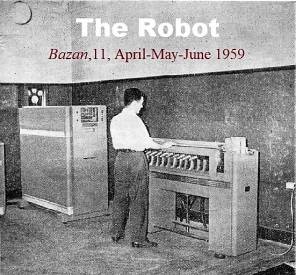
Mathematical "proof" is advanced on page 34 of Bazan, 7, that four equals five!
The tongue-in-cheek fib is introduced with a little story.
An important retail store asked its marketeers to come up with a catchphrase that would attract more customers. The marketing department returned a tagline insinuating that four dollars had the purchasing power of five in the store.
Management voted to approve the tagline if it could be shown that four is really equal to five, a requisite to avoid being sued for false advertising.
Consequently the store hired the services of a computing robot to investigate the claim.
After complicated and laborious combinations of numbers the hired robot showed mathematically that four is equivalent to five. After trying out many combinations of numbers the robot first settled opportunely on these two,
16 — 36 = -20 (1)
25 — 45 = -20 (2)
Evidently the left-hand side of (1) and (2) also constitutes an equality,
16 — 36 = 25 — 45 (3)
The robot then decided to add the same number to both sides of (3). After repetitive trials with many numbers it finally picked the singular fraction 81/4,
16 — 36 + 81/4 = 25 — 45 + 81/4 (4)
The astute robot then noticed that the left-hand side of (4) could be factored,
16 — 36 + 81/4 = (4 — 9/2)2 (5)
The right-hand side of (4) can also be factored,
25 — 45 + 81/4 = (5 — 9/2)2 (6)
(5) and (6) retain the equality of (3). That is to say,
(4 — 9/2)2 = (5 — 9/2)2 (7)
The robot then had the "felicitous idea" of taking the square root of both sides,
(4 — 9/2) = (5 — 9/2) (8)
Adding 9/2 to both sides yielded the desired result,
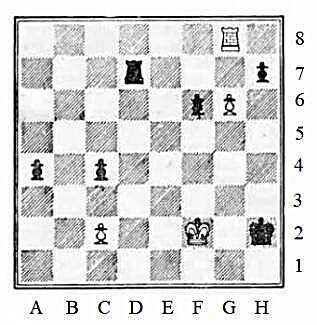
The illustration comes from page 32 of Bazan, 5. The endgame is credited to A. Selesnieff, 1919.
The white piece on G8 is a rook. The white king is on F2. The black piece on D7 is a rook. The black piece on F6 is a bishop. The black king is on H2. All the remaining pieces are pawns.
Origin of International Workers Day May 1st. The Federation of Organized Trades and Labor Unions of the U.S. and Canada (F.O.T.L.U.) held its fourth congress in October 1884. It called for the start of an 8-hour-workday labour movement and urged all labour organizations to vote on a general strike set for no later than May 1, 1886, to press their demands. The Fifth Annual Congress of 1885 reiterated the call. On May 1, 1886, over 190,000 workers struck. On May 3 Chicago police killed two workers in a confrontation between strikers and scabs at the McCormick Harvesting Machine Company. A small crowd gathered at Haymarket Square on May 4 to protest the police action. A bomb exploded killing seven policemen. Public opinion reproved the trade unions and the eight-hour-workday movement fell apart.
On July 14, 1889, the International Workingmen's Congress (i.e. the Second Communist International) gathered in Paris. American delegates acquainted the rest with their plight. The congress then instituted May 1, 1890, as the day for workers all over the world to demand the legal reduction of the workday to eight hours.
On Sunday May 1, 1955, Pope Pius XII instituted the feast of St. Joseph the Worker to counterpose Communist influence in the working class of Catholic countries. Spain follows suit the following year 1956.
The Bishop's Letter To Bazan Workers. The source is Bazan, 5, January-February 1958. The bishop's letter anticipated the festivity of 1958, it was signed beforehand with the premature date of April 11, 1958.
My dear friends:The date of May 1 is the feast day of St. Joseph the Worker.
It was just and proper that workers had their Day. Note: They had it already. Reverend Fanego the chaplain of Bazan states in the same number that the festivity of "Glorious Saint Joseph the patron saint of the workers" had been celebrated "as always" on March 19, 1957, at San Julián Church (End of Note).
The Pope has desired it so, acknowledging and blessing what already existed and giving it a global dimension. I still keep in my retina the unerasable impression of the 500,000 workers, believers in Jesus Christ, gathered two years ago in the immense square of Milan. It was a truly international demonstration. Workers from all countries and races in genuine brotherhood acclaimed the Holy Craftsman. Pius XII undersigned the birth certificate of this Feast with a lovely address, broadcast by radio and television. Notes: "The immense square of Milan" is the Piazza del Duomo, but the Vatican archive has Pius XII giving the speech at St. Peter's Square; both can't be right. The "Holy Craftsman" here is St. Joseph. (End of Notes).
Significance of The Feast
The object of the Day of St. Joseph the Worker is to make everyone understand the nobility of manual labour, a source of sustenance for a great number of men, magnificent opportunity for sanctification and a necessary instrument for the life of society.
Jesus Christ wanted to be an artisan, he chose this most noble profession; St. Joseph was one too; and the Virgin Mary devoted herself to the domestic chores of her simple home. St. Joseph's family was the classic workingman's family: with its joys, its prostrations and its privations. He even had to eat the hard bread of emigration. Note: Venezuela alone received 45,000 legal Galician immigrants between 1950 and 1956 inclusive. Source: Xosé Ramón Campos Álvarez, 2020: "Brief quantitative analysis of the Galician emigration to Venezuela." University of Vigo (End of Note).
The Day of St. Joseph The Worker In The Diocese
Here too we are going to celebrate the Day of St. Joseph the Worker with all solemnity. We will begin in El Ferrol del Caudillo and Puentes de García Rodríguez. Note: Today's As Pontes, 42 kilometers from Ferrol. The coal mine closed and was replaced with an artificial lake (End of Note).
On May 1 at 11:00 AM I will celebrate Mass at San Julián Church for those who perished in workplace accidents. We can call them, "martyrs of labour."
They practised sturdy virtues: honesty, industry, camaraderie, fulfilment of duty; they worked conscientiously to maintain their wife and children with dignity; and death at the breach crowned their noble life. We hope that God will have accepted their holocaust.
The bishop will make use of the Holy Sacrifice for the eternal rest of their souls. Preferential station in the temple will be assigned to their widows and orphans.
Ferrolian workers, for the sake of camaraderie and solidarity, you can not miss this heartfelt tribute. Your bishop invites every one of you without exception and he expects to see you there.
A similar ceremony will be held at 9.00 AM in Puentes de García Rodríguez with my obligated presence. I also hope to see all the workers of that Important Industrial Complex there.
Performance At Teatro Jofre
Acción Católica Obrera (Workers' Catholic Action) will organize a Christian act of exaltation of labour and glorification of St. Joseph the Worker at 12:00 noon at Teatro Jofre. The Polyphonic Chorale of Bazan, showcase of your sensibility and culture, will lend its unsurpassable cooperation.
We hope that this Day's celebration will leave the most gratifying impression on your souls.
My First Contacts With The Workers
Recently I had the pleasure of speaking to the workers of Bazan, to the ones of Empresa Nacional Calvo Sotelo in Puentes de García Rodríguez and to the nucleus of workingmen in Jubia. Note: Today's Xuvia, a borough of Neda County, 7 kilometers from Ferrol (End of Note). I wish to establish bonds of true friendship with them and with everybody else.
Naturally my talks have been commented on. Some saw in their bishop a cordial, modest man who wants to do as much good as he can. I don't know if that's who I am. But I want to be that way.
Apparently others did not fully believe my offers of cordiality. Let time say.
I do not promise you anything. I am almost as weak as you are. But I assure you that you will discover a sincere friend in me, full of the best goodwill, and always at your disposal.
Count on the affection, blessing and best prayers of
YOUR BISHOP
Mondoñedo. April 11, 1958.
Dad once told me that at a regular meeting of Acción Católica in Ferrol a motion carried asking for volunteers to distribute a Catholic magazine aimed at the workers. When the roll call got around to my father, he answered, "When the bishop comes with us to distribute and he is the first one in line, I'll go also."
I never asked Dad for details, so I do not know what year it was or who the bishop, but I suspect that this happened in the late 1940's and that the magazine in question was the weekly, "¡Tú!" (You!) published by Hermandad Obrera de Acción Católica (Workingman Brotherhood of Catholic Action). This brotherhood, in existence today, is commonly known by the acronym, HOAC.
The General Archive of Universidad de Navarra keeps the papers of HOAC militant Teófilo Pérez Rey (1923-1999); his records (PDF) show that "¡Tú!" was suppressed during the first week of December 1949, accused of "an insidious campaign against Falange Española and against Franco's rule and government." Simultaneously a Falange official of Toledo charged that "many" HOAC members hid their socialist and even marxist ideals behind the sign of the Cross. Note: The allegation was true (End of Note). The publication went underground. Ferrol must have been a notable center of distribution because from January 4, 1950, the local radio station broadcast a virulent campaign orchestrated by the far-right paramilitary organization, Guardia de Franco, against HOAC and "¡Tú!" The paramilitaries published a weekly sheet called, "Sí" (Yes). It had carried a conspicuous article on September 25, 1948, entitled, "A Modest Essay of Communist Agitation In El Ferrol" (here). Thus distributing "¡Tú!" in an environment of open Falangist opposition was fraught with danger.
HOAC protested the Falangist persecution and appealed to Enrique Pla y Deniel the cardinal primate of Spain. The records imply that the cleric demurred. HOAC then ceased printing the magazine.
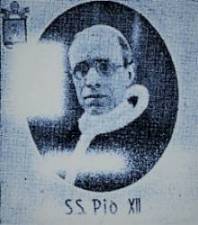
Pope Pius XII passed away on Thursday October 9, 1958.
NO-DO produced a special newsreel dedicated to the glum tidings. It lasts six minutes and was first shown on Monday October 13, 1958.
Official Spanish Newsreel NO-DO 823. Special coverage of the death of Pope Pius XII (Castel Gandolfo segment)
Voice-Over Translated: Castel Gandolfo registers the most grievous news that could stir the Catholic world. His Holiness Pope Pius XII has died. The physicians who attend His Holiness sign the medical bulletin. Professor Lisi reads this briefing to the reporters who will immediately disseminate it throughout the world. Representatives of the diplomatic corps and top personalities arrive at Castel Gandolfo to give account of the first testimonies of the grief that everywhere has caused the decease of the Vicar of Christ on earth. The prayers of everyone multiply for the soul of the Pope who gave himself to the service of God without dodging efforts or sacrifices and whose departure from this world sows mourning in the souls and stirs the children whom he so loved in perfect imitation of Our Lord Jesus Christ. The information circulates in the press. The flags are lowered to fly at half mast. His Holiness passed away at 3:52 AM of October 9, 1958. The door of the pontifical Chamber is already sealed. The Catholic world apprehends the heartache of the unrecoverable. The egregious figure of Pius XII, Pastor of the world, expired virtuously on the modest iron cot where he bedded after falling ill. Cardinal Tisserant the dean of the Sacred College of Cardinals recites the prayers for the dead and imparts the priestly blessing with holy water. The pontificate of Pius XII coincided with one of the grimmest periods in the history of the world. Hardly ascended to the throne, the Pope had to face up to one of the greatest belligerent conflicts recorded by history and in addition brave the Communist persecution of the Church. The multitude gathers before the papal residence after knowing the news of the death and renders its final and heartfelt tribute. The mortal remains of the Supreme Pontiff are carried to the chamber where he used to grant his audiences. The head of the Italian State comes to express his condolences to Cardinal Tisserant. The faithful of Castel Gandolfo give their last good-bye to the Supreme Pontiff.
Official Spanish Newsreel NO-DO 823. Special coverage of the death of Pope Pius XII (Madrid segment)
Voice-Over Translated: In Catholic Spain the newspapers echo the heartache of the people when the unfortunate news becomes known. The top echelon of the state dictates, expressing the testimony of the profound sorrow of our fatherland, the decree that lays down ten days of official mourning. During this time the flag will be hoisted at half mast upon the public buildings. As well black bows are pinned on the national flag placed in windows and on balconies. The testimonies of grief are unanimous at the hall of the apostolic nunciature, and the pages fill quickly with signatures. The mayor of Madrid and also all the ministers of the government arrive to express the sorrow which the head of the state interpreted accurately in his message to the Vatican. Thus a witness of condelence for the death of Pius XII is preserved, surrounded by the filial love and fervorous devotion of the faithful who were proud of so glorious a pontiff. The diplomatic corps certified in Madrid arrives also at the diplomatic site of the Vicar of Christ in our capital to express its condolence for the decease of the common father. A solemn funeral arranged by the Spanish government is going to be officiated at the national temple of San Francisco El Grande, attended by representatives of the diplomatic corp. Monsignor Antoniutti the nuncio of His Holiness and Dr. Eijo y Garay the patriarch of the West Indies and bishop of Madrid arrive. Also in attendance are the president of the Cortes and the ministers of the government. After reviewing the troops that render him honours, His Excellency the Head of State, accompanied by his wife, is complimented by the ministers. Franco makes his entrance under processional canopy. The tumulus with pontifical tiara rises in the center of the temple. The patriarch-bishop officiates the Mass assisted by religious brothers of the Franciscan community. The death of the most beatus father shrouds the world in mourning. He will be unforgettable for his immense labour that enriched the Church in her universality and in her prestige. He sacrificed himself for peace, fought for the social headways of Christian spirit and for justice and charity. The example of his life and of his ministry will always illuminate us. The Generalissimo reiterates the testimony of sorrow to the nuncio in the name of the whole of Spain.
Reverend Fanego the Factory's chaplain dedicated pages 30-31 of Bazan, 9, to the news. According to his article, Pius XII had been an "extraordinary figure," "one of the most eminent men in world history," "a wise man in the broadest sense of the word, wise in all the branches of human knowledge," "an eminent polyglot," "a Saint," "a man of immense inner spirituality," "a man of enthralling supernatural charm," "eminent Diplomat, great Statesman, most loving Father of all humanity without distinction of races or creeds, the Pope of Peace, of Social Justice," "the man most esteemed, most admired and most revered of the contemporary world." And he continued, "Today Pontiff Eugenio Pacelli fills one of the most glorious chapters not only in the history of the Pontiffs of the Church but in the Gilded Book that inscribes the most illustrious men of the History of Humanity."
The article then proceeds to report on and translate into Spanish the various notes of condolence forwarded to the Vatican Secretariat of State by the most relevant personalities of the day. Some instances follow,
The world is today poorer than yesterday because Pius XII has died. He was the highest example of a life dedicated to divine devotion and to the service of humanity. Dwight D. Eisenhower, President of the United States.
The greatest statesman of the last two hundred years has died. Harry S. Truman, ex-President of the United States.
A grave loss for the whole world and for the German people in particular. Konrad Adenauer, Chancellor of West Germany.
This generation has lost one of its noblest sons and the greatest of its leaders. Dag Harmmarkjold, Secretary-General of the United Nations.
In a generation afflicted by wars and unrest, Pius XII preserved the highest ideals of peace and compassion. Golda Meir, Foreign Affairs Minister of Israel.
Future generations will bless his name for his many kindnesses, for the vigilance and love with which he grazed his sheep and indoctrinated the world. And Spain, participating with such deeply felt emotion in the mourning of the Church, bows faithful and devout to honour the name and the work of he who was staunch defender of peace and angelic Pastor of Christendom. Francisco Franco, head of the Spanish State.
The article also points to the "respectful minute of silence at the United Nations for the Leader of Peace," the uncustomarily bold headlines in the British press, "the prayers in synagogues," and the telegrams from President Nasser and from the Patriarch of the Greek Orthodox Church, "the funerals everywhere, presided by Eisenhower in the U.S., Hirohito in Japan, etc."
On October 15, 1958, Ferrol celebrated a "most solemn funeral" at 7:30 PM in San Francisco Church, the military temple where Franco had been baptized in 1892. Bazan's Polyphonic Chorale and Orchestra performed Perosi's Messa da Requiem.
Reverend Fanego the Factory's chaplain dedicated the remainder of his article to a biographical sketch of the elect Pope John XXIII, making special mention of the elect Pope's pilgrimage to Santiago de Compostela in the "Holy Year" of 1954.
The Reporter Was A Magician. On pages 26-27 of Bazan, 8, and continuing on pages 25-26 of Bazan, 9, José Lorente de Castro (1927-2006) "employee of our Factory and illusionist of international renown" sent to the editors "this brief and interesting" report from the "faraway country of Israel."
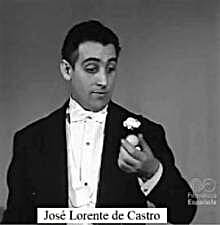
José Lorente de Castro was featured and interviewed on pages 29-30 of Bazan, 4. The article states that Lorente joined the Factory as an apprentice accountant who later graduated to administrative first officer. He took his first steps in show business at Teatro Jofre as part of the earliest festivals arranged by Bazan's branch of "Educación y Descanso."
The year 1949 marked his breakthrough to national recognition when he won "the first prize" with the unanimous vote of the jury at the "International Congress of Magic and Illusionism" held in Barcelona. Note: A stretching of the truth. Lorente earned the first prize in the Manual Dexterity category and won second prize in the Creativity category. According to this webpage, Li-Chang (a Catalan magician) earned the Extraordinary Prize and Niberco (a Dutch magician) the Grand Prize of the congress. The official name of the convention was "First National Congress of Illusionism," held in Barcelona between May 26-29, 1949 (End of Note).
"Due to excessive self-criticism," Lorente opted to retire temporarily to work at improving his skills. He returned to the show business circuit seven years later in 1956. The Bazán interview follows.
"Age, Lorente friend?" "Thirty years old. I am married to Julit, and from this happy marriage I have a son already."
"What is the reason behind the artistic name, Lor'C y Julit?" "Professionalism forced me to substitute my real surname for something that would better attune with certain commercial imperatives."
"Do you think that illusionism still has a future?" "Look, not indeed as it has been practiced until now. I'd say that it stands at a crucial moment of transition and adaptation to the sensibility of the era."
"Do you esteem that you have made some worthy contribution to illusionism?" "Quite. In regard to technique I have created and perfected the sleight of hand with coins, and in regard to the performance on stage I have bolstered the modern technique of not speaking by combining magic tricks with dancing moves; this embellishes the execution of a magic trick. I am now daring to introduce juggling with magic in view of the favourable reception obtained by the previous innovation."
"A final question. What was always your maximum goal as an artist aside from the success you have already achieved?" "To be constantly upgrading."
Vidal the Bazan interviewer adds that the magician sent a "very fond greeting" mingled with deep gratitude to the Factory. "And a moment before my departure," continues Vidal, "this good friend returns to me the wrist watch he had swiped during the interview without my being aware."
Lorc and Julit (Clip from NO-DO Revista Cinematográfica Imágenes Nº 697, year 1958)
Spain had no diplomatic relations with Israel until the year 1986. Consequently it may be assumed that José Lorente de Castro had become famous enough to be granted a special Israeli visa to do a show there in the year 1958.
The following first half of the report comes from pages 26-27 of Bazan, 8. It is translated in full.
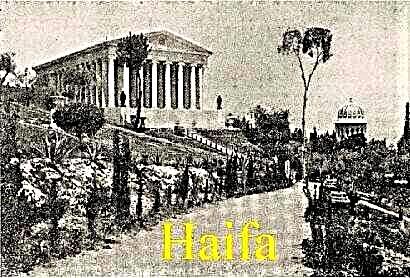
Haifa: Israel's biggest port (160,000 inhabitants). Situated on the slopes of Mount Carmel in the country's north, some 25 kilometers from Nazareth, 75 from Tel-Aviv and 100 from Jerusalem.
Dear reader, you can not imagine the sensation one experiences upon disembarking in the Holy Land where each hill has its history, each olive tree its legend and each pilgrimage destination its parable. It is an immense bliss to be able to see, in this gallery of the past, the cortège of heroes, prophets and saints who have woven with gilded thread the netting fabric of Faith, History and Legend.
On debarking one will nevertheless be amazed at coming face-to-face with a big port suited to a modern industrial city where oil refineries, big smelting works, car factories, clothing manufacturers, etc., are not absent.
But without going too far beyond the city limits and just gazing at Mount Carmel you will be able to appreciate the stunning architecture of the Bahai Temple—the Persian palace with its golden dome that sends out like a moon in broad daylight blinding reflections of sunlight—and the cavern of Elijah the Prophet.
Heading to Tel-Aviv between sea and plowland.
You will be able to choose between fast trains or a wide highway for your trip to Tel-Aviv. A delightsome scenery will file past your eyes during the trip of several hours' duration. The landscape will change progressively from rugged Castilian plateau to the vibrant and gladsome greenery of Galicia, and you will admire the wonderful agriculture of this surprising country, but your amazement will increase when they inform you that what is a blossoming orchard today was an arid desert a decade ago.
Multiple soil horizons: a modern system of agronomy.
How did they accomplish it? Very easily! By overlaying the scorched sands of the desert with layers of loam and moistening them with underground water pumped from very deep artesian wells and distributed with a type of watering cans which, rotating like windmill blades, generate a drizzle very similar to the "calabobos." Two productive harvests are in this manner wrested from the stones and burning sands that once constituted a barren wasteland. Notes: The "watering cans" were lawn sprinklers. "Calabobos" is Galician slang for a fine drizzle that drenches ("cala") the fools ("bobos") who loiter long enough in it (End of Notes).
The greatest accomplishment of Israeli agricultural engineering is the transformation of Hula Lake on the country's north into a beautiful and productive valley.
Tel-Aviv: The biggest urban center with 365,000 inhabitants. Situated on the seashore some 65 kilometers from Nazareth, 50 from Jerusalem and 110 from Sodom.
Upon arrival to Tel-Aviv you will find a modern city, most of whose buildings are surrounded by small gardens and whose broad avenues are lined with plentiful trees which provide a pleasant cool in the summer heat. As regards its character, Tel-Aviv is a cosmopolitan city that induces the traveller to suppose that he is in the heart of Europe and not at this end of the Mediterranean.
Galilee: Center of pilgrimage and tradition. Governed by king Herod in the years of the Gospel. It is crossed by the river Jordan and bathed by the waters of Lake Tiberias. At its heart lies the small town of Nazareth.
But not everything is modernity and evolution in Israel. There are places like the Galilee which have hardly changed in the course of recent times. There, at Lake Tiberias, fishermen keep casting their nets as they did in Gospel days. With a brief flight of the imagination, simply closing one's eyes, you will fancy seeing, emerging from the waters, the majestic figure of Jesus walking on the subdued waves toward the boat his frightened disciples sail.
The second half of the report comes from pages 25-26 of Bazan, 9. It is also translated in full.
Tel-Aviv and the "Sherut".Generally speaking, a tourist lodges in Tel-Aviv and travels from there to the various and manifold places of interest that this surprising country has.
The long-distance bus is the chief means of public transport followed by the railway, the Sherut (shared taxi that covers bus routes) and the city buses.
The "Sherut" accomplishes two things: affordable travel and the use of one taxi for several passengers, compensating the dearth of cars. I must confess that this has been the first of all the countries I have visited where I found this arrangement of shared taxis. Of course the individual taxi is also available.
The hotels and the ambience.
Israeli hotels range from the highest luxury rating down to the modest comfortable boarding house.
The majority of these hotels and boarding houses provides lodgings only, making it necessary to eat in a restaurant. Hotel prices vary from 12 Israeli pounds for luxury accommodations down to 2 pounds for modest ones.
As regards restaurants, the most diverse kinds are available with the most eclectic gamut of meals found nowhere else in the world. Depending on the owner's national origin, you are offered Russian dishes, French, Spanish, Polish, Bulgarian, British, German, Arab, etc. The cost of a menu starts at 2.50 Israeli pounds.
In the evening you can choose between going a theater, a movie house or a Ballroom modelled on the typical French "boîte," i.e., tiny, welcoming, offering a select "music-hall" program.
Nazareth, the cradle of Christianity.
Locared in the mountainous region of Galilee it displays a lovely landscape with white houses detached from each other by small orchards.
Wrecked several times by persistent invasions and different empires it endured and was rebuilt just as often with its buildings preserving a patriarchal charm that calls up the biblical era, as if Time had dozed off over the wheat fields and over the scorched rocks.
Today, as in the days of Jesus, there is only one fountain, the same one that the Virgin Mary visited twenty centuries ago to fill her clay water jug. The fountain is named Ain sitti Mariam (Fountain of Lady Mary) in her honour.
Contrary to general belief, Christianity did not put down roots in Nazareth during the first three centuries. Even Jesus seldom returned there during his public ministry, and when he did, was always unwelcome to the point where, on a certain occasion, his fellow townspeople tried to shove him off a cliff. It was not until the fourth century that Nazareth became the center of the Christian world.
Incidentally the name "Nazareth" comes from the Hebrew word, "Nezer" (male child, cute kid).
Currently Nazareth is a town of some 23,000 inhabitants, the majority Arab Christians, comprising the largest Christian-Arab nucleus in the nation of Israel.
In the Holy Sites.
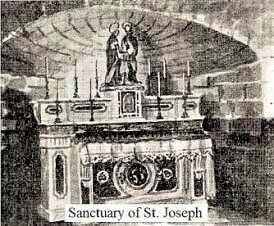
The tourist finds reasons for infinite satisfaction in this village, revelling in the contemplation and admiration of the Sanctuary of the Annunciation which houses the Grotto where St. Gabriel the Archangel appeared to the Most Blessed Virgin.
The Nourishment Church is not far away. Under the tutelage of Greek-Orthodox priests it is located over St. Joseph's house where the Sacred Family dwelt.
You can also perceive traces of the primitive Synagogue where Jesus began to preach. It is very close to the hilltop where the Galileans attempted to thrust Christ downward.
The most diverse Christian denominations converge in these Holy Sites of Nazareth: Catholics, Armenians, Orthodox, Evangelicals, etc.
The Doves and the Orphan Girl.
We picked a small bunch of flowers during the excursion and tour of the various sites of interest. Upon our return to the hotel this posy motivated the old waiter serving us some well-earned refreshments to tell us the story of Nazareth's flowers.
He started by saying, "Many years ago there lived a poor orphan girl here for whom life reserved few pleasures. Still she was very glad to dwell where Mary the Mother of Jesus had also lived.
"On her way to the fountain one day the Virgin appeared wearing a blue mantle and a pink veil over her face. From that day on the young girl saved all the money she could to purchase a blue mantle and a pink veil like those the Mother of Jesus wore. Once purchased, the girl thus bedecked headed proudly to the fountain. The pious townswomen, dressed in typical black garb, were deeply offended and resolved to stone her to death.
"Suddenly two doves appeared which grabbed both mantle and veil with their beaks and carried them off though the air, but in their flight both items tangled and tore in the thorny bushes."
The old waiter concluded, "This is the reason why the roses and the thistles have a more vivid and beautiful colour here than anywhere else in the world." Note: The roses of Nazareth are pink; the thistles blue (End of Note).
José LORENTE
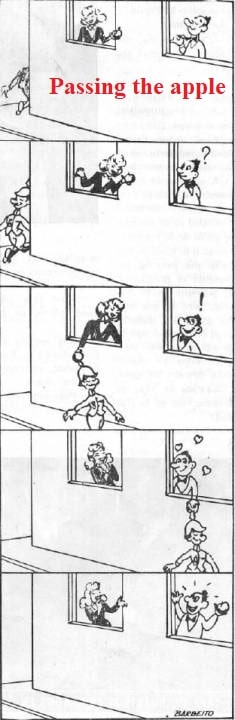
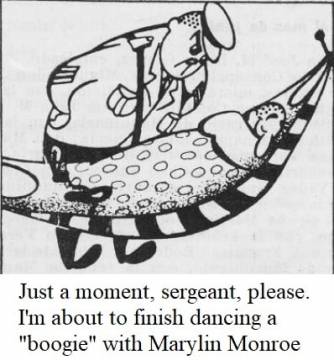
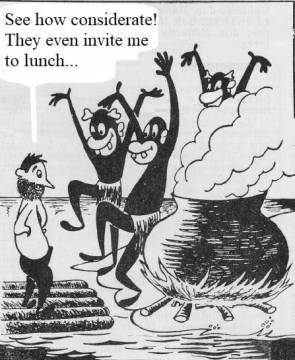
These cartoons evince the influence of Marilyn Monroe and Sputnik in the collective psyche of the year 1958.
According to Wikipedia the Soviet Union launched its second Sputnik on November 3, 1957. It carried a dog named Laika which died of overheating on the fourth orbit due to an air-conditioning failure.
 |
 |
 |
 |
 |
 |
 |
| Ferrol's New England Theater (1906-1914) |