British Pathé Reviews the Year 1957
The source for the news in this chapter has already been discussed in the chapter entitled, "Bazan Magazine for the Year 1956."

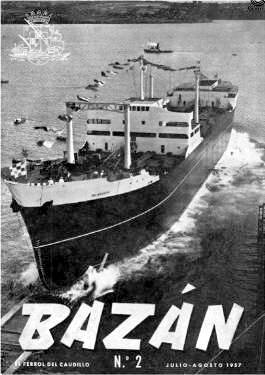
The highlight of the year 1957 in the Factory was the launch on July 12 of the oil tanker, "Valmaseda".
The launch was more or less on schedule despite the shipyard's persistent difficulties in the procurement of sheet steel.
All the workshops dedicated to the manufacture of assembly components and of subassemblies worked without a break.
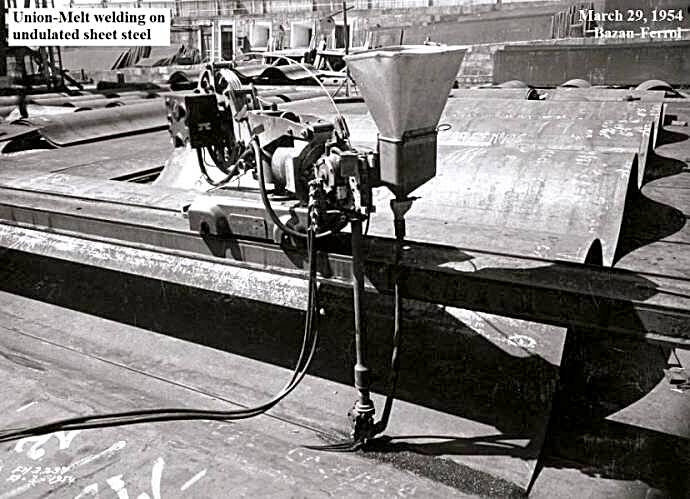
A very intensive use was made of welding in the prefabrication of great blocks and vast panels which the cranes charily maneuvered onto the vessel's bare hull successively.
Most welding was performed manually, but where conditions allowed, "union-melt welding" (photograph below) was done in the modern and very fast installations of the dockyard, and these expedited the labour considerably.
The "Valmaseda" made number 108 in the list of ships built at Bazan-Ferrol. This tanker was the third of a certain Series "T" whose first and second members, "Puertollano" and "Puentes de García Rodríguez" respectively, were built here as well. The three adhered to the standards of Lloyd's Register of Shipping.
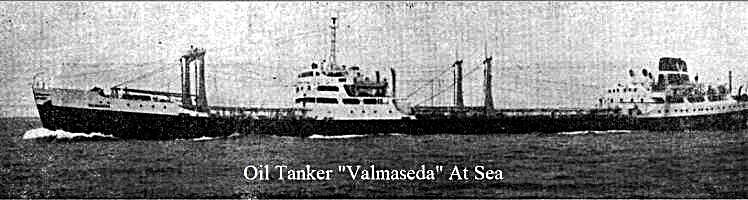
The oil tanker was delivered to the "Naviera Vizcaína" shipping company on December 17, 1957.
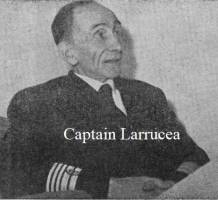
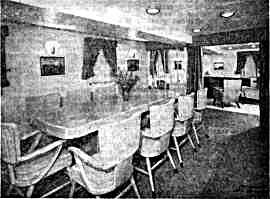
Bazan, 4, interviewed the crew before departure. Captain Juan Larrucea, 56 years old and holding the rank of captain since age twenty-nine, said that the vessel's accommodations were "magnificent" and that it had been equipped with "the epoch's most advanced aids to navigation." Asked about Bazan-Ferrol's standing in relation to other Spanish shipyards he replied, "In first place, especially as regards a fine finish to jobs." His verdict of Bazan workers and technicians was "very good."
The chief deck officer described the "Valmaseda" as the best boat he had ever travelled on, "and I have sailed on many, mind you," he contended. At the Bazan dockyard he had witnessed "the most beautiful stocks" of his life. The second officer waxed enthusiastic about the "Valmaseda," volunteering that he had voyaged on more than twenty vessels since age fifteen. The third officer commented that the junior-officers' accommodations on the tanker were better than the chief-officers' on many ships. He added that "the bridge was a marvel and so too were the installations of the air conditioning, the washrooms, the kitchen, etc., etc."
After a short break in the recreational room, the Bazan reporter headed astern to talk with the two officers natives of Ferrol and found them in their repective cabins.
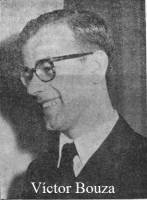
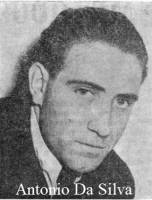
Antonio Da Silva started as an apprentice in the Factory and taught himself the machinist trade. "Da Silva, friend, what might be the cause of your apparent sadness?" asked the reporter. "The fact that I will have to spend the Christmas holidays away from home. But deep down I am happy because I have what I wanted: a job on the Valmaseda which is a marvelous craft." Da Silva then summoned the other Ferrolian, Víctor Bouza Evia, benjamin of the entire crew. He was also a little doleful at the prospect of spending the holidays away from home, "but his youth, optimism and good humour copes with the low spirits."
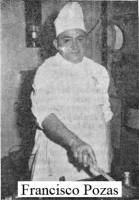
Francisco Pozas the chief cook was the last interviewee. "Do you esteem yourself a good cook?" "I think I'm average." "How would you rate the galley of this ship?" "Very good. The best I've seen in my seventeen years of sailing. I too do my part to ensure that the food satisfies all the crew members."
Bazan's report ends on a sentimental note,
Now they advise us that the "Valmaseda" will be putting out to sea in a very few minutes. Loudspeakers scream and forewarn us of the same immediacy. The unberthing maneuver is set to start. We are almost the last ones to go down the gangway to the pier. A sweet drizzle moistens the flaming heart of the "Valmaseda". And as the vessel starts to move and recede from us, the evening drizzle turns even sweeter, finer, like a sobbing sorrow that is not heard but seen, magical and unreal.
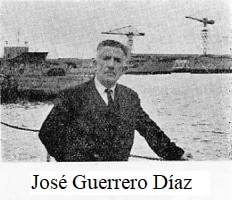
1. José Guerrero Díaz started in 1911 as a first-rate apprentice of the Assembly Workshop. He emigrated to America in 1916 but returned two years later, retaining rank and workplace. To the question, "What do you feel when you hear the shipyard whistle blow, now you are retired?" he replied, "It keeps waking me up every morning and my whole being thrills to its sound. Then I think almost always about my faraway workmates but without any feeling of sadness." "If you could start in the Factory anew, what job or profession would you like to have?" "The same one. I always liked doing my job."
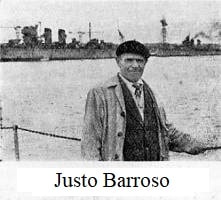
2. Justo Barroso joined the Factory in 1917 as a general laborer at the Foundry. "They told us that you did not wish to retire. Is that true?" "How could it be true? Don't you understand that I can manage my day now as I please?" "Did you perform many different tasks over these almost 40 years at the behest of the Factory?" "Goodness me! I've done general labor everywhere in the workshop. I spent eighteen years at the furnaces, five months at the mill, two years in the washrooms, another two carting fuel for the ovens, seven years two months and three days as an errand boy and the remainder I spent cleaning the workshop."
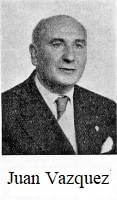
3. Juan Vazquez joined the Factory in 1918 as an Assembly Workshop apprentice. He became foreman at age 39, a lower grade master at 41 and he graduated at age 46 to master blacksmith and design drafter. "When did people work more and better, in the old days or now?" "One worked harder in the old days but, paradoxically, produced less. The worker of today is superior thanks to the technical training he receives." "Your greatest joy working for the company? Your greatest sorrow?" "My greatest joy is to have built four large oil tankers already without having to lament a major workplace accident, something that seems almost impossible because having two to four victims per vessel is a frequent occurrence in other shipyards, especially when dealing with boats as big as ours. I experience my greatest sorrow when one of my men gets hurt."
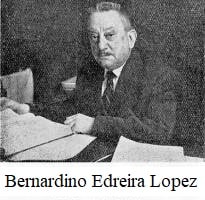
4. Bernardino Edreira Lopez started to work in 1909 as the assistant and interpreter of Mr. Munro then head of the Mechanics Workshop. A short time later he was secretary to Mr. Muir the Chief Engineer at the same workshop. Note: The Ferrolian shipyard was under majority private British management between the years 1908-1928 (End of Note). Subsequently he taught English at the Factory and in the High School. In 1957 he headed Bazan's Technical Information Office and the shipyard's library. "You have been around British people a good number of years. Did you miss them a lot when they left?" "Truly, yes; among other reasons because when the British colony settled in Ferrol I acted as the personal and trusted interpreter of them all, which forced me to speak English almost twenty-four hours everyday."
5. Manuel Candales Perille began to work in 1917 as a fifteen-year-old Pre-Assembly Workshop apprentice. He mounted naval mines first, then learned the rest of the specialties. In 1944 he was transferred with the rank of foreman to the Machine Workshop. As the technical assistant there he was sent abroad more than once.
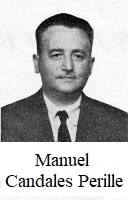 "What impressions did you gather in your visits abroad?" "I visited the shipbuilding yards of Nantes and the Rateau Paris plant in 1950. Note: The Société Rateau of Paris manufactured steam turbines (End of Note). For me it was a source of satisfaction to compare our industry and our organization with the ones we visited and to see that we are up to par with them and that our workforce has no reason to envy theirs.
"In the year 1956 I was in North America at the Charleston dockyards. Aside from technical matters, what drew my attention particularly was an office labelled 'Suggestions Office' where they accept tips and proposals for improving work safety and performance and reward the beneficial contributors; the installations had posters distributed around various locations that simply said, 'It is time to make a suggestion.' This made me remember that here years ago the entire workforce had been invited to make any recommendation that would improve working conditions by way of the workshop masters, and regretting that this concept has been neglected somewhat, especially after witnessing with what pride some American workers showed their suggestions to us, suggestions which any one of our workers would deem prosaic."
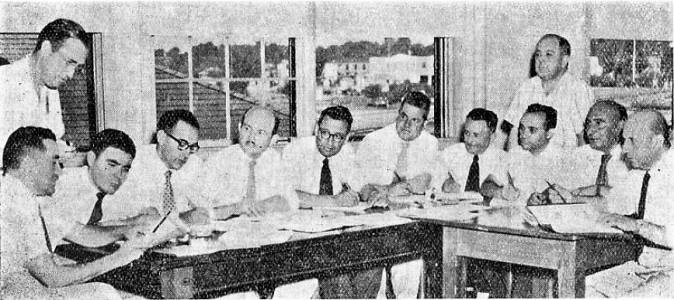
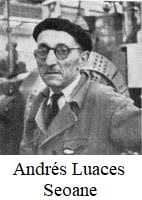 6. Andrés Luaces Seoane joined the Factory as a Machine Workshop apprentice on January 10, 1912, "a day that rained cats and dogs," he recalled. "Do you like your profession or would you have preferred another one?" "I love being a lathe operator, which is what I am and have been until today. My sole ambition in life was to work. So much so that I turned down the promotion to foreman many times because I like to work with my hands more than I like ordering my workmates about. I could have gone to university also, the financial standing of my family allowed this, but I chose to become a lathe operator, as I said, a trade that I am very proud of, despite the many people who, lacking the minimum skills required for this profession, disparage it." "What are the differences between the modern and the old ways of working, if any?" "It is not easy to enumerate them because they are many and of great importance, but the excellent training of apprentices and operators stands out. Today we have a sizeable number of lathe operators, structural steel/plate fitters and milling machine operators who can compete without fear with their counterparts from any other country in the world." "Do you believe the currency of 'fellowship' or solidarity among today's workers?" "Never man was so selfish as he is today, leaving out the exceptions, of course." "If you had command of the workshop for a week at least, what would you order to be done most urgently?" "Whatever was possible to allocate more modern tools each time."
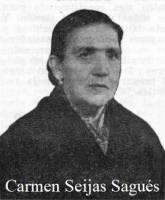 7. Carmen Seijas Sagués joined the Factory as a varnisher in 1927 and switched to upholstery after eleven years, a job where she stood out for her unquestionable ability. She was retired at the time of this interview. "Being a married and intelligent lady, what do you think is preferable for a wife, work outside the house or an exclusive dedication to domestic chores?" "Undoubtedly the second option is preferable. My working outside the house was due to pressing economic needs. But I esteem that among the high hopes of every woman must be this one of an exclusive dedication to the home." "I fully agree with you. Another question: whom do you consider the better upholsterers, men or women?" "Women and men seem equally good to me." Note: The Bazan interviewer makes the following comment in brackets, "And upon giving me this answer she could not avoid the trace of a smile at what she had just told me. Will she have truly told us what she thinks?... Truly, truly?... Since Mrs. Carmen is intelligent and all intelligent women think, though they later say otherwise, that man is superior!..." (End of Note). "Do you wish to answer one last question? What has been your highest hope all life long?" "To have always the love of my husband and the economic means to raise my children decently. This wish has already been realized in great measure, but I had to do a lot of equilibrium in the domestic sphere." "Thank you very much, Mrs. Carmen, in the name of the numerous readers of this Magazine. Now you can dedicate yourself full time to taking care of 'home, sweet home'."
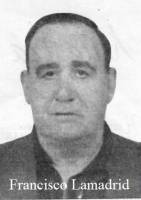
8. Francisco Lamadrid Gurruchuaga was born in Comillas, Santander. The military draft destined him to Ferrol, where he fell in love and got married. The newlyweds emigrated to America, but returned to Spain shortly after the outbreak of the Civil War. Lamadrid joined the Department of Public Works. Two months later he moved to the riveters' guild, and lately he worked in the On-Board Outfitting Workshop as a specialist. He had retired at the time of this interview. "Mr. Lamadrid, why did you come back from America?" "My wife fell sick and had to return, and I followed behind because I wanted to be by her side." "What work did you do in the New World?" "I worked on a boat as a stoker." "Would you not have relished settling in Santander?" "Pish; in fact no. My woman is from here, and since I like Galicia—it enthuses me—I decided to stay permanently."
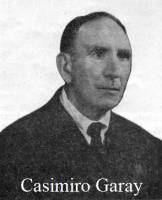
9. Casimiro Garay Villanueva was born in Agüera, Santander. He joined the Factory in 1919 as an iron boiler operator. He was transferred to the Assembly Workshop after thirty years' service and lately to the New Machinery Workshop where he attained the rank of first-class operator. He had retired when this interview took place. "If the question is not indiscreet, what motivated you to take up residence in Ferrol? Did you always live in our City?" "I came to Ferrol to do the military service, but I found a Galician girlfriend and I got married. Do you not think that this is sufficient motivation for all that followed?" "More than sufficient. Besides it is always lucky, a true lottery prize, to be able to marry a Galician girl. Something else, would you have liked being the head of some workshop?" "Well no, because I had the chance to be at least a foreman and I refused it; I think my character is not suited for that." "Final question. Tell us one of your main hobbies." "Reading, for two reasons: first, because it is true, and second, because saying it publicly always sounds good."
A short article written by Manuel F. Cabezón in Bazan, 2, disputes the prevalent opinion that the first Spanish fleet to go to war was under the command of Bonifaz of Castile, the date was Nov. 23, 1248, and the event the reconquest of Seville. He argues that the birth of the Spanish navy had in fact taken place more than a century before, in the year 1131, when Gelmírez the Bishop of Santiago de Compostela ordered the construction of a fleet to oppose the Norman raiders who periodically invaded Galicia to loot the wealth obtained by the church from the multifold pilgrimage to the purported tomb of St. James the Apostle. Gelmírez brought prestigious master carpenters of Genoa and Pisa under contract to construct a dockyard and the required boats, biremes. The Galician fleet soon gained the respect of its adversaries. Later it took part in the reconquest of Almería (1147) and eventually Seville.
The same writer draws in Bazan, 3, a biographical sketch of Álvaro de Bazán the marquis whose surname the Factory took. The second one-page essay claims that many historians concurred that the disastrous end of the Spanish Armada would not have occurred had De Bazán led the expedition, but his death "shortly before the Armada sailed out of Lisbon" put a duke in charge who lacked the energy and the ability required for the enterprise. Apparently a certain Jesuit affirmed that De Bazán died fruit of a severe row with the Spanish monarch over the slow assembling of the Armada. Previously the king had dismissed the marquis' pleas to delay the sea campaign until the unrest in the Low Countries ceased.
We ignore why these sound counsels were brushed off by the most prudent Philip the Second; we know the consequences of it: weather and the ineptitude of the duke wrecked the naval supremacy of Spain and laid the way open for the blonde Albion lording it over the seas.
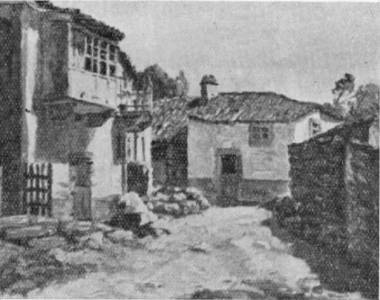
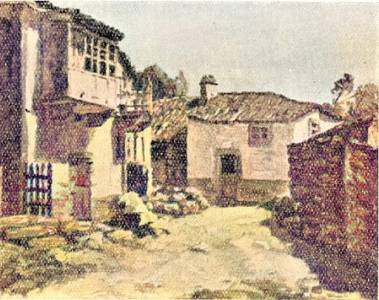 Francisco Iglesias (b. 1918, d. 1995) was a well-known artist in Ferrol who collaborated with the dockyard by way of painting watercolors of the ships (three AI colorized watercolors: gunboat, anti-submarine frigate, and a landing craft) and who arranged the décor of the company's nobler premises as well as the officers' cabins and the meeting rooms on the boats under construction. He also designed the floats used in the Three Wise Kings parade every January 6 and he prepared Bazan's official almanac.
The two paintings directly above are another showing of his work. The black-and-white image on the left comes straight from page 21 of Bazan, 2. The colour version was generated by Hotpot's Artificial Intelligence Picture Colorizer, using a colorization factor of 25 (URL=https://hotpot.ai/colorize-picture). "Hotpot" is the name of a private company founded in the year 2019.
There were budding poets in the Factory as well. What is surprising about the fragment below, extracted from Bazan, 3, page 23, is that it is written in the Galician language! In the Ferrolian schools I went to, pupils were severely punished if they spoke Galician in class, so nobody dared to, even if it happened to be their mother tongue.
The overwhelming majority of Galicians had voted for regional autonomy in the referendum of June 28, 1936. Participation had been extremely high (75%) and practically everyone voted in favour of autonomy (the percentage was 99%). The Spanish Civil War broke out less than a month later, on July 18. The victorious fascist side set out to eradicate the latent desire for autonomy in Galicia by introducing a reign of terror in both urban and rural settings.
The piece of poetry below therefore is a testimony of courage on the part of the writer and of tolerance on the side of the shipyard's upper management. The unexpected circumstance can perhaps be explained by reflecting on the admiration that Rosalía de Castro (b. 1837, d. 1885) the unquestioned poet laureate of Galicia evoked in notable figures of Spanish literature. Even José Antonio Primo de Rivera the founder of Falange Española admired her; the fascist leader too dabbled in the occasional verse. In a speech he delivered on September 4, 1930, at a movie house of Ribadavia (Ourense Province) he said these words,
Whoever calls [Galicia] feeble forgets that from here depart her men for America where, after struggling through work, come back with great wealth; and they return to their original place of birth, where they find women, strong like themselves, who commingle with the strength of their soul the delicate sentiment that is reflected in the verses of your incomparable Rosalía.
|
Din as ondas coa escuma, mansedume,
A dorna, no mar azur, faise gume |
Counsel the whitecaps humility,
The wherry on the blue sea becomes frontier |
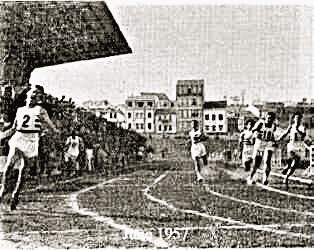
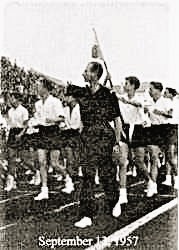
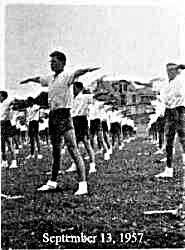
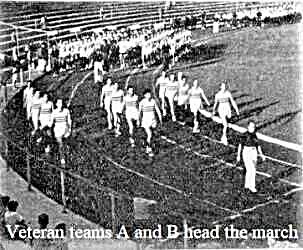
Manuel Rivera Stadium was the venue for two athletic exhibitions in 1957. The first, held in June, was the customary yearly display. The second was a special event which drew a bigger crowd.
This second gymnastic exhibition was held on September 13 in honour of the Sixth National Congress of the Physical Education and Sports section of the state-run organization, Educación y Descanso (Education and Leisure). The congress met in Ferrol. Around six hundred apprentices participated in the display along with Bazan's two veteran teams: team A which won the national Educación y Descanso competition in 1955 and team B which won it in 1956. Also taking part were pupils of the schools financed by Bazan; these performed a separate athletics demonstration similar to the ones they put on at school festivals and in the celebration marking the end of the school year. The two veteran teams led the inaugural march around the stadium. The fourteen men wore a distinctive three-horizontal-stripes shirt. The regulations of Educación y Descanso stipulated that a veteran team had to be composed of six regular members and one substitute; three out of the six regulars had to be over 35 years old.
An Educación y Descanso congressman, the head of sports for the province of Segovia, near Madrid, was asked what he thought of the show and he replied, "Very good, very good all of it, and you can say that this is the opinion of all the congressmen since we have gotten an excellent impression." "As someone who is knowledgeable about athletics, have you observed some flaw in the progression or in the planning of this festival?" "No, absolutely none." "What impressed you the most?" "Everything. But what I liked most was the exercise sequence with the flags, it was quite colourful."
The Bazan reporter asked a phys ed instructor how long it took to train the apprentices for the September exhibition. "About eighteen hours. That is to say, six days with a 3-hour rehearsal each day." "Does this demonstration reveal a particular note of improvement over previous demonstrations?" "Naturally we always try to improve. I think the most notable aspect of this event is the higher degree of synchronicity that we have achieved in all the exercises."
The exhibition of September 13 got underway at 6:15 PM sharp, "a punctuality not made use of in other activities of Spanish life," remarked M. Cristóbal Romero the author of the sports article (Bazan, 3, pages 26-28).
 |
 |
 |
 |
 |
|
 |
||
|
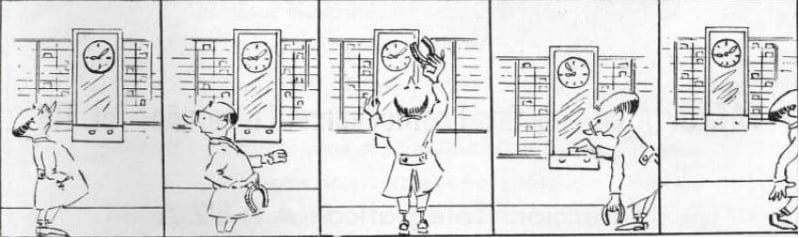
Acknowledgement: Mr. Xan Ramírez Gómez commented on punching the clock at Bazan-Ferrol via e-mail sent to me on Wednesday November 30, 2022. An employee could punch the clock up to 20 minutes late for up to 3 days per month without being penalized. This gave rise to the dockyard idiom, "to punch in the twentieth," (fig. in the nick of time) argot that breached the walls of the shipyard. |
| Ferrol's New England Theater (1906-1914) |