|
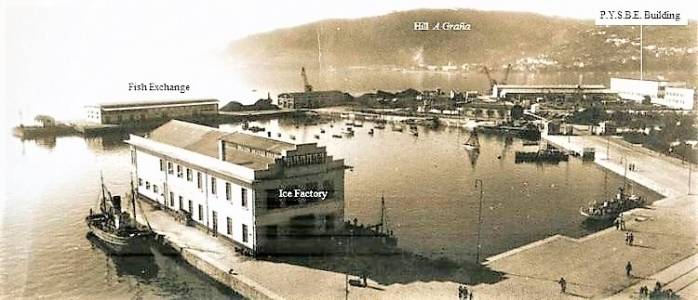
Acknowledgement: Mr. Anxo Grandal d'Anglade pointed out the correct locations of the P.Y.S.B.E. building (where his father worked as a draftsman) and of the Fish Exchange via e-mail sent to me on Friday June 14, 2019. He also kindly invited me to download photographs from his Google Album on Ferrol, which I have done (e.g. the Bazan women's basketball team, a new hyperlink of Chapter 1, "The Shipyard"). |
It was probably the year 1957. Dad and I were down at the harbour and in our stroll we chanced across a pair of codders side by side, the dockside vessel moored to a bollard. "These ones go to Newfoundland." Newfoundland. The placename conjured up images of thick fog, driving rain, snow and ice, endless gales and heroic walnut-sized boats braving monstruous waves. I could but look on the vessels admiringly.
P.Y.S.B.E. Company financed the cod fishing enterprise. The acronym stood for Pesquerías Y Secaderos de Bacalao de España, a Basque business with headquarters in Pasajes that had a second base and factory in Ferrol. The company owned a couple of buildings in the harbour, the "ice factory" (foreground of the above photograph) and a two-storey building. The names of some P.Y.S.B.E. ships that used the port were Euskalherria, Galerna, Hispania, Mistral, Tifón and Tramontana. Most dated from the nineteen twenties. In January of 1955 Bazan took on the maintenance and repair of four.
The following clip records the inauguration and blessing of the PYSBE installations and of the codder "Mareiro". The clip co-opts the newsreel's intro for show. The actual newsreel, thirteen minutes long, was first shown on Monday March 5, 1945.
Official Spanish Newsreel NO-DO 114 B
Voice-Over Translated: On the "Concepción Arenal" piers of El Ferrol del Caudillo the codfish processing plant of P.Y.S.B.E., which bears the name of Saint Julian the patron saint of the city, has been officially inaugurated. The installations and the work done here are one more demonstration of the high level and growing industrial vigor attained by this branch of our economy in Spain. In the act of inauguration Dr. de Arriba y Castro the prelate of Oviedo blessed the factory. Accompanied by the authorities and invited guests the bishop blesses the ship "Mareiro" also, one of the boats slated for service at this important center.
There was a second codder company named P.E.B.S.A. with headquarters in A Coruña. Their ships bore the name of female saints, and so together with the Portuguese codders that followed the same tradition, they were known to Newfoundlanders as "Santa's Ships": Santa Amalia, Santa Elvira, Santa Inés and Santa Rita among others. For their part Ferrolian fishermen dubbed St. John's Signal Hill, Chamorro. The twelve P.E.B.S.A. boats dated from the nineteen forties and fifties, most were built by the rival shipyard Astano, five kilometers away from Ferrol by road. The last one slid down the slipway at 4:30 PM on March 25, 1959. Its name was Santa Regina and the newspaper dubbed it "a magnificent codder."
All sources agree that a codder's life was very tough.
Whoever has sailed in the area of the Grand Banks will know that the temperature is usually below freezing during the winter and that the area is well known for the fierceness of its storms, which coming one after the other, afford no respite to the crews and make seafaring in these waters difficult. I had the experience of working on deck deep in the month of November at Port-Cartier and I can guarantee you that I finished the job virtually frozen. And this happened on a modern boat with excellent heating and with the deck fifteen meters above sea level. Now let my readers imagine the small steamboats of nearly a hundred years ago plying the heavy seas—smooth seas, they called them—with scant heating and with the crew labouring on deck having little protection against the temperature, stationed hardly a meter above sea level, skinning and cleaning the cod fish (a chore that caused eczema and skin irritation) and being periodically exposed to deck-clearing waves for which only a small contraption was provided...to hang on to. Working without rest until prostration set in...without a water closet, with permanent humidity and temperatures below freezing. Add to this the absence of doctors or medicines, the lack of privacy or hygiene, exhaustion and the neurosis caused by the working conditions and one will grasp the way of life of these courageous and hardy mariners.

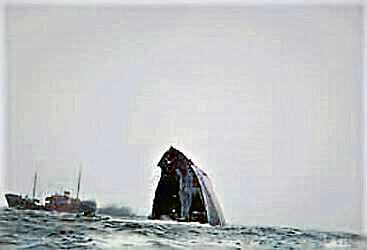
On June 1, 1955, the newspaper reported tersely that the codder "Tifón" had sunk off Newfoundland and that the entire crew had survived.
P. U. Ochoa (see footnote) explains that the Portuguese ship Invicta rammed the Tifón accidentally and sank it within eleven minutes. Most of the crew was picked up by the Portuguese trawler Álvaro Martins Homem.
Ochoa states that the "Tifón" had its hold full and that providentially the accident occurred in relatively tranquil seas, for about an hour later another storm blew in and the rescue would not have been possible then.
Portuguese references to the accident give the date of the mishap as May 26.
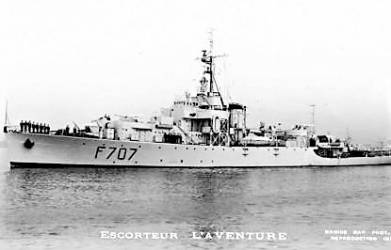
P.Y.S.B.E. paid homage to the French crew of L'Aventure in the year 1961.
The French frigate provided mailing services and meteorological data, warned about the location of ice floes, transported sick or injured fishermen and maintained constant radio communication with the trawlers.
Captain Blanchard remarked in his memoir, "L'Aventure Et Ses Terres-Neuvas," that "French and Portuguese mariners get along quite well and render each other mutual services."
However the frigate's captain writes that the French mistrust the Spaniards and that "relations between Canadian and foreign fishermen are not cordial."
| Ferrol's New England Theater (1906-1914) |