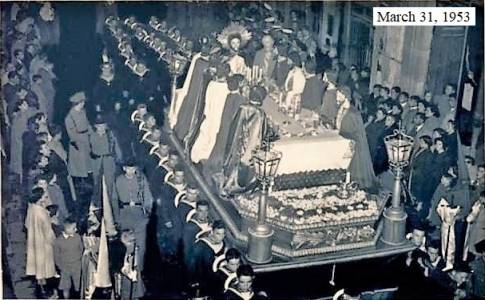
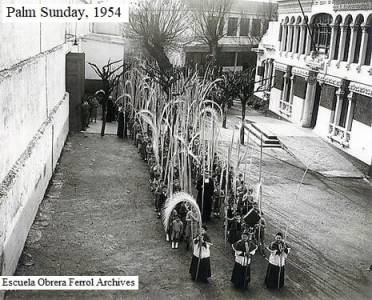
Religion played a central role in the Ferrol of my childhood. Street-level displays of religiosity ranged from simple affairs like the blessing of a new store, or the taking of the Blessed Sacrament under canopy to sick parishioners, to the pageantry of Holy Week and the Corpus Christi procession of late spring.
Every pillar of Ferrol society had its patron saint, a date observed with a Mass and a fraternity meal. Bazan had two patron saints: St. Joseph (March 19) and Our Lady of Carmel (July 16) who was also the Navy's. On July 16, 1954, all shops in Ferrol closed except for bars and cafeterias. The Mass held at San Julián Church was attended among others by the captain general of the maritime department, the military governor of the base and the mayor. The chorale of the shipyard sang during the service and a company of naval infantry waited outdoors. The public was "very numerous." On the eve of St. Joseph, 1955, the shipyard rewarded the oldest and most reliable worker with an important sum of money: the beneficiary was a shop sheet-metal worker.
Every branch of the military stationed in Ferrol had its patron saint. The patron saint of the regular infantry was the Immaculate Conception (December 8). On this day of 1954 a solemn Mass was held in San Julián Church at 11:00 AM. The Mass was presided by the captain general of the maritime department, the military governor of the base, the mayor, the admiral of the fleet and the rear admiral of the arsenal. The Association of Ladies of the Immaculate Conception also had their place of honour. Many other local officials were present, army and navy officers and commanders and "a very numerous public." A company of regular infantry made up the guard of honour. A military parade followed the Mass. Garrisons served their troops a special meal. The following day a Requiem Mass was celebrated at 11:00 AM for the eternal rest of all dead infantrymen. The patron saint of the artillery corps was St. Barbara (December 4). On this day of 1955 the pattern was repeated: solemn Mass in San Julián Church at 11:00 AM, a battery of coast artillery as honour guard, and the next day a Requiem Mass at 11:00 AM for the eternal rest of all dead artillerymen.
Every major organization and trade had its patron saint. The patron saint of the School of Commercial Agents was Our Lady of Hope (December 18). On Saturday December 19, 1954, the School attended a solemn Mass in San Julián Church at 11:00 AM. At noon a new center was inaugurated and blessed, the invited guests toasted with a glass of Spanish wine. A midday meal followed in a downtown restaurant. On Monday December 21 a Requiem Mass was held at 11:00 AM for the eternal rest of all dead commercial agents. The following year the celebration which fell on a Sunday acquired "extraordinary splendour." The solemn Mass at San Julián Church was presided by the president of the School, the captain general of the maritime department, the deputy mayor, a corvette captain, the local leadership of the fascist Falange Española and the president of the port authority for public works. Again the public was "very numerous." The Requiem Mass was held at 11:00 AM on Monday. Note: Requiem Masses for all dead members of a profession were fairly common, e.g. on the Day of the Book, 1954, a Mass was held at San Julián Church for "all dead Spanish writers" (End of Note). The patron saint of watchmakers and jewellers was St. Eloy (December 1). On this day of 1955 they had Mass in San Julián Church at 12:00 noon for all dead watchmakers and jewellers. Town Hall feted the living professionals with a "fraternity meal" in one of its chambers at 2:00 PM. There was also an evening party with dinner and dancing. The patron saint of Radio Ferrol was the archangel St. Gabriel (March 24 until the year 1969). And on it went.
Doing a pilgrimage to Santiago de Compostela was also an obligation for many workers. On Sunday August 29, 1954, a delegation of a thousand shipyard workers and employees made Bazan's official pilgrimage by train. Between 350 and 400 apprentices had set out on foot three days earlier, "equipped with all the required provisions including camping gear." The official delegation was headed by the chairman of the shipyard; he made the "offering to the apostle."
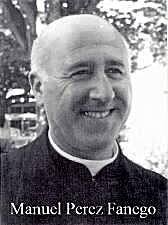
That same day Bazan's Polyphonic Chorale, composed of 70 men, 40 women and 30 children, gave an outdoor concert at Quintana Square in Santiago de Compostela before a large audience (photograph). The chorale, founded by Reverend Manuel Perez Fanego the chaplain of the dockyard, had had its official debut on June 15, 1941, at the "Jofre" theater. It performed outside Ferrol for the first time on April 23, 1953. It received great reviews everywhere it sang. It even turned down an invitation by the Spanish Embassy to go to London, England. On September 20, 1956, the chorale sang in the cathedral of Santiago de Compostela under the baton of American composer, choir director, professor and musicologist William Levi Dawson (b. 1899, d. 1990) during the final stop of the American's Spanish tour. That day left a "very gratifying souvenir in everybody's spirit and constituted a source of legitimate pride for the chorale and for the shipyard."
On September 26, 1954, Town Hall made its official pilgrimage: "around 1,500 Ferrolians gained the Jubilee of Holy Year last Sunday," reported the newspaper on the Tuesday. The citizens travelled on chartered buses, the police rode motorcycles.
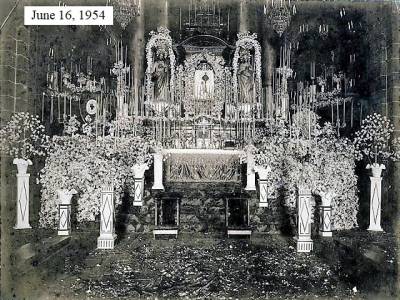
The year 1954 was particularly fervorous. On Easter Sunday a "solemn act of Easter communion" took place at the Hospital of Charity escorted by a platoon of naval infantry with regimental flag, squad of fusiliers and marching band. The patients were served an extraordinary meal. On Sunday May 9 a throng brought the Virgen de Chamorro icon in procession from its hermitage on a high place three kilometers away. Thousands of citizens accompanied the statuette "on her triumphal entry to Ferrol." There was Mass at the Home of the Apprentices with full attendance. The icon stayed in the city for one week, conveyed from parish to parish. On the afternoon of the 12th it was carried to San Julián Church amid "crowds, emotion, devotion and fervour" and there it remained until the journey back to the high place on the 15th. At 7:30 PM that same day another icon was brought from a church six kilometers away. Previously Town Hall had urged everyone to festoon their balconies. The arrival of the second icon was an "apotheosis"; the statuette was greeted by crowds, the military and Town Hall. On June 16, 1,000 carrier pigeons were released at Plaza de Armas as the Corpus Christi procession reached the square. On Sunday August 15 a Catholic association of nighttime worshipers celebrated "its golden wedding anniversary." Many members of the association came by train from other parts of Spain to take part. There was Mass at San Julián Church, a procession, an official reception at Town Hall and a complimentary cruise around the bay. Even a spokesman for the "Generalissimo" sent a telegram of congratulations. Another grand occasion was the "Day of the Hispanic Race" (October 12). A solemn Mass was held at San Julián Church "to consecrate the city of Ferrol to the Immaculate Heart of Mary," and the newspaper reported that "the naves overflowed with people."
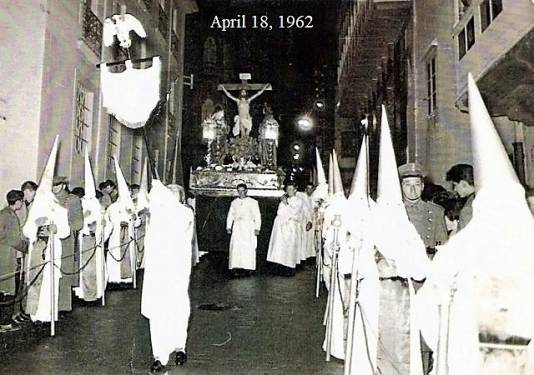
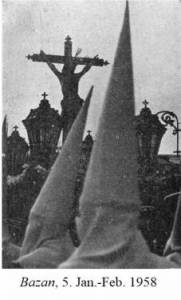
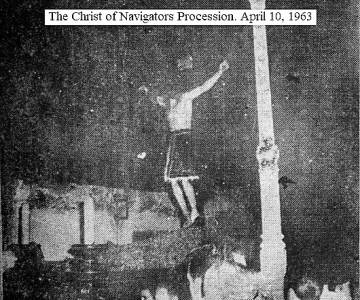
The pageantry of Holy Week was the highlight of every year; the first record of a Ferrolian procession dates from the year 1616. Palm Sunday had the cheeriest processions, palm-carrying children and no pointed hoods. The Christ of Navigators procession on Holy Wednesday is the oldest. There were no pointed hoods and its circuit hardly left the circumscription of what used to be the fishermen's quarter. This was not an "official" procession, yet one of the more deeply felt. On April 6, 1955, its marching sequence was a band of bugles and drums followed by a pole cross and two pole candlesticks, rows of male and female devotees, among them "many navy oficers and commanders," fishermen and sailors, a float with the image of the Christ borne on the shoulders of navymen, an escort of navymen, parish clergy and last a naval infantry band of bugles and drums. A "large number" of the faithful was present. Behind the float walked the mayor, a navy commander and a retired vice admiral. Through traffic was diverted to the ring road from noon on Holy Thursday until Saturday. Holy Friday had the greatest number of processions, Holy Burial was the gloomiest. The last one set out at 11:00 PM and went by the Galician nickname, Os Caladiños (The Dear Quiet Ones). I remember watching it with my parents and brothers once. On April 8, 1955, its marching sequence was headed by the brotherhoods of Jesus the Nazarene and of St. John the Evangelist (red hoods and capes, white robes) then a first float with the image of St. John the Evangelist, followed by the brotherhoods of Our Lady of Mercy (green hoods and capes, white robes) and Holy Burial (black hoods and capes, black robes with golden embroidery) then a second float with the throne image of Our Lady of Sorrows, parish council and secular authorities, brotherhoods of Our Lady of Sorrows, Sacred Supper, Christ of Mercy and Our Lady of Piety. The presidents of the various brotherhoods walked together at the close. This was the only procession without a military band (hence its nickname).
The Corpus Christi procession was the second highlight of the religious year. Traditionally children did their first communion in a late morning Mass that day. The procession set off at 6:00 PM from San Julián Church. On June 9, 1955, it made temporary stops at makeshift altars put up on behalf of the civil government, Town Hall, Falange Española, Navy and the shipyard. The newspaper of May 28, 1959, gave the location of the altars: the Army's at the military government building, the altar of Town Hall at Plaza de Armas, the altar of Falange Española at Plaza de Amboage, the Navy's at Navy Command Headquarters and Bazan's at the esplanade in front of San Julián Church. Bazan's choir performed in San Julián Church and at Town Hall square. A "traditional blessing of the sea" was performed at the Paseo de Herrera lookout. The newspaper recorded that "the gonfalon of the Most Blessed was carried by the state prosecutor accompanied by the principal of the high school and by the chairman of Bazan."
| Ferrol's New England Theater (1906-1914) |