When I was a child my father worked as a draftsman in Empresa Nacional Bazán.
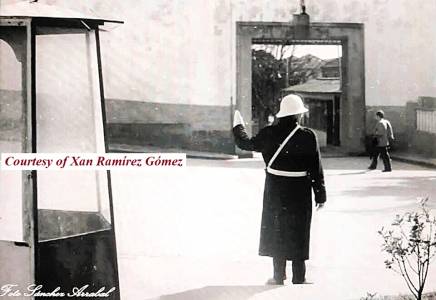
The shipyard was in those days concealed from view along its entire perimeter by a whitewashed wall four meters high. Years later some stretches were toppled and replaced with a picket fence to let the public peep through.
Various entrances segregated the Bazan-Ferrol employees. Blue-collar employees entered through this door. Downslope from it, white-collar employees like Dad entered through the door photographed on the left. This opening in the wall no longer exists; it faced the downtown gardens. Navy personnel had and have two reserved doors secured by marines. The one named "Dry Dock Gate" faces the right flank of the Monument to the Fallen in Africa, a memorial raised in 1949 to all the Ferrolian soldiers who died in the Spanish colonial wars of that continent. The Dry Dock Gate boasts a clock tower built in 1857. The second Navy door is situated nearest the harbour on a small triangular offset where stands an obelisk named Fountain of Fame dating from 1787.
A narrow sidewalk made of tiny-square paving slabs borders the long white wall running from the Dry Dock Gate to the Fountain of Fame Obelisk. The sidewalk is offset from the ring road by plots of grass with trees, lamp posts and rounded cement edging. I remember strolling back from the harbour some summer night with family and friends. I could not resist the temptation of tripping and balancing on the round edging. Our pace was relaxed, the conversation of the adults animated, the air mild: a brief interlude of bliss.
Empresa Nacional Bazán took off in the month of October, 1947, and began construction at a furious pace.
Nine destroyers were launched between 1951-61,
At the same time Bazan was graduating to the construction of bulk carriers and oil tankers.
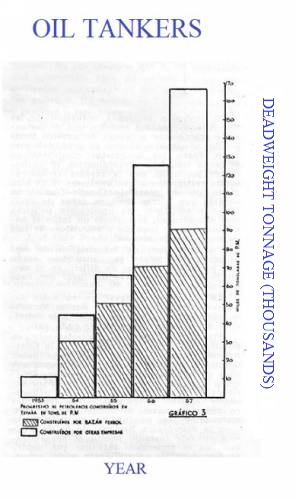
The graph on the right shows the cumulative deadweight tonnage of the oil tankers delivered at the Ferrolian shipyard between the years 1953-1957. The diagram is taken from the article entitled, "Bazán y la Construcción Naval en España," written by Ernesto J. Maceira the Chief Projects Engineer and which is found on pg. 14 of Bazan, 4. I have added the blue-coloured labels in English (top, right and bottom).
The leftmost labelled abscissa corresponds to the year 1953. Increments along this x-axis are of course in units of 1. The rightmost labelled abscissa corresponds to the year 1957.
The lowermost labelled ordinate is 10, corresponding to 10,000 tonnes. Increments along this y-axis are in units of 10. The uppermost labelled ordinate is 170, corresponding to 170,000 tonnes.
Histogram height increases from left to right as one would expect. The white portion of every histogram represents the oil-tanker tonnage built at Spanish shipyards other than Bazan-Ferrol. The striped portion represents the tonnage built at Bazan-Ferrol. A cursory glance reveals that Bazan-Ferrol failed to deliver a single oil tanker during the year 1953. Deliveries started in earnest during 1954 and the output immediately eclipsed that of all the other shipyards combined.
On page 15 of Bazan, 31, February 1967, as part of an article entitled, "The Construction of Oil Tankers," F. Vila Segura the writer lists "the oil tankers built or being built by the factory of E. N. Bazán of El Ferrol del Caudillo." His table is reproduced below, abridged to the year-of-launch interval 1953-1965. The two columns below entitled "Year of Launch" and "Year of Delivery" constitute my own contribution. Moreover I have corrected Segura's year-of-contract data for the four "T" class oil tankers, "Valmaseda," "Durango," "Compostilla" and "Ribagorzana," based on the information found on this webpage.
| Name |
Deadweight Tonnage |
Year of Contract |
Year of Launch |
Year of Delivery |
Feb. 1967 Status |
|---|---|---|---|---|---|
| Almirante F. Moreno | 14,000 | 1951 | 1953 | 1954 | In service |
| Almirante M. Vierna | 14,000 | 1951 | 1953 | 1954 | In service |
| Puertollano | 18,410 | 1952 | 1955 | 1955 | In service |
| Puentes de G. Rodríguez | 18,410 | 1952 | 1956 | 1956 | In service |
| Valmaseda | 19,250 | 1955 | 1957 | 1957 | In service |
| Durango | 19,250 | 1955 | 1958 | 1958 | In service |
| Compostilla | 19,250 | 1955 | 1958 | 1959 | In service |
| Ribagorzana | 19,250 | 1955 | 1960 | 1960 | In service |
| Bilbao | 32,000 | 1959 | 1961 | 1962 | In service |
| Guernica | 32,000 | 1959 | 1962 | 1962 | In service |
| Ingeniero Hermitte | 19,660 | 1960 | 1964 | 1967 | Under construction |
| Sardinero | 53,000 | 1963 | 1965 | 1966 | In service |
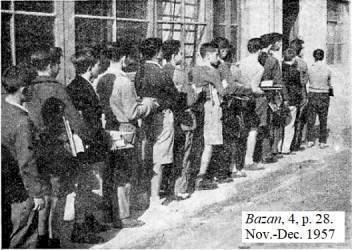

The above photograph comes from the article entitled, "And Tomorrow They Shall Be Men," found on page 28 of Bazan, 4, November-December 1957. The original caption reads: "Apprenticeship class of 1957-58 picking up school supplies." The article states that 154 applicants had passed the entrance examinations and qualified to join Bazan-Ferrol as apprentices. Luis Eugenio Lopez Rey the author wishes every single one of them "the most commendable success, that is, a permanent job in the Company, foundation of your future," and ends the article with this encouragement, "Welcome, children. Work and study. And tomorrow you will be men."
Almost all Bazan workers were trained by the company. Their apprenticeship started at the age of ten to fifteen. According to the feature article in La Voz de Galicia of Sunday August 29, 1954, apprentices could specialize in one of Machining, Drafting or Accounting. They signed up for an intensive 3-year training period subdivided into six semester courses. The teaching staff numbered thirty-seven for the theoretical courses. Daily classes ran from 7:45 AM to 8:30 PM. The trainees enjoyed a 3-month summer holiday during which they attended cultural seminars, went on paid trips, visited other factories and did recreational camping.
Beside the technical curriculum the shipyard enrolled all apprentices in sports and athletics. Gym classes were organized and run by three professional teachers assisted by nine instructors (Dad was one for a while). The factory organized year-round tournaments of track and field, basketball, soccer, swimming and longboat regattas. The factory grounds had a soccer field and a running track plus an excellent gymnasium with shower facilities and a basketball court. There was a second soccer field outside the shipyard a short sprint away.
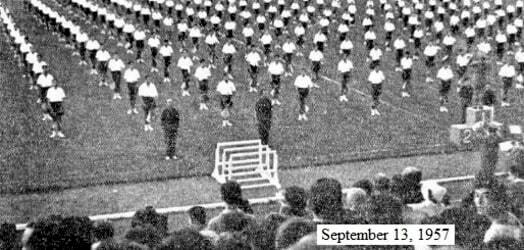
The curriculum included singing classes, whose better pupils were selected for the musical groups of the state organization, Educación y Descanso (Education and Leisure). This state union promoted culture, sports and built more than twenty-five holiday residences and chalet towns for workers across Spain.
All apprentices took the same subjects in first year: Arithmetic, Geometry, Algebra, Trigonometry and Mechanical Drawing I.
Specialization began in the second. Those specializing in Machining or in Drafting took some of these courses: Physics, Mechanics, Marine Boilers I, Tooling, Descriptive Geometry and Projection, Metallurgy, Plumbing, Mechanical Drawing II and Electricity I.
Third-year courses included: Engines, Alternative Engines, Motors, Turbines, Lathes, Technical Sketching, Blueprint Reading, Foundry and Molding, Modeling, Marine Boilers II, Shipbuilding, Mechanical Drawing III and Electricity II.
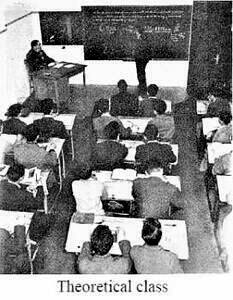
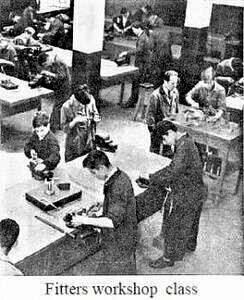
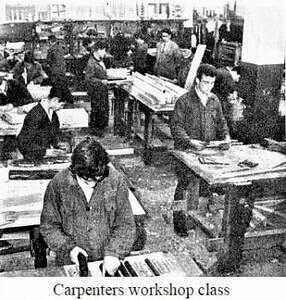
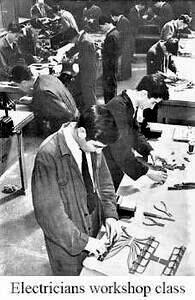
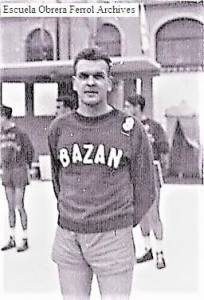
The first three photographs above (from left to right) come from the article entitled, "The Apprenticeship Schools," found on pages 8-11 of Bazan, 10, January-February-March 1959. The fourth comes from that number's back cover. The article first boasts of the long-running reputation of the Ferrolian shipyards, "many were the boats that descended the slipways of Ferrol, so many that they composed mighty navies by themselves." Next it informs the reader that the Factory had built "new, modern, comfortable, luminous" classrooms for training the apprentices. Gym classes and participation in sport competitions were compulsory. The apprenticeship now took "more than three years of rational, efficient instruction." Manuel Cristobal Romero the author urged the apprentices, School and teachers to live up to their responsability so that Bazan-Ferrol would continue to rank among the best shipyards and so that "many will be the ships whose maiden voyage will ride the waters of this broad and beautiful bay of Ferrol."
The apprentices were not only graded on their courses, note was also taken of "their moral condition and work attitude." Successful graduates became regular employees of the company. Unsuccessful ones were hired as general-purpose laborers or helpers.
When I was a child the apprentices boasted their own bugle-and-drum band. Its members dressed in faded blue workwear. Whenever they appeared at the close of a military parade or in a religious procession the public applauded them the most.
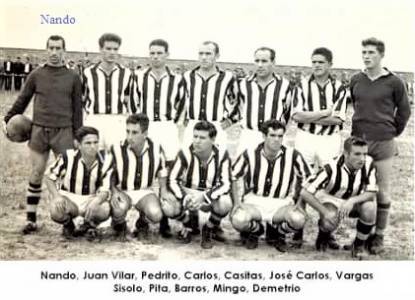
Bazan sponsored its own soccer club between 1947 and 1981. Its original name, "Galicia," was changed to Arsenal when Bazan took it over in July 1947. The team played in the Third Division of the Spanish soccer league until the year 1965. Dad would take us to watch Arsenal play on Sunday afternoons at the old Manuel Rivera Stadium after a brief stop over at a candy shop near the venue. There was no artificial lighting so the games started as early as 3:30 PM when the days were short or as late as 6:00 PM when they were long. In the cloudy days of late fall and early winter it would be getting dark by the time the game finished. The scoreboard was a steel panel with boards numbered 0-9. The scorekeeper inserted and replaced the boards manually. The public was made up mostly of men and children. Tobacco smoke filled the air and there were the inevitable swear words from a few fans in the stands. Some would bring transistor radios along to keep track of First Division matches. The pitch displayed a groomed green during the dry season (clip) but would become a quagmire during the late autumn and winter (clip). Nando the goalkeeper is the player I remember best. He would walk onto the pitch clasping a cap which he would finally wear if the sun was shining or would throw into his own net, baseball style, if the afternoon was overcast.
On September 19, 1954, Arsenal played a regular season match before visiting officers and sailors of the Dominican Navy. Spanish military and civil authorities were also in attendance. The match started at 5:00 PM and the final score was 4-0.
The 1954-55 season was Arsenal's best. On Sunday Jan. 9, 1955, the team defeated Lugo 7-2 at home and qualified for a round-robin, eight-team tourney of promotion to Second Division in which first place alone promoted. Arsenal got off to a great start, but on Sunday Feb. 13 the team travelled to Burgos without Nando; he stayed home mourning the death of a son. The substitute goalie received four goals and the team scored only two. The following Sunday the team with Nando back in the lineup faced Torrelavega at home. The local referee disallowed a legitimate Arsenal goal in the ninth minute. The visitor played defensively for the remainder of the match and were lucky to score on a counterattack in the last minute of play. These two consecutive losses took the wind out of the team's sails. On April 17 Arsenal trailing by seven points played a home game against first place Indauchu. The game started at 5:00 PM and despite windy conditions Arsenal won 2-0. Next Sunday, with only two games left, they played their final home game and beat second-place Langreano 4-2. The crowd in the stadium gave the players a "deafening ovation" as they saluted from midfield at the end of the match. They next travelled to Valladolid where they lost the last game of the tourney, a mere formality. Arsenal finished third in the standings with a 6-3-5 record.
Between the years 1960 and 1965 the city's professional team Ferrol and the shipyard's Arsenal were direct Third Division rivals. The last time I recall watching them play was on Sunday February 24, 1963, when after a brilliant performance and leading 1-0, Arsenal threw the game away with two deliberate own goals in the final few minutes of play. Rumour had it that the match had been fixed to give Ferrol a chance to promote to Second Division at the end of the regular season. If memory serves me right, we never went back to watch another soccer game.
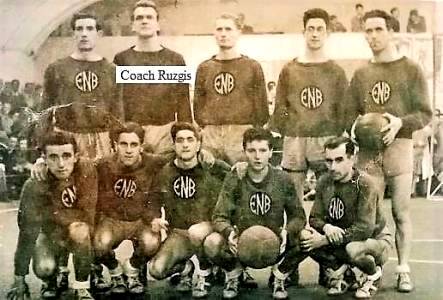
The source for the photograph was the Twitter account "Fer Agras" with associated date, May 20, 2022.
Bazan also sponsored its own men's (1951) and women's (1953) basketball teams. The men's A Team was good enough to play in the Second Division, and some say that the shipyard refused a berth in the First for financial reasons. On Monday June 1, 1953, Bazan won the Regions Federation Cup in Valladolid by defeating Español de Valencia 43-30. The newspaper Mundo Deportivo praised the speed of the Bazan players and singled out Rusghise [sic] as their best player, who was also the coach and whose real name was Michael Paul Ruzgis.
The 1954 season was arguably Team A's best. In February Bazan played a home friendly against the Spanish national team, the game started at 7:30 PM and Bazan won by the score of 69-57. Between May 11-13 Bazan played in the round-robin inter-regional championship held in Valladolid against Águilas de Valladolid, Real Valladolid and Covadonga de Gijón. On Tuesday May 11 Bazan beat Covadonga de Gijón 44-28 with "manifest superiority." On Wednesday Bazan defeated Águilas de Valladolid 59-43. The decisive game was played at noon on Thursday "under a blazing sun" against Real Valladolid. In a "colossal feat" Bazan won 54-39. The outstanding Bazan players of the series were Pardo, Lobón and Polo. The championship advanced the team to the Generalissimo's Cup in Madrid where they would face San Adrián de Barcelona, Estudiantes de Madrid and Real Madrid.
On Thursday May 20, 1954, Bazan left Ferrol for Madrid on the TAF. On Sunday at 7:00 PM Bazan beat San Adrián de Barcelona 64-46. On Monday at 11:00 PM Bazan defeated Estudiantes de Madrid 74-63. On Tuesday at 11:00 PM Bazan succumbed to Real Madrid 37-67. "The superiority of Real Madrid was evident, they were always ahead on the scoreboard." On Wednesday May 26 the team returned from Madrid. "Players of juvenile and junior basketball teams [and] many fans gave the Ferrol sportsmen an affectionate and cordial welcome home" at a transfer railway station forty-one kilometers away from the city. A short note in the newspaper La Voz de Galicia of June 9, 1954, summed up the extraordinary season thus, "Our unreserved applause for Ruzgis and those sportsmen he so skilfully trains."
This photograph taken at Manuel Rivera Stadium is almost certainly from a public presentation/celebration of the basketball team shortly after returning from its triumphant debut in Madrid. The photograph comes from the archives of Escuela Obrera Ferrol.The format of the Generalissimo's Cup for the year 1955, held in Barcelona, was altered—rigged, one could argue—to favour a final between Madrid and Barcelona teams. On Friday May 20 the quarter finals of the Madrid Group started with six teams, Real Madrid, Bazan, S.D. Astur, Estudiantes de Madrid, Español de Barcelona and Águilas de Valladolid, split in two groups so the two teams from Madrid did not have to face each other. Every team played two games. On Saturday Bazan defeated S.D. Astur 79-48. On Sunday Real Madrid defeated Bazan 66-43, knocking it out of the competition.
The following year Bazan ended third behind Real Madrid and Aismalíbar de Montcada and ahead of Grupo Covadonga.
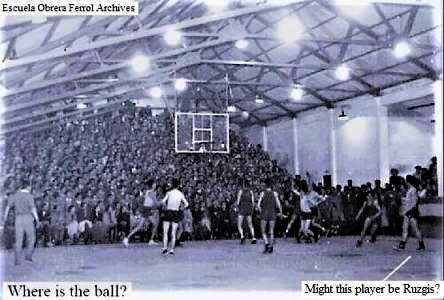
The Lithuanian National Radio and Television Broadcasting Service published an excellent webpage on November 29, 2020, written by Rytis Kazlauskas, which casts light on what transpired during the year 1956. Ruztgis and his family had been living a carefree life in Ferrol. But one day in 1956 as Ruztgis and his eight-year-old son Michel were returning from the shipyard they were met by three officers.
"One of them took me home, while Dad got in the car with the other two. The one who was escorting me introduced himself as a representative of Franco's political police and said that there was nothing to worry about," Michel said. "Dad came back home after a few hours and said that everything was fine. But he warned me not to walk close to roads from then on and to scream to attract people's attention if a car stopped next to me."
Soon after the encounter with the officers, Ruztgis' family went to visit friends who lived some 30 kilometres away from Ferrol. Michel recalled that while he was playing out in the garden, a man started reading words from a notebook and asked him whether he had ever heard these words at home: Leningrad, anarchists, secret police, Budriunas, N.A.T.O., F.B.I., Kaunas, Republicans, Vilnius. The list went on. Michel said yes.
Michel said that the home environment turned hard after the episodes. Ruztgis and his French wife Andrée started arguing over their next place of residence; she wished to return to France, he preferred going back to the U.S.A. and beginning a new life there.
"I don't remember when exactly, but officers came to our house and took Ruzgis with them. He kissed us and promised to bring us to the U.S.," Michel said. The following day, Ruzgis' wife and children were relocated to Santiago de Compostela, a town some 100 kilometres south of Ferrol. Andrée started teaching French and literature in the local university. "People at my school advised my mother to introduce herself by her maiden name so as not to cause any problems because of the American one," Michel wrote.
Archived American documents reveal that Ruzgis left Spain on December 1, 1956, bound for Miami where he landed two weeks later. He then went to Cook County (Chicago) by way of New York. Ruzgis was born in Cook County on January 15, 1919, and there he passed away on December 15, 1986.
Bazan would soon be demoted to the second group of the Second Division of the National Basketball League, a division euphemistically tagged First Division B. The basketball teams of this group were Galician plus one Castilian Maristas Champagnat de Salamanca. Bazan was the champion of the group for the 1957-58 season. The following year Bazan defeated U.D. Lucense 106-65 in the final and were champions again.
The golden years passed away with the nineteen fifties. La Voz de Galicia of February 24, 1961, remarked in passing, "The potential of the Bazan team has dropped sharply in the last two seasons," and four days later, "Bazan is not even the shadow of the powerful team of yesteryear."
I remember going at dusk with Dad and my two brothers to watch a basketball game in the gymnasium, the year may have been 1959. We entered the shipyard via the Workers Gate. The stands were few, the fans loud. I do not remember who played or what the final score was, but the mood was subdued, even downcast at the end of the match.
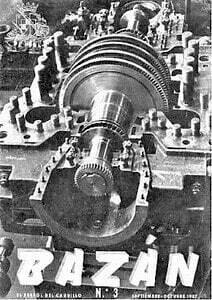
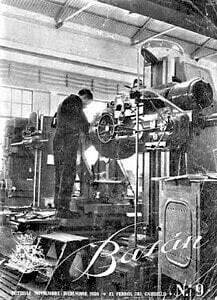
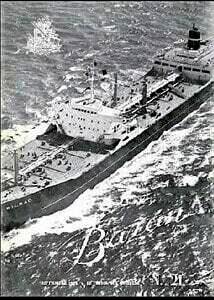
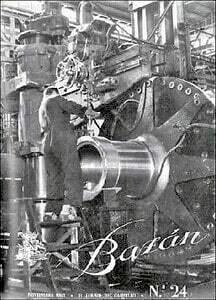
Bazan Magazine first came out in May-June 1957 with the express goal of becoming the "literary vehicle" of Bazan and of promoting camaraderie between workers, personnel and company staff inside and outside the shipyard. In Bazan's first number the editors declared their intention of creating a popular magazine, easy to read and understand, straightforward, cheerful and restrained, "without coarse leanings or vain prophecies." It was everyone's duty, they asserted, to make the bimonthly publication good and long-lasting. The pages of the magazine were open to contributions by managers, employees and workers. Bazan promised to keep its readers abreast of the burning questions of the day, to divulge the technical and social activity of the company, to make entertaining observations on memorable dates, and to orient readers with briefings on the Arts and Letters without neglecting a humorous nook intended to bring cheer and optimism after a hard day's work.
The first seven numbers of the magazine came out bimonthly as promised, the following thirteen were released trimonthly. Starting with number 21 (September 1962) release dates became erratic and the magazine eventually ceased publication in 1967.
The contents of Bazan Magazine are examined for the years 1956-58, 1960, 1962 and 1964.
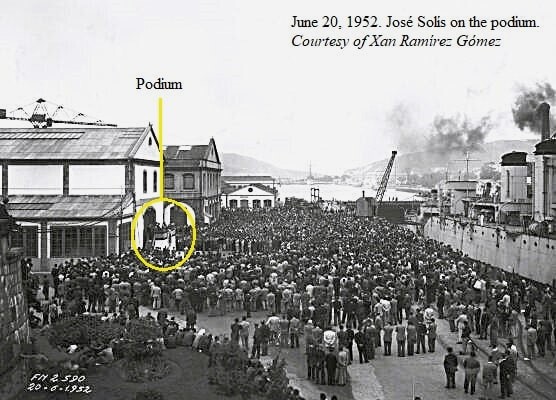
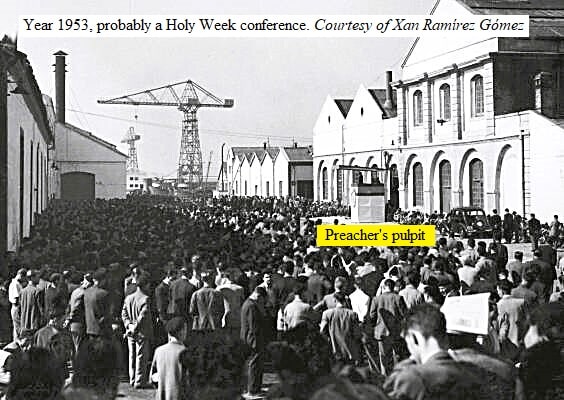
The above photographs received by e-mail on February 18, 2025, are courtesy of Xan Ramírez Gómez.
The photograph on the left shows a political meeting on June 20, 1952, where the speaker was José Solís Ruiz the National Delegate of Trade Unions. All unions answered to the state.
In 1953 Ruiz was enrolled in the "Council of the Kingdom." The induction ceremony recorded by this newsreel bares the religious odour that filled Franco's regime. Ruiz in white uniform is the last selectee to kneel down before an off-color crucifix and recite the pledge of allegiance.
In 1957 Ruiz became Minister Secretary-General of the "National Movement," a catchphrase embracing all the political groups affiliated to the Nationalist side of the Spanish Civil War.
The principles of this National Movement were defined by law in 1958. Article I enjoined every Spanish citizen to preserve and further the unity, greatness and liberty of Spain. Article II bade,
the establishment of the nation's obedience to God's law according to the doctrine of the Holy Apostolic Roman Catholic Church, the one true faith, the undetachable component of the national consciousness and the inspirer of its legislation.(Article II. Ley de Principios del Movimiento Nacional. May 17, 1958)
The photograph on the right shows an outdoor "religious conference" of 1953. The actual date is unknown, but judging by the fine weather, it was probably held during Holy Week, which in 1953 stretched from Sunday March 29 to Sunday April 5. The Religion Section of Chapter 12, "Bazan Magazine for the Year 1960," and of Chapter 16, "Bazan Magazine for the Year 1964," abound in this theme.
| Ferrol's New England Theater (1906-1914) |